
Dialysis access procedures and complications — MCQs

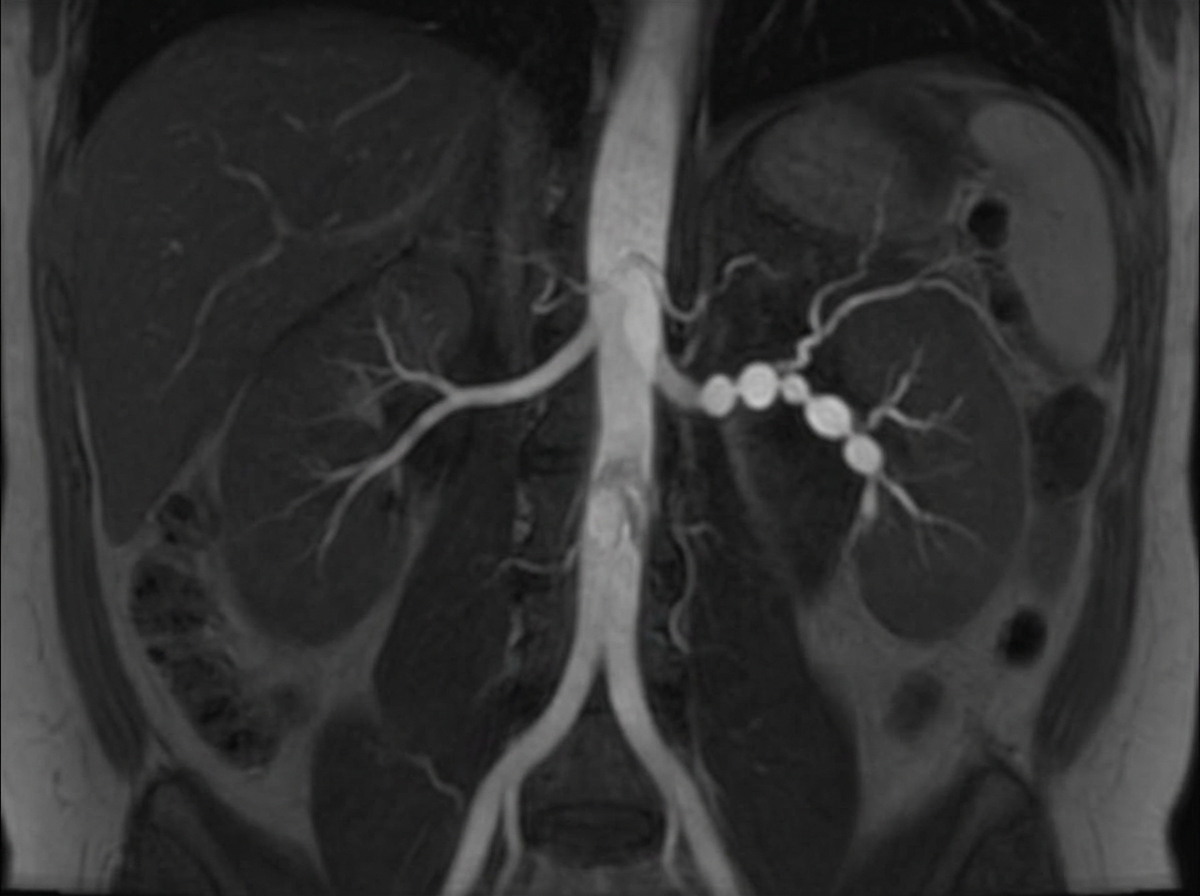
A 31-year-old woman returns to her primary care provider for a follow-up visit. At a routine health maintenance visit 2 months ago, her blood pressure (BP) was 181/97 mm Hg. She has adhered to a low-salt diet and exercises regularly. On repeat examination 1 month later, her BP was 178/93, and she was prescribed hydrochlorothiazide and lisinopril. The patient denies any complaint, except for occasional headaches. Now, her BP is 179/95 in the right arm and 181/93 in the left arm. Physical examination reveals an abdominal bruit that lateralizes to the left. A magnetic resonance angiogram of the renal arteries is shown in the image. Which of the following is the best next step for the management of this patient condition?
A 71-year old man is brought to the emergency department because of progressively worsening shortness of breath and fatigue for 3 days. During the last month, he has also noticed dark colored urine. He had an upper respiratory infection 6 weeks ago. He underwent a cholecystectomy at the age of 30 years. He has hypertension, hyperlipidemia, and type 2 diabetes mellitus. He immigrated to the US from Italy 50 years ago. Current medications include simvastatin, lisinopril, and metformin. He appears pale. His temperature is 37.1°C (98.8°F), pulse is 96/min, respirations are 21/min, and blood pressure is 150/80 mm Hg. Auscultation of the heart shows a grade 4/6 systolic murmur over the right second intercostal space that radiates to the carotids. Laboratory studies show: Leukocyte count 9,000/mm3 Hemoglobin 8.3 g/dL Hematocrit 24% Platelet count 180,000/mm3 LDH 212 U/L Haptoglobin 15 mg/dL (N=41–165) Serum Na+ 138 mEq/L K+ 4.5 mEq/L CL- 102 mEq/L HCO3- 24 mEq/L Urea nitrogen 20 mg/dL Creatinine 1.2 mg/dL Total bilirubin 1.8 mg/dL Stool testing for occult blood is negative. Direct Coombs test is negative. Echocardiography shows an aortic jet velocity of 4.2 m/s and a mean pressure gradient of 46 mm Hg. Which of the following is the most appropriate next step in management to treat this patient's anemia?
You are called to a hemodialysis suite. The patient is a 61-year-old man with a history of hypertension, hypercholesterolemia, and type-2 diabetes mellitus-induced end-stage renal disease who has required hemodialysis for the past year. His current hemodialysis session is nearing the end when the nurse notices that his blood pressure has dropped to 88/60 mm Hg from his normal of 142/90 mm Hg. The patient denies any shortness of breath or chest pain. He took his daily bisoprolol, metformin, and insulin this morning before coming to the hospital. On examination, the patient’s blood pressure is 92/60 mm Hg, and his heart rate is 119/min. Chest auscultation is unremarkable. What is the most appropriate next management step?
A 68-year-old man presents for a screening ultrasound scan. He has been feeling well and is in his usual state of good health. His medical history is notable for mild hypertension and a 100-pack-year tobacco history. He has a blood pressure of 128/86 and heart rate of 62/min. Physical examination is clear lung sounds and regular heart sounds. On ultrasound, an infrarenal aortic aneurysm of 4 cm in diameter is identified. Which of the following is the best initial step for this patient?
Two hours after admission to the intensive care unit, a 56-year-old man with necrotizing pancreatitis develops profound hypotension. His blood pressure is 80/50 mm Hg and he is started on vasopressors. A central venous access line is placed. Which of the following is most likely to decrease the risk of complications from this procedure?
A 27-year-old soldier stationed in Libya sustains a shrapnel injury during an attack, causing a traumatic above-elbow amputation. The resulting arterial bleed is managed with a tourniquet prior to transport to the military treatment facility. On arrival, he is alert and oriented to person, place, and time. His armor and clothing are removed. His pulse is 145/min, respirations are 28/min, and blood pressure is 95/52 mm Hg. Pulmonary examination shows symmetric chest rise. The lungs are clear to auscultation. Abdominal examination shows no abnormalities. There are multiple shrapnel wounds over the upper and lower extremities. A tourniquet is in place around the right upper extremity; the right proximal forearm has been amputated. One large-bore intravenous catheter is placed in the left antecubital fossa. Despite multiple attempts, medical staff is unable to establish additional intravenous access. Which of the following is the most appropriate next step in management?
A 43-year-old man comes to the physician because of increasing shortness of breath for 1 month. He has been using two pillows at night but frequently wakes up feeling as if he is choking. Five months ago, he underwent surgery for creation of an arteriovenous fistula in his left upper arm. He has hypertension and chronic kidney disease due to reflux nephropathy. He receives hemodialysis three times a week. His current medications are enalapril, vitamin D3, erythropoietin, sevelamer, and atorvastatin. His temperature is 37.1°C (98.8°F), respirations are 22/min, pulse is 103/min and bounding, and blood pressure is 106/58 mm Hg. Examination of the lower extremities shows bilateral pitting pedal edema. There is jugular venous distention. A prominent thrill is heard over the brachiocephalic arteriovenous fistula. There are crackles heard at both lung bases. Cardiac examination shows an S3 gallop. The abdomen is soft and nontender. Which of the following is the most likely cause of this patient's symptoms?
A 60-year-old man with a long-standing history of type 2 diabetes and hypertension managed with lisinopril and metformin presents with itchy skin. He also describes moderate nausea, vomiting, muscle weakness, and fatigue. The vital signs include: temperature 36.8°C (98.2°F), heart rate 98/min, respiratory rate 15/min, blood pressure 135/85 mm Hg, oxygen saturation 100% on room air. Physical exam is notable for pale conjunctivae, pitting edema, and ascites. Laboratory findings are shown below: BUN 78 mg/dL pCO2 25 mm Hg Creatinine 7.2 mg/dL Glucose 125 mg/dL Serum chloride 102 mmol/L Serum potassium 6.3 mEq/L Serum sodium 130 mEq/L Total calcium 1.3 mmol/L Magnesium 1.2 mEq/L Phosphate 1.9 mmol/L Hemoglobin 9.5 g/dL MCV 86 μm3 Bicarbonate (HCO3) 10 mmol/L Shrunken kidneys are identified on renal ultrasound. The doctor explains to the patient that he will likely need dialysis due to his significant renal failure until a renal transplant can be performed. The patient is concerned because he is very busy and traveling a lot for work. Given his lifestyle requirements, what is a potential complication of the most appropriate dialysis modality for this patient?
A 45-year-old man presents to the emergency department because of fever and scrotal pain for 2 days. Medical history includes diabetes mellitus and morbid obesity. His temperature is 40.0°C (104.0°F), the pulse is 130/min, the respirations are 35/min, and the blood pressure is 90/68 mm Hg. Physical examination shows a large area of ecchymosis, edema, and crepitus in his perineal area. Fournier gangrene is suspected. A right internal jugular central venous catheter is placed without complication under ultrasound guidance for vascular access in preparation for the administration of vasopressors. Which of the following is the most appropriate next step?
A 34-year-old woman is brought into the emergency department by emergency medical services after an electrical fire in her apartment. She is coughing with an O2 saturation of 98%, on 2L of nasal cannula. The patient's physical exam is significant for a burn on her right forearm that appears to be dry, white, and leathery in texture. Her pulses and sensations are intact in all extremities. The patient's vitals are HR 110, BP 110/80, T 99.2, RR 20. She has no evidence of soot in her mouth and admits to leaving the room as soon as the fire started. Which of the following is the best treatment for this patient?
Want unlimited practice?
Get full access to all questions, explanations, and performance tracking.
Scan to download app