
Abdominal aortic aneurysm repair — MCQs

A 70-year-old man presents for his annual check-up. He says he feels well except for occasional abdominal pain. He describes the pain as 4/10–5/10 in intensity, diffusely localized to the periumbilical and epigastric regions, radiating to the groin. The pain occurs 1–2 times a month and always subsides on its own. The patient denies any recent history of fever, chills, nausea, vomiting, change in body weight, or change in bowel and/or bladder habits. His past medical history is significant for hypertension, hyperlipidemia, and peripheral vascular disease, managed with lisinopril and simvastatin. The patient reports a 40-pack-year smoking history and 1–2 alcoholic drinks a day. The blood pressure is 150/100 mm Hg and the pulse is 80/min. Peripheral pulses are 2+ bilaterally in all extremities. Abdominal exam reveals a bruit in the epigastric region along with mild tenderness to palpation with no rebound or guarding. There is also a pulsatile abdominal mass felt on deep palpation at the junction of the periumbilical and the suprapubic regions. The remainder of the physical exam is normal. Laboratory studies show: Serum total cholesterol 175 mg/dL Serum total bilirubin 1 mg/dL Serum amylase 25 U/L Serum alanine aminotransferase (ALT) 20 U/L Serum aspartate aminotransferase (AST) 16 U/L Which of the following is the most likely diagnosis in this patient?
During a surgical procedure to repair an abdominal aortic aneurysm, the surgeon must be careful to avoid injury to which of the following arterial structures that originates near the level of the renal vessels?
A 68-year-old man presents for a screening ultrasound scan. He has been feeling well and is in his usual state of good health. His medical history is notable for mild hypertension and a 100-pack-year tobacco history. He has a blood pressure of 128/86 and heart rate of 62/min. Physical examination is clear lung sounds and regular heart sounds. On ultrasound, an infrarenal aortic aneurysm of 4 cm in diameter is identified. Which of the following is the best initial step for this patient?
A 64-year-old woman has progressively worsening abdominal pain 5 hours after an open valve replacement with cardiopulmonary bypass. The pain is crampy and associated with an urge to defecate. The patient reports having had 2 bloody bowel movements in the last hour. Her operation was complicated by significant intraoperative blood loss, which prolonged the operation and necessitated 2 transfusions of red blood cells. She has hypercholesterolemia and type 2 diabetes mellitus. The patient received prophylactic perioperative antibiotics and opioid pain management during recovery. Her temperature is 37.9°C (98.9°F), pulse is 95/min, and blood pressure is 115/69 mm Hg. Examination shows a soft abdomen with mild tenderness to palpation in the left quadrants but no rebound tenderness or guarding. Bowel sounds are decreased. Rectal examination shows blood on the examining finger. Which of the following is the most likely underlying cause of this patient's symptoms?
A 71-year-old man with hypertension is taken to the emergency department after the sudden onset of stabbing abdominal pain that radiates to the back. He has smoked 1 pack of cigarettes daily for 20 years. His pulse is 120/min and thready, respirations are 18/min, and blood pressure is 82/54 mm Hg. Physical examination shows a periumbilical, pulsatile mass and abdominal bruit. There is epigastric tenderness. Which of the following is the most likely underlying mechanism of this patient's current condition?
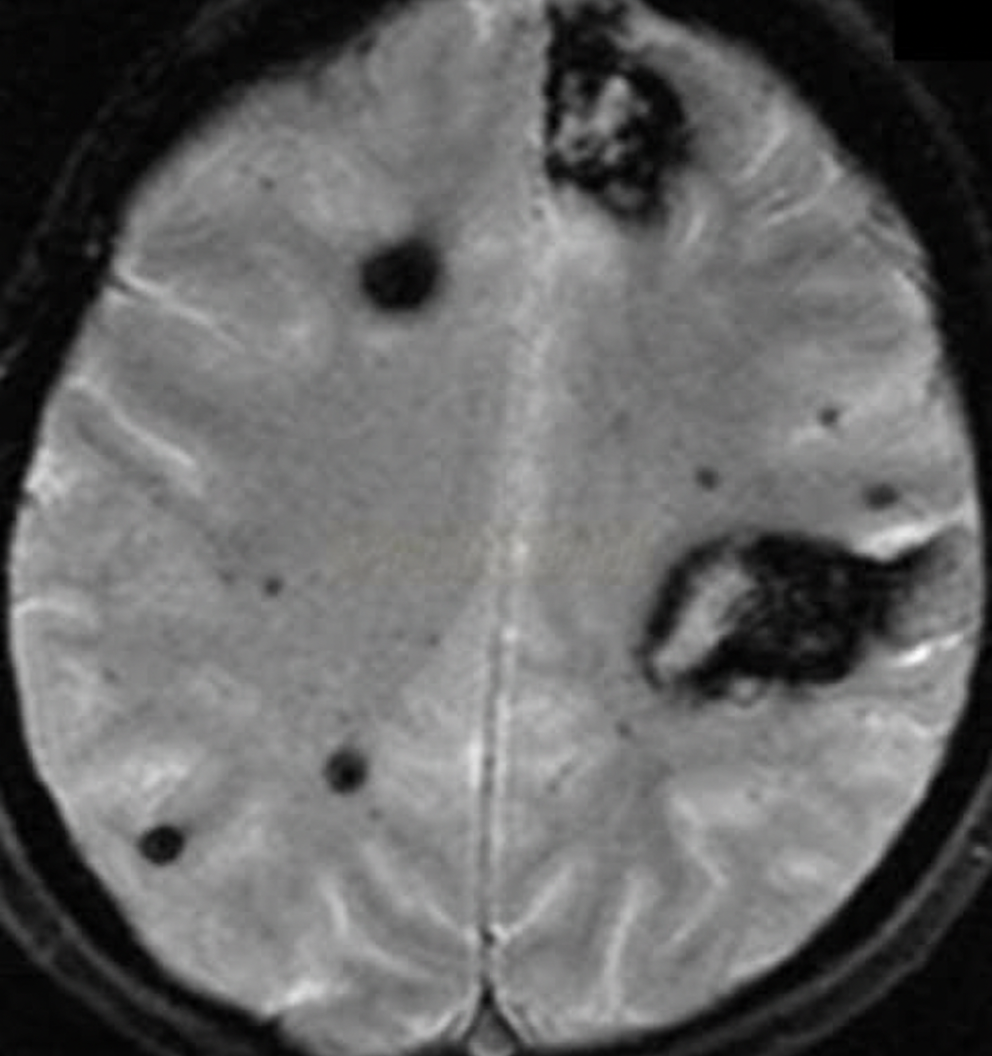
An 88-year-old woman with no significant medical history is brought to the emergency room by her daughter after a fall, where the woman lightly hit her head against a wall. The patient is lucid and complains of a mild headache. The daughter indicates that her mother did not lose consciousness after the fall. On exam, there are no focal neurological deficits, but you decide to perform a CT scan to be sure there is no intracranial bleeding. The CT scan is within normal limits and head MRI is performed (shown). Which of the following conditions has the most similar risk factor to this patient's condition?
A 67-year-old man presents to the emergency department with abdominal pain that started 1 hour ago. The patient has a past medical history of diabetes and hypertension as well as a 40 pack-year smoking history. His blood pressure is 107/58 mmHg, pulse is 130/min, respirations are 23/min, and oxygen saturation is 98% on room air. An abdominal ultrasound demonstrates focal dilation of the aorta with peri-aortic fluid. Which of the following is the best next step in management?
A previously healthy 64-year-old man comes to the physician 3 days after noticing a lump in his right groin while he was bathing. He has no history of trauma to the region. He has hypercholesterolemia and hypertension treated with atorvastatin and labetalol. He has smoked 2 packs of cigarettes daily for 35 years. His vital signs are within normal limits. Examination shows a 4-cm (1.6-in), nontender, pulsatile mass with a palpable thrill at the right midinguinal point. On auscultation, a harsh continuous murmur is heard over the mass. Femoral and pedal pulses are palpable bilaterally. The remainder of the examination shows no abnormalities. Which of the following is the most likely diagnosis?
A 31-year-old man presents to the Emergency Department with severe left leg pain and paresthesias 4 hours after his leg got trapped by the closing door of a bus. Initially, he had a mild pain which gradually increased to unbearable levels. Past medical history is noncontributory. In the Emergency Department, his blood pressure is 130/80 mm Hg, heart rate is 87/min, respiratory rate is 14/min, and temperature is 36.8℃ (98.2℉). On physical exam, his left calf is firm and severely tender on palpation. The patient cannot actively dorsiflex his left foot, and passive dorsiflexion is limited. Posterior tibial and dorsalis pedis pulses are 2+ in the right leg and 1+ in the left leg. Axial load does not increase the pain. Which of the following is the best next step in the management of this patient?
A 56-year-old man presents to the emergency department with severe chest pain and a burning sensation. He accidentally drank a cup of fluid at his construction site 2 hours ago. The liquid was later found to contain lye. On physical examination, his blood pressure is 100/57 mm Hg, respiratory rate is 21/min, pulse is 84/min, and temperature is 37.7°C (99.9°F). The patient is sent immediately to the radiology department. The CT scan shows air in the mediastinum, and a contrast swallow study confirms the likely diagnosis. Which of the following is the best next step in the management of this patient’s condition?
Want unlimited practice?
Get full access to all questions, explanations, and performance tracking.
Scan to download app