
Nephrectomy indications — MCQs

A 61-year-old man presents with back pain and hematuria. The patient says his back pain gradually onset 6 months ago and has progressively worsened. He describes the pain as moderate, dull and aching, and localized to the lower back and right flank. Also, he says that, for the past 2 weeks, he has been having intermittent episodes of hematuria. The patient denies any recent history of fever, chills, syncope, night sweats, dysuria or pain on urination. His past medical history is significant for a myocardial infarction (MI) 3 years ago status post percutaneous transluminal coronary angioplasty and peripheral vascular disease of the lower extremities, worst in the popliteal arteries, with an ankle:brachial index of 1.4. Also, he has had 2 episodes of obstructive nephrolithiasis in the past year caused by calcium oxalate stones, for which he takes potassium citrate. His family history is significant for his father who died of renovascular hypertension at age 55. The patient reports a 20-pack-year smoking history and moderates to heavy daily alcohol use. A review of systems is significant for an unintentional 6.8 kg (15 lb) weight loss over the last 2 months. The vital signs include: blood pressure 145/95 mm Hg, pulse 71/min, temperature 37.2℃ (98.9℉), and respiratory rate 18/min. On physical examination, the patient has moderate right costovertebral angle tenderness (CVAT). A contrast computed tomography (CT) scan of the abdomen and pelvis reveals an enhancing mass in the upper pole of the right kidney. A percutaneous renal biopsy of the mass confirms renal cell carcinoma. Which of the following was the most significant risk factor for the development of renal cell carcinoma (RCC) in this patient?
A 53-year-old male presents to your office for abdominal discomfort. The patient states he first noticed pain on his right flank several months ago, and it has been gradually getting worse. For the past week, he has also noticed blood in his urine. Prior to this episode, he has been healthy and does not take any medications. The patient denies fever, chills, and dysuria. He has a 40 pack-year smoking history. Vital signs are T 37 C, BP 140/90 mmHg, HR 84/min, RR 14/min, O2 98%. Physical exam is unremarkable. CBC reveals a hemoglobin of 17 and hematocrit of 51%, and urinalysis is positive for red blood cells, negative for leukocytes. Which of the following is the most likely diagnosis?
A 40-year-old man comes to the physician for a follow-up examination. He feels well. He has no urinary urgency, increased frequency, dysuria, or gross hematuria. He has a history of recurrent urinary tract infections. His last urinary tract infection was 3 months ago and was treated with ciprofloxacin. Current medications include a multivitamin. He has smoked one pack of cigarettes daily for 18 years. Vital signs are within normal limits. The abdomen is soft and nontender. There is no costovertebral angle tenderness. Laboratory studies show: Hemoglobin 11.2 g/dL Leukocyte count 9,500/mm3 Platelet count 170,000/mm3 Serum Na+ 135 mEq/L K+ 4.9 mEq/L Cl- 101 mEq/L Urea nitrogen 18 mg/dL Creatinine 0.6 mg/dL Urine Blood 2+ Protein negative RBC 5–7/hpf, normal shape and size RBC casts negative WBC 0–2/hpf Bacteria negative Urine cultures are negative. Urine analysis is repeated and shows similar results. A cystoscopy shows no abnormalities. Which of the following is the most appropriate next step in management?
A 59-year-old Caucasian man presents with a one-month history of left flank fullness and pain. The patient has stable angina, which is controlled with medications including atorvastatin, metoprolol, and aspirin. His vital signs are within normal limits. BMI is 32 kg/m2. Clinical examination reveals a 10 x 10-cm palpable mass in the left flank. Testicular examination indicates left varicocele. Laboratory parameters are as follows: Urine Blood 3+ WBC none RBC 65/hpf without dysmorphic features Abdominal CT scan confirms the presence of a large solid mass originating in the left kidney with impingement on the left renal vein. Based on the most likely diagnosis, which of the following is considered a risk factor in this patient?
A 42-year-old woman comes to the physician because of right flank pain that started 3 days following a procedure. Her vital signs are within normal limits. Physical examination shows right costovertebral angle tenderness. An intravenous pyelogram shows a dilated renal pelvis and ureter on the right with a lack of contrast proximal to the ureterovesical junction. This patient most likely recently underwent which of the following procedures?
A 61-year-old man comes to the physician because of several episodes of dark urine over the past 2 weeks. He does not have dysuria or flank pain. He works in a factory that produces dyes. Since an accident at work 5 years ago, he has had moderate hearing loss bilaterally. He takes no medications. He has smoked a pack of cigarettes daily for 29 years and drinks one alcoholic beverage daily. Vital signs are within normal limits. Physical examination shows no abnormalities. His urine is pink; urinalysis shows 80 RBC/hpf but no WBCs. Cystoscopy shows a 3-cm mass in the bladder mucosa. The mass is resected. Pathologic examination shows an urothelial carcinoma with penetration into the muscular layer. An x-ray of the chest and a CT scan of the abdomen and pelvis with contrast show a normal upper urinary tract and normal lymph nodes. Which of the following is the most appropriate next step in management?
A 63-year-old man undergoes uncomplicated laparoscopic cholecystectomy for acute cholecystitis and is admitted to the surgical ward for postoperative management. On postoperative day 1, routine laboratory studies reveal an increase in serum creatinine to 1.46 mg/dL from 0.98 mg/dL before the operation; BUN is 37 mg/dL, increased from 18 mg/dL on prior measurement; K is 4.8 mEq/L and CO2 is 19 mEq/L. The patient has an indwelling urinary catheter in place, draining minimal urine over the last few hours. Which of the following is the most appropriate next step in management?
Three hours after undergoing open proctocolectomy for ulcerative colitis, a 42-year-old male complains of abdominal pain. The pain is localized to the periumbilical and hypogastric regions. A total of 20 mL of urine has drained from his urinary catheter since the end of the procedure. Temperature is 37.2°C (98.9°F), pulse is 92/min, respirations are 12/min, and blood pressure is 110/72 mm Hg. Pulse oximetry on room air shows an oxygen saturation of 99%. Physical examination shows a 20 cm vertical midline incision and an ileostomy in the right lower quadrant. There is no fluid drainage from the surgical wounds. The urinary catheter flushes easily and is without obstruction. Cardiopulmonary examination shows no abnormalities. Serum studies show a blood urea nitrogen of 30 mg/dL and a creatinine of 1.3 mg/dL. Which of the following is the most appropriate next step in management?
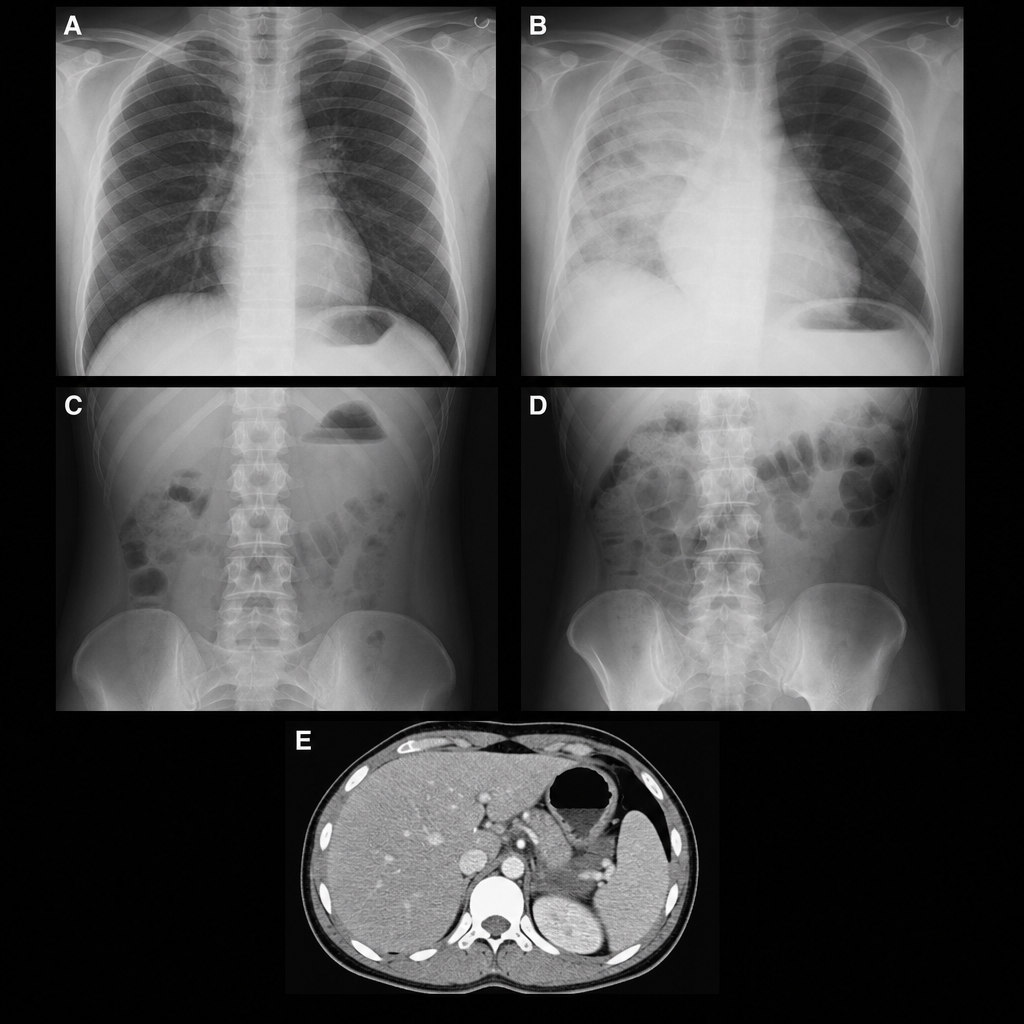
A 24-year-old male is brought in by fire rescue after being the restrained driver in a motor vehicle accident. There was a prolonged extraction. At the scene, the patient was GCS 13. The patient was boarded and transported. In the trauma bay, vitals are T 97.2°F, HR 132 bpm, BP 145/90 mmHg, RR 22/min, and O2 Sat 100%. ABCs are intact with a GCS of 15, and on secondary survey you note the following (Figure F). FAST exam is positive at Morrison's pouch. Abdominal exam shows exquisite tenderness to palpation with rebound and guarding. Which of the following radiographs is most likely to be present in this patient?
A 33-year-old man is brought to the emergency department 20 minutes after losing control over his bicycle and colliding with a parked car. The handlebar of the bicycle hit his lower abdomen. On arrival, he is alert and oriented. His pulse is 90/min, respirations are 17/min and blood pressure is 110/70 mm Hg. Pulse oximetry on room air shows an oxygen saturation of 97%. The pupils are equal and reactive to light. There are multiple bruises over his chest and lower extremities. The lungs are clear to auscultation. Cardiac examination shows no abnormalities. The abdomen is soft and nontender. There is no pelvic instability. Rectal examination is unremarkable. A complete blood count, prothrombin time, and serum concentrations of glucose, creatinine, and electrolytes are within the reference range. Urine dipstick is mildly positive for blood. Microscopic examination of the urine shows 20 RBCs/hpf. Which of the following is the most appropriate next step in management?
Want unlimited practice?
Get full access to all questions, explanations, and performance tracking.
Scan to download app