
Spinal trauma — MCQs

A 45-year-old man is brought to the emergency department by ambulance after a motor vehicle collision. He is not responsive to verbal commands and is unable to provide any history. His pulse is 108/min and regular. Physical examination shows ecchymoses over the neck and back. Neurological examination indicates damage to the spinal cord at the level shown in the illustration. This patient's injury is most likely located at which of the following levels of the spinal cord?
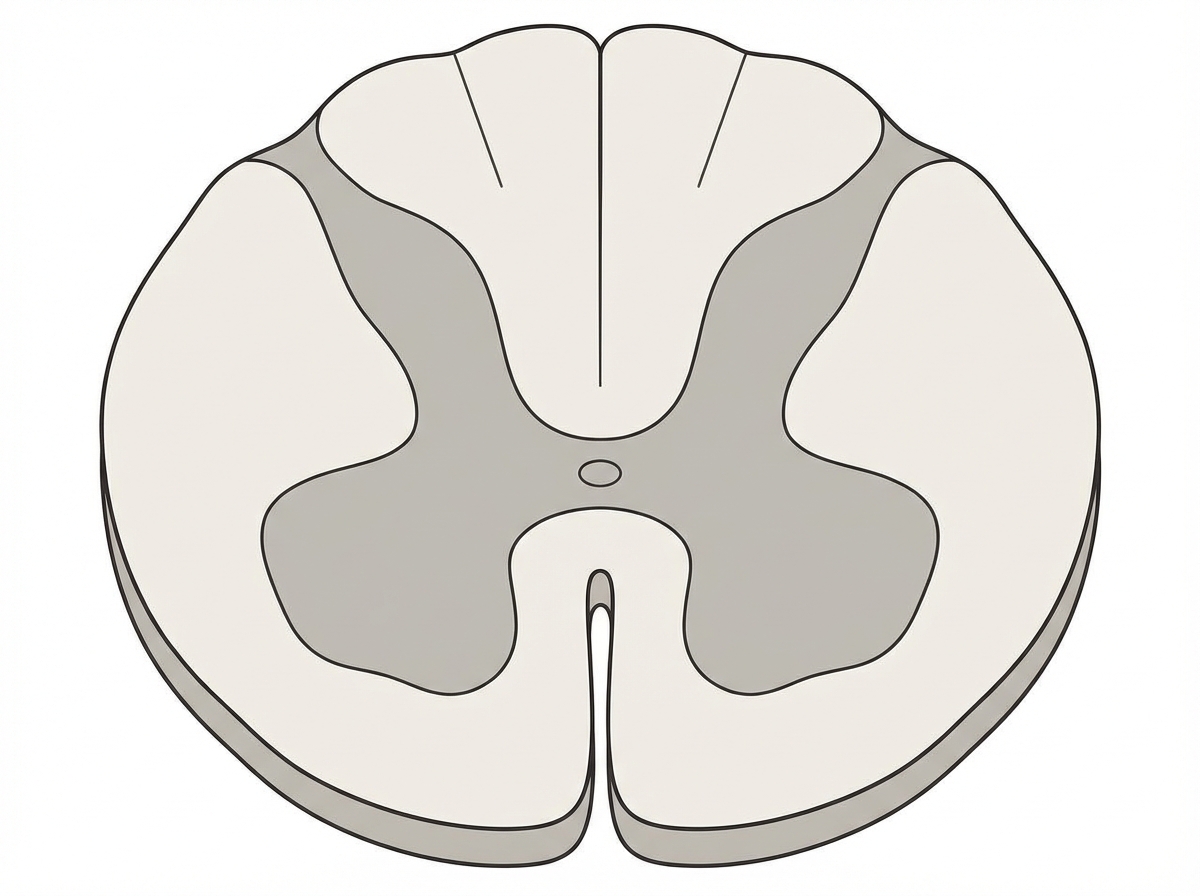
A 44-year-old man is brought to the emergency department 25 minutes after falling off the roof of a house. He was cleaning the roof when he slipped and fell. He did not lose consciousness and does not have any nausea. On arrival, he is alert and oriented and has a cervical collar on his neck. His pulse is 96/min, respirations are 18/min, and blood pressure is 118/78 mm Hg. Examination shows multiple bruises over the forehead and right cheek. The pupils are equal and reactive to light. There is a 2-cm laceration below the right ear. Bilateral ear canals show no abnormalities. The right wrist is swollen and tender; range of motion is limited by pain. The lungs are clear to auscultation. There is no midline cervical spine tenderness. There is tenderness along the 2nd and 3rd ribs on the right side. The abdomen is soft and nontender. Neurologic examination shows no focal findings. Two peripheral venous catheters are placed. Which of the following is the most appropriate next step in management?
A 12-year-old boy presents to the emergency department after falling from his bike. He is holding his right arm tenderly and complains of pain in his right wrist. When asked, he says that he fell after his front tire hit a rock and landed hard on his right hand. Upon physical examination he is found to have tenderness on the dorsal aspect of his wrist in between the extensor pollicis longus and the extensor pollicis brevis. Given this presentation, which of the following is the most likely bone to have been fractured?
A 38-year-old man comes to the physician for a follow-up examination. He has quadriparesis as a result of a burst fracture of the cervical spine that occurred after a fall from his roof 1 month ago. He has urinary and bowel incontinence. He appears malnourished. His temperature is 37.1°C (98.8°F), pulse is 88/min, and blood pressure is 104/60 mm Hg. Examination shows spasticity in all extremities. Muscle strength is decreased in proximal and distal muscle groups bilaterally. Deep tendon reflexes are 4+ bilaterally. Plantar reflex shows extensor response bilaterally. Sensation to pinprick and temperature is absent below the neck. Sensation to vibration, position, and light touch is normal bilaterally. Rectal tone is decreased. There is a 1-cm area of erythema over the sacrum. Which of the following is the most likely cause of this patient's symptoms?
A patient with a known spinal cord ependymoma presents to his neurologist for a check up. He complains that he has had difficulty walking, which he attributes to left leg weakness. On exam, he is noted to have 1/5 strength in his left lower extremity, as well as decreased vibration and position sensation in the left lower extremity and decreased pain and temperature sensation in the right lower extremity. Which of the following spinal cord lesions is most consistent with his presentation?
A 47-year-old man comes to the emergency department because of urinary and fecal incontinence for 6 hours. Earlier in the day, he suffered a fall at a construction site and sustained injuries to his back and thighs but did not seek medical attention. He took ibuprofen for lower back pain. His temperature is 36.9°C (98.4°F), pulse is 80/min, and blood pressure is 132/84 mm Hg. Examination shows tenderness over the lumbar spine, bilateral lower extremity weakness, absent ankle jerk reflexes, and preserved patellar reflexes. There is decreased rectal tone. An ultrasound of the bladder shows a full bladder. Which of the following is the most likely diagnosis?
A 22-year-old man is brought to the emergency department 30 minutes after being involved in a high-speed motor vehicle collision in which he was the unrestrained driver. After extrication, he had severe neck pain and was unable to move his arms and legs. On arrival, he is lethargic and cannot provide a history. Hospital records show that eight months ago, he underwent an open reduction and internal fixation of the right humerus. His neck is immobilized in a cervical collar. Intravenous fluids are being administered. His pulse is 64/min, respirations are 8/min and irregular, and blood pressure is 104/64 mm Hg. Examination shows multiple bruises over the chest, abdomen, and extremities. There is flaccid paralysis and absent reflexes in all extremities. Sensory examination shows decreased sensation below the shoulders. Cardiopulmonary examination shows no abnormalities. The abdomen is soft. There is swelling of the right ankle and right knee. Squeezing of the glans penis does not produce anal sphincter contraction. A focused assessment with sonography for trauma shows no abnormalities. He is intubated and mechanically ventilated. Which of the following is the most appropriate next step in management?
A 22-year-old man is rushed to the emergency department after a motor vehicle accident. The patient states that he feels weakness and numbness in both of his legs. He also reports pain in his lower back. His airway, breathing, and circulation is intact, and he is conversational. Neurologic exam is significant for bilateral lower extremity flaccid paralysis and impaired pain and temperature sensation up to T10-T11 with normal vibration sense. A computerized tomography scan of the spine is performed which shows a vertebral burst fracture of the vertebral body at the level of T11. Which of the following findings is most likely present in this patient?
A 36-year-old male is taken to the emergency room after jumping from a building. Bilateral fractures to the femur were stabilized at the scene by emergency medical technicians. The patient is lucid upon questioning and his vitals are stable. Pain only at his hips was elicited. Cervical exam was not performed. What is the best imaging study for this patient?
A 56-year-old man is brought to the emergency department 25 minutes after he was involved in a high-speed motor vehicle collision where he was the unrestrained passenger. He has severe lower abdominal and pelvic pain. On arrival, he is alert and oriented. His pulse is 95/min, respirations are 22/min, and blood pressure is 106/62 mm Hg. Examination shows severe tenderness to palpation over the lower abdomen and over the left anterior superior iliac spine. There is no limb length discrepancy. Application of downward pressure over the pelvis shows no springy resistance or instability. Rectal examination is unremarkable. A focused assessment with sonography shows no free fluid in the abdomen. There is no blood at the urethral meatus. Placement of a Foley catheter shows gross hematuria. An x-ray of the pelvis shows a fracture of the left pelvic edge. Which of the following is the most appropriate next step in management?
Want unlimited practice?
Get full access to all questions, explanations, and performance tracking.
Scan to download app