A 33-year-old woman is brought to the emergency department 15 minutes after being stabbed in the chest with a screwdriver. Her pulse is 110/min, respirations are 22/min, and blood pressure is 90/65 mm Hg. Examination shows a 5-cm deep stab wound at the upper border of the 8th rib in the left midaxillary line. Which of the following structures is most likely to be injured in this patient?
Q82
A 65-year-old woman presents to her primary care provider for shoulder pain. She reports that she initially thought the pain was due to "sleeping funny" on the arm, but that the pain has now lasted for 4 weeks. She denies trauma to the joint and says that the pain is worse when reaching overhead to retrieve things from her kitchen cabinets. On physical exam, the patient's shoulders are symmetric, and the right lateral shoulder is tender to palpation. The shoulder has full passive and active range of motion, although pain is reproduced on active abduction of the right arm above 90 degrees. Pain is also reproduced on passively internally rotating and then lifting the shoulder. The patient is able to resist elbow flexion without pain, and she otherwise has 5/5 strength. Which of the following is the most likely diagnosis?
Q83
A 62-year-old man comes to the physician for the evaluation of nocturia and a weak urinary stream. These symptoms began 1 year ago, but have progressively worsened over the past 6 months. He now wakes up 3–5 times every night to urinate. He has hypertension treated with hydrochlorothiazide and lisinopril. The patient has smoked a half-pack of cigarettes daily for the past 30 years. He appears well. His temperature is 37.3°C (99.1°F), pulse is 77/min, and blood pressure is 128/77 mm Hg. Cardiopulmonary examination shows no abnormalities. His abdomen is soft and nontender. Digital rectal examination shows a diffusely enlarged prostate with a firm nodule in the right posterior lobe. Urinalysis is within normal limits. Prostate-specific antigen (PSA) level is 6.5 ng/mL (N = 0–4). Which of the following is the most appropriate next step in management?
Q84
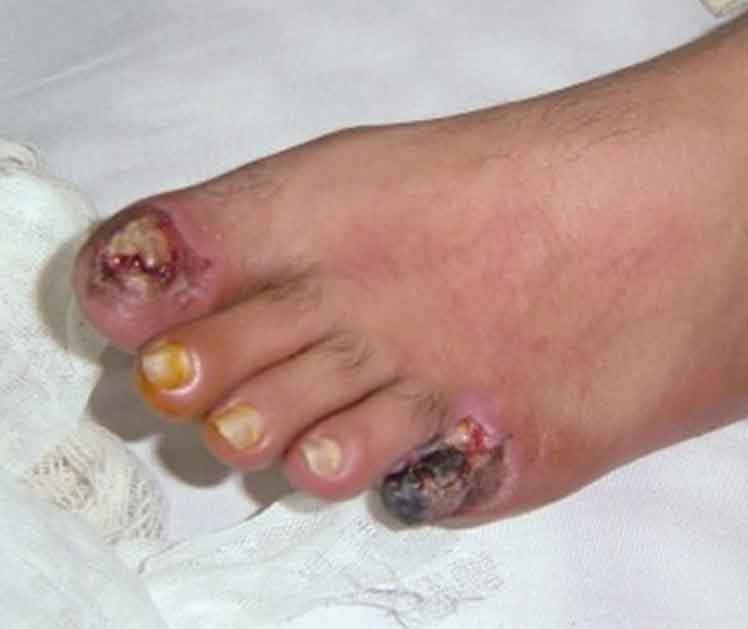
A 75-year-old man presents to the emergency department because of pain in his left thigh and left calf for the past 3 months. The pain occurs at rest, worsens with walking, and is slightly improved by hanging his foot off the bed. He has had hypertension for 25 years and type 2 diabetes mellitus for 30 years. He has smoked 30–40 cigarettes per day for the past 45 years. On examination, the femoral, popliteal, and dorsalis pedis pulses are diminished, but detectable on both sides. The patient’s foot is shown in the image. Which of the following is the most likely diagnosis?
Q85
A 67-year-old man comes to the physician for a follow-up examination. He has had lower back pain for several months. The pain radiates down the right leg to the foot. He has no history of any serious illness and takes no medications. His pain increases after activity. The straight leg test is positive on the right. The results of the laboratory studies show:
Laboratory test
Hemoglobin 14 g/d
Leukocyte count 5,500/mm3 with a normal differential
Platelet count 350,000/mm3
Serum
Calcium 9.0 mg/dL
Albumin 3.8 g/dL
Urea nitrogen 14 mg/dL
Creatinine 0.9 mg/dL
Serum immunoelectrophoresis shows an immunoglobulin G (IgG) type monoclonal component of 40 g/L. Bone marrow plasma cells return at 20%. Skeletal survey shows no bone lesions. Magnetic resonance imaging (MRI) shows a herniated disc at the L5. Which of the following is the most appropriate next step?
Q86
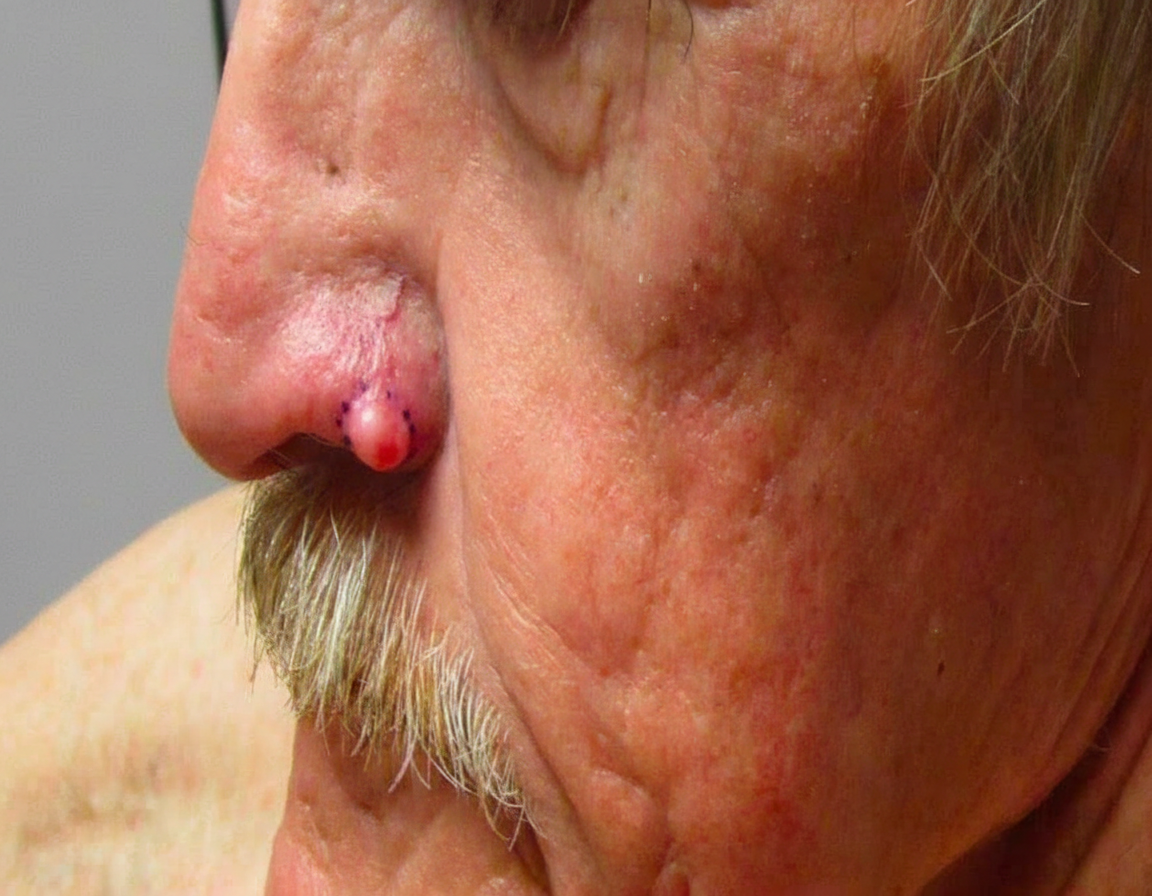
A 67-year-old man is referred to a dermatologist after a reddish mole appears on his nose. The mole’s size has changed over the last 2 years, and occasional bleeding is noted. The man’s medical history is unremarkable, and he does not take any medications. He retired from his construction job 15 years ago. Physical examination of his nose reveals a 2-cm pink papule with a pearly appearance and overlying telangiectasia on the ala of the nose (see image). Which of the following would be the best treatment modality if surgery is not an option?
Q87
A 57-year-old woman presents to an outpatient clinic with lower extremity weakness and lower back pain. The patient says that her symptoms began 2 weeks ago when she was working in her garden and have progressively worsened to the extent she currently is unable to walk on her own. She describes the pain as sharp, severe and descending bilaterally from her lower back to her lateral ankles along the posterior surface of her thighs and legs. She also states that she has had several episodes of urinary incontinence for the past couple of days. The patient denies having any similar pain or incontinence in the past. No other significant past medical history. Current medications are alendronate 5 mg orally daily and a daily multivitamin. Her temperature is 37.0℃ (98.6℉), the blood pressure is 110/70 mm Hg, the pulse is 72/min, the respiratory rate is 15/min, and oxygen saturation is 99% on room air. On physical examination, the patient appears to be in significant distress. Strength is ⅗ in her thighs bilaterally and ⅖ in the legs bilaterally left greater than right. Muscle tone is decreased in the lower extremities. The patellar reflex is 1+ bilaterally and plantar reflex is 0+ bilaterally. Fine touch and pain and temperature sensation are decreased in the lower extremities bilaterally, left greater than right. Saddle anesthesia is present. Which of the following is the next, best step in the management of this patient?
Q88
A 24-year-old woman is brought to the emergency department after being assaulted. The paramedics report that the patient was found conscious and reported being kicked many times in the torso. She is alert and able to respond to questions. She denies any head trauma. She has a past medical history of endometriosis and a tubo-ovarian abscess that was removed surgically two years ago. Her only home medication is oral contraceptive pills. Her temperature is 98.5°F (36.9°C), blood pressure is 82/51 mmHg, pulse is 136/min, respirations are 24/min, and SpO2 is 94%. She has superficial lacerations to the face and severe bruising over her chest and abdomen. Her lungs are clear to auscultation bilaterally and her abdomen is soft, distended, and diffusely tender to palpation. Her skin is cool and clammy. Her FAST exam reveals fluid in the perisplenic space.
Which of the following is the next best step in management?
Q89
A 27-year-old man presents to the emergency department with severe dyspnea and sharp chest pain that suddenly started an hour ago after he finished exercising. He has a history of asthma as a child, and he achieves good control of his acute attacks with Ventolin. On examination, his right lung field is hyperresonant along with diminished lung sounds. Chest wall motion during respiration is asymmetrical. His blood pressure is 105/67 mm Hg, respirations are 22/min, pulse is 78/min, and temperature is 36.7°C (98.0°F). The patient is supported with oxygen, given corticosteroids, and has had analgesic medications via a nebulizer. Considering the likely condition affecting this patient, what is the best step in management?
Q90
A 16-year-old boy presents to the emergency department after a skateboarding accident. He fell on a broken bottle and received a 4 cm wound on the dorsal aspect of his left hand. His vitals are stable and he was evaluated by the surgeon on call who determined that suturing was not required. After several weeks the wound has almost completely healed (see image). Which of the following is the correct description of this patient's wound before healing?
Trauma/Emergencies US Medical PG Practice Questions and MCQs
Question 81: A 33-year-old woman is brought to the emergency department 15 minutes after being stabbed in the chest with a screwdriver. Her pulse is 110/min, respirations are 22/min, and blood pressure is 90/65 mm Hg. Examination shows a 5-cm deep stab wound at the upper border of the 8th rib in the left midaxillary line. Which of the following structures is most likely to be injured in this patient?
A. Left kidney
B. Left ventricle
C. Intercostal nerve
D. Lower lung lobe (Correct Answer)
E. Spleen
Explanation: ***Lower lung lobe***
- A stab wound at the **8th rib in the left midaxillary line** is located within the anatomical boundaries of the **lower lobe of the left lung**. The diaphragm can rise to the level of the 5th intercostal space during expiration, and the lung extends into this region.
- The patient's **hypotension** and **tachycardia** are consistent with potential **hemorrhage** or **pneumothorax/hemothorax** due to lung injury.
*Left kidney*
- The left kidney is located retroperitoneally, typically at the level of the **T12 to L3 vertebrae**, making it less likely to be injured by a stab wound at the 8th rib in the midaxillary line of a standing or supine patient.
- Injury to the kidney would likely cause **hematuria**, which is not mentioned in the presentation as an immediate concern.
*Left ventricle*
- The left ventricle is located more medially and anteriorly within the chest, deep to the **sternum** and **costal cartilages**, making a stab wound at the 8th rib in the midaxillary line an unlikely entry point.
- Cardiac tamponade or severe hemorrhage from left ventricular injury would typically present with more rapid and profound hemodynamic collapse.
*Intercostal nerve*
- While an intercostal nerve would certainly be injured by a stab wound through the intercostal space, injury to the nerve alone would not explain the patient's **hemodynamic instability** (hypotension and tachycardia).
- Isolated intercostal nerve injury primarily causes **localized pain** and potentially some sensory or motor deficits in the distribution of that nerve.
*Spleen*
- The spleen is located in the left upper quadrant, typically lying beneath the **9th to 11th ribs**, making injury to the spleen possible with a deeper wound. However, it is situated more laterally and posteriorly than the lung at the 8th rib midaxillary line.
- While splenic injury can cause **hypotension** and **tachycardia**, the lung lies in a more superficial and posterior plane relative to the 8th rib in the midaxillary line, making it a more direct target for injury.
Question 82: A 65-year-old woman presents to her primary care provider for shoulder pain. She reports that she initially thought the pain was due to "sleeping funny" on the arm, but that the pain has now lasted for 4 weeks. She denies trauma to the joint and says that the pain is worse when reaching overhead to retrieve things from her kitchen cabinets. On physical exam, the patient's shoulders are symmetric, and the right lateral shoulder is tender to palpation. The shoulder has full passive and active range of motion, although pain is reproduced on active abduction of the right arm above 90 degrees. Pain is also reproduced on passively internally rotating and then lifting the shoulder. The patient is able to resist elbow flexion without pain, and she otherwise has 5/5 strength. Which of the following is the most likely diagnosis?
A. Biceps tendinopathy
B. Rotator cuff tendinopathy (Correct Answer)
C. Adhesive capsulitis
D. Glenohumeral osteoarthritis
E. Rotator cuff tear
Explanation: ***Rotator cuff tendinopathy***
- The patient's presentation of gradual onset shoulder pain, worse with overhead activities, tenderness of the **lateral shoulder** to palpation, and pain with active abduction beyond 90 degrees and passive internal rotation and lifting
is highly characteristic of **rotator cuff tendinopathy**.
- **Full active range of motion** despite pain indicates that the tendon is intact, but inflamed, making tendinopathy more likely than a tear.
*Biceps tendinopathy*
- This condition typically causes pain in the anterior shoulder, especially with **lifting** or **carrying heavy objects**, and tenderness in the **bicipital groove**.
- The patient's pain is primarily located in the lateral shoulder and is reproduced with abduction and internal rotation, which are less typical for biceps tendinopathy.
*Adhesive capsulitis*
- Characterized by significant **restriction of both active and passive range of motion** in multiple planes, often described as a "frozen shoulder."
- This patient maintains full passive and active range of motion, which rules out adhesive capsulitis.
*Glenohumeral osteoarthritis*
- While it can cause pain and stiffness, osteoarthritis typically presents with **crepitus**, **limited range of motion** (both active and passive) with an insidious onset, and pain that often worsens with activity but does not specifically point to subacromial involvement.
- The patient's full passive range of motion makes severe osteoarthritis unlikely.
*Rotator cuff tear*
- A rotator cuff tear usually presents with **weakness** in specific movements (e.g., abduction, external rotation) and often **limited active range of motion**, even if passive range of motion is preserved.
- The patient's ability to maintain full active range of motion and 5/5 strength makes a complete tear less likely, although a partial tear could be considered if tendinopathy doesn't improve with conservative management.
Question 83: A 62-year-old man comes to the physician for the evaluation of nocturia and a weak urinary stream. These symptoms began 1 year ago, but have progressively worsened over the past 6 months. He now wakes up 3–5 times every night to urinate. He has hypertension treated with hydrochlorothiazide and lisinopril. The patient has smoked a half-pack of cigarettes daily for the past 30 years. He appears well. His temperature is 37.3°C (99.1°F), pulse is 77/min, and blood pressure is 128/77 mm Hg. Cardiopulmonary examination shows no abnormalities. His abdomen is soft and nontender. Digital rectal examination shows a diffusely enlarged prostate with a firm nodule in the right posterior lobe. Urinalysis is within normal limits. Prostate-specific antigen (PSA) level is 6.5 ng/mL (N = 0–4). Which of the following is the most appropriate next step in management?
A. Transrectal ultrasound-guided prostate biopsy (Correct Answer)
B. Simple prostatectomy
C. Cystoscopy
D. CT scan of the abdomen and pelvis
E. Repeat PSA level in one year
Explanation: ***Transrectal ultrasound-guided prostate biopsy***
- The presence of a **firm nodule** on digital rectal examination (DRE) and an **elevated PSA level (6.5 ng/mL)** in this patient are highly suspicious for **prostate cancer**.
- A definitive diagnosis requires **histological examination** of prostate tissue, which is obtained via **transrectal ultrasound-guided prostate biopsy**.
*Simple prostatectomy*
- This procedure is a treatment for **benign prostatic hyperplasia (BPH)**, not for suspected prostate cancer.
- While the patient has symptoms consistent with BPH, the DRE finding and elevated PSA necessitate ruling out malignancy first.
*Cystoscopy*
- **Cystoscopy** allows direct visualization of the urethra and bladder but is not the primary diagnostic tool for evaluating a suspicious prostate nodule.
- It would not provide the tissue sample needed for a definitive cancer diagnosis.
*CT scan of the abdomen and pelvis*
- A **CT scan** is typically used for **staging prostate cancer** (once diagnosed) to assess for local invasion or distant metastasis.
- It is not the initial diagnostic step for confirming the presence of prostate cancer.
*Repeat PSA level in one year*
- Given the highly suspicious DRE finding (firm nodule) and the significantly **elevated PSA level (6.5 ng/mL)**, waiting one year to repeat the PSA would be an inappropriate delay in diagnosis.
- Such findings warrant immediate investigation for prostate cancer.
Question 84: A 75-year-old man presents to the emergency department because of pain in his left thigh and left calf for the past 3 months. The pain occurs at rest, worsens with walking, and is slightly improved by hanging his foot off the bed. He has had hypertension for 25 years and type 2 diabetes mellitus for 30 years. He has smoked 30–40 cigarettes per day for the past 45 years. On examination, the femoral, popliteal, and dorsalis pedis pulses are diminished, but detectable on both sides. The patient’s foot is shown in the image. Which of the following is the most likely diagnosis?
A. Pseudogout
B. Raynaud’s phenomenon
C. Venous ulcer
D. Critical limb ischemia (Correct Answer)
E. Cellulitis
Explanation: **Critical limb ischemia**
- The patient exhibits classic symptoms of **critical limb ischemia (CLI)**, including **rest pain** in the lower extremities that is relieved by dependency (hanging foot off the bed), along with **diminished pulses** and significant risk factors like **smoking, hypertension, and diabetes**.
- The image further supports CLI by showing **ischemic changes** in the toes, such as **gangrene** of the second and third toes and **subungual hemorrhage** in the great toe, indicative of severe arterial insufficiency.
*Pseudogout*
- Pseudogout typically presents as acute, painful arthritis of a single joint, most commonly the **knee**, due to calcium pyrophosphate crystal deposition.
- It does not cause diffuse leg pain, diminished pulses, or ischemic changes in the toes as seen in this patient.
*Raynaud's phenomenon*
- Raynaud's phenomenon is characterized by episodic **vasospasm** leading to blanching, cyanosis, and redness, primarily affecting the fingers and toes, often triggered by cold or stress.
- While it involves digital ischemia, it is usually episodic, affects multiple digits symmetrically, and does not explain the chronic rest pain, diminished pulses, or gangrenous changes seen here.
*Venous ulcer*
- Venous ulcers are typically found around the **malleoli**, have irregular borders, and are associated with **edema**, **stasis dermatitis**, and normal pulses.
- The patient's symptoms of rest pain, relief with dependency, and digital gangrene, along with diminished arterial pulses, are not consistent with venous disease.
*Cellulitis*
- Cellulitis is a bacterial skin infection characterized by **erythema**, **warmth**, **swelling**, and pain, often with a rapidly spreading border.
- Although the image shows some redness, the patient's chronic symptoms, diminished pulses, and clear signs of tissue necrosis in the toes are inconsistent with primary cellulitis and point towards an underlying vascular etiology.
Question 85: A 67-year-old man comes to the physician for a follow-up examination. He has had lower back pain for several months. The pain radiates down the right leg to the foot. He has no history of any serious illness and takes no medications. His pain increases after activity. The straight leg test is positive on the right. The results of the laboratory studies show:
Laboratory test
Hemoglobin 14 g/d
Leukocyte count 5,500/mm3 with a normal differential
Platelet count 350,000/mm3
Serum
Calcium 9.0 mg/dL
Albumin 3.8 g/dL
Urea nitrogen 14 mg/dL
Creatinine 0.9 mg/dL
Serum immunoelectrophoresis shows an immunoglobulin G (IgG) type monoclonal component of 40 g/L. Bone marrow plasma cells return at 20%. Skeletal survey shows no bone lesions. Magnetic resonance imaging (MRI) shows a herniated disc at the L5. Which of the following is the most appropriate next step?
A. Dexamethasone
B. Thalidomide
C. Physical therapy (Correct Answer)
D. Autologous stem cell transplantation
E. Plasmapheresis
Explanation: ***Physical therapy***
- The patient's symptoms of radiated lower back pain, positive straight leg test, and MRI findings of a **herniated disc at L5** are classic for **radiculopathy** caused by disc herniation.
- **Conservative management**, including physical therapy, is the most appropriate initial step for symptomatic lumbar disc herniation, aiming to reduce pain and improve function.
*Dexamethasone*
- While corticosteroids like dexamethasone can reduce inflammation and pain, they are typically considered for **short-term relief** in severe cases or as an adjunct, not as the primary or sole treatment for herniated disc.
- In the context of the elevated IgG monoclonal component and plasma cells, dexamethasone is part of treatment regimens for **multiple myeloma**, but the primary issue presented is disc herniation.
*Thalidomide*
- Thalidomide is an **immunomodulatory drug** used in the treatment of multiple myeloma, particularly in combination with dexamethasone.
- It has no role in the management of **lumbar disc herniation** or radiculopathy.
*Autologous stem cell transplantation*
- This is a treatment option for **multiple myeloma** once a patient achieves remission, especially in younger, fitter patients.
- It is an aggressive procedure and **not indicated** for the treatment of a herniated disc, nor as an initial step for myeloma given the current presentation.
*Plasmapheresis*
- Plasmapheresis is used to remove **excess proteins** or antibodies from the blood, often in conditions like hyperviscosity syndrome or specific autoimmune diseases.
- It is **not a treatment** for herniated disc and would only be considered for multiple myeloma in cases of severe hyperviscosity, which is not indicated by the current lab values.
Question 86: A 67-year-old man is referred to a dermatologist after a reddish mole appears on his nose. The mole’s size has changed over the last 2 years, and occasional bleeding is noted. The man’s medical history is unremarkable, and he does not take any medications. He retired from his construction job 15 years ago. Physical examination of his nose reveals a 2-cm pink papule with a pearly appearance and overlying telangiectasia on the ala of the nose (see image). Which of the following would be the best treatment modality if surgery is not an option?
A. Radiation therapy (Correct Answer)
B. Imiquimod
C. Interferon
D. 5-fluorouracil
E. Photodynamic therapy
Explanation: ***Radiation therapy***
- This patient's presentation is highly suggestive of **basal cell carcinoma (BCC)**, given the reddish, pearly papule with telangiectasias on a sun-exposed area, a history of growth over two years, bleeding, and his prior occupation as a construction worker. **Radiation therapy** is an excellent option for **localized BCC** when surgery is contraindicated or not feasible due to patient preferences, tumor location (e.g., cosmetic areas), or medical comorbidities.
- **Definitive radiation therapy** can achieve high cure rates for BCC, comparable to Mohs surgery for appropriately selected superficial and nodular types, and is particularly useful in older patients.
*Imiquimod*
- **Imiquimod** is an **immune-response modifier** used topically for superficial BCCs, actinic keratoses, and external genital warts.
- While effective for **superficial BCCs**, its efficacy is lower for nodular or infiltrative BCCs, which appears more likely given the size (2 cm) and depth implied by chronic bleeding and growth over 2 years.
*Interferon*
- **Interferon** has been explored as an intralesional treatment for BCC, but it is **not a first-line or standard treatment option** due to variable response rates and the availability of more effective and reliable modalities.
- Its use is generally reserved for more advanced or difficult-to-treat cases, typically as part of clinical trials or for very specific indications, not as a primary treatment for a localized BCC where surgery or radiation is an option.
*5-fluorouracil*
- **5-fluorouracil (5-FU)** is a **topical chemotherapeutic agent** used primarily for **actinic keratoses** and **superficial BCCs**.
- Similar to imiquimod, its efficacy is limited to **superficial lesions** and is less effective for nodular, infiltrative, or larger BCCs due to insufficient penetration and risk of recurrence.
*Photodynamic therapy*
- **Photodynamic therapy (PDT)** involves applying a photosensitizing agent followed by exposure to specific wavelengths of light, primarily used for **actinic keratoses** and **superficial BCCs**.
- While effective for superficial lesions, its efficacy significantly decreases for **nodular BCCs** or those with deeper invasion, making it less suitable for a 2 cm lesion that has been growing and bleeding.
Question 87: A 57-year-old woman presents to an outpatient clinic with lower extremity weakness and lower back pain. The patient says that her symptoms began 2 weeks ago when she was working in her garden and have progressively worsened to the extent she currently is unable to walk on her own. She describes the pain as sharp, severe and descending bilaterally from her lower back to her lateral ankles along the posterior surface of her thighs and legs. She also states that she has had several episodes of urinary incontinence for the past couple of days. The patient denies having any similar pain or incontinence in the past. No other significant past medical history. Current medications are alendronate 5 mg orally daily and a daily multivitamin. Her temperature is 37.0℃ (98.6℉), the blood pressure is 110/70 mm Hg, the pulse is 72/min, the respiratory rate is 15/min, and oxygen saturation is 99% on room air. On physical examination, the patient appears to be in significant distress. Strength is ⅗ in her thighs bilaterally and ⅖ in the legs bilaterally left greater than right. Muscle tone is decreased in the lower extremities. The patellar reflex is 1+ bilaterally and plantar reflex is 0+ bilaterally. Fine touch and pain and temperature sensation are decreased in the lower extremities bilaterally, left greater than right. Saddle anesthesia is present. Which of the following is the next, best step in the management of this patient?
A. Outpatient management with a 3-day course of meloxicam and tolperisone and reassess
B. Recommend non-emergent inpatient spinal manipulation program
C. Outpatient management with a 3-day course of diclofenac and gabapentin and reassess
D. Immediate transfer to the emergency department for management (Correct Answer)
E. Outpatient management with 3 days of strict bed rest and reassess
Explanation: ***Immediate transfer to the emergency department for management***
- The patient presents with classic symptoms of **cauda equina syndrome**, including bilateral lower extremity weakness, severe sciatica, **urinary incontinence (new-onset)**, and **saddle anesthesia**. These constitute a **neurological emergency** requiring urgent evaluation and intervention.
- Cauda equina syndrome results from compression of the neural elements below the conus medullaris (typically L2-L5 and sacral nerve roots).
- **Immediate management** includes urgent **MRI of the lumbosacral spine** (gold standard for diagnosis) and **emergent neurosurgical consultation** for **surgical decompression within 48 hours** (ideally within 24 hours) to prevent permanent neurological deficits, including irreversible bladder/bowel dysfunction and paralysis.
*Outpatient management with a 3-day course of meloxicam and tolperisone and reassess*
- Administering **NSAIDs (meloxicam)** and **muscle relaxants (tolperisone)** for outpatient management would **delay critical care** for a rapidly progressing neurological emergency.
- This approach is inappropriate given the **acute onset of incontinence** and **saddle anesthesia**, which are red flags for cauda equina syndrome requiring immediate intervention.
*Recommend non-emergent inpatient spinal manipulation program*
- **Spinal manipulation** is absolutely **contraindicated** in cases of suspected cauda equina syndrome due to the risk of exacerbating spinal cord or nerve root compression.
- Such a program is designed for less severe, chronic back pain conditions, not for an **acute neurological emergency** with progressive deficits.
*Outpatient management with a 3-day course of diclofenac and gabapentin and reassess*
- While diclofenac (NSAID) and gabapentin (for neuropathic pain) can manage some back pain, they are **insufficient** for cauda equina syndrome, which requires **urgent diagnosis and surgical intervention**.
- Delaying definitive treatment for a few days to "reassess" would likely lead to **irreversible neurological damage**, including permanent bladder dysfunction and paralysis.
*Outpatient management with 3 days of strict bed rest and reassess*
- **Strict bed rest** is generally **not recommended** for acute low back pain and can often be detrimental, potentially leading to deconditioning.
- More importantly, it does nothing to address the underlying **spinal compression** causing the cauda equina syndrome and would lead to **critical delays** in care, risking permanent neurological sequelae.
Question 88: A 24-year-old woman is brought to the emergency department after being assaulted. The paramedics report that the patient was found conscious and reported being kicked many times in the torso. She is alert and able to respond to questions. She denies any head trauma. She has a past medical history of endometriosis and a tubo-ovarian abscess that was removed surgically two years ago. Her only home medication is oral contraceptive pills. Her temperature is 98.5°F (36.9°C), blood pressure is 82/51 mmHg, pulse is 136/min, respirations are 24/min, and SpO2 is 94%. She has superficial lacerations to the face and severe bruising over her chest and abdomen. Her lungs are clear to auscultation bilaterally and her abdomen is soft, distended, and diffusely tender to palpation. Her skin is cool and clammy. Her FAST exam reveals fluid in the perisplenic space.
Which of the following is the next best step in management?
A. Emergency laparotomy (Correct Answer)
B. Abdominal radiograph
C. Abdominal CT
D. Fluid resuscitation
E. Diagnostic peritoneal lavage
Explanation: ***Emergency laparotomy***
- The patient presents with **hemodynamic instability** (BP 82/51 mmHg, HR 136/min) and a **positive FAST exam** showing fluid in the perisplenic space, indicating intra-abdominal hemorrhage.
- According to **ATLS guidelines**, a hemodynamically unstable patient with a positive FAST exam requires **immediate operative intervention** to control bleeding. This is the definitive management for ongoing hemorrhage.
- While fluid resuscitation is initiated simultaneously (en route to OR), **surgical control of the bleeding source** is the priority and should not be delayed.
*Fluid resuscitation*
- Fluid resuscitation with IV crystalloids is essential and should be started immediately in this patient with hypovolemic shock.
- However, in a patient with **uncontrolled intra-abdominal hemorrhage** (positive FAST, hemodynamic instability), fluids alone will not stop the bleeding. Continued fluid resuscitation without surgical intervention can lead to dilutional coagulopathy and worsening outcomes.
- Fluid resuscitation occurs **concurrently with preparation for surgery**, not as a separate step that delays definitive management.
*Diagnostic peritoneal lavage*
- DPL is an invasive diagnostic procedure that has largely been replaced by FAST exam in modern trauma care.
- Given that the **FAST is already positive**, DPL would provide no additional useful information and would only **delay definitive surgical management**.
- In hemodynamically unstable patients with positive FAST, proceeding directly to laparotomy is indicated.
*Abdominal radiograph*
- Plain radiographs have **limited sensitivity** for detecting intra-abdominal bleeding or solid organ injury.
- They may show free air (indicating hollow viscus perforation) but cannot assess for fluid or characterize solid organ injuries.
- This would **delay necessary operative intervention** without providing actionable information.
*Abdominal CT*
- CT abdomen is the imaging modality of choice for **hemodynamically stable** trauma patients to characterize injuries and guide management.
- For **unstable patients**, CT is **contraindicated** as it delays definitive treatment and removes the patient from a resuscitation environment where deterioration can be immediately addressed.
Question 89: A 27-year-old man presents to the emergency department with severe dyspnea and sharp chest pain that suddenly started an hour ago after he finished exercising. He has a history of asthma as a child, and he achieves good control of his acute attacks with Ventolin. On examination, his right lung field is hyperresonant along with diminished lung sounds. Chest wall motion during respiration is asymmetrical. His blood pressure is 105/67 mm Hg, respirations are 22/min, pulse is 78/min, and temperature is 36.7°C (98.0°F). The patient is supported with oxygen, given corticosteroids, and has had analgesic medications via a nebulizer. Considering the likely condition affecting this patient, what is the best step in management?
A. CT scan
B. ABG
C. Chest X-rays (Correct Answer)
D. Tube insertion
E. Sonogram
Explanation: ***Chest X-rays***
- The patient's presentation with **sudden onset dyspnea** and **sharp chest pain** post-exercise, along with **hyperresonance** and **diminished lung sounds** in the right lung field, is highly suggestive of a **spontaneous pneumothorax**.
- However, the patient is **hemodynamically stable** (BP 105/67, HR 78/min) with no signs of tension physiology (no severe hypotension, marked tachycardia, or cardiovascular collapse).
- In a stable patient with suspected pneumothorax, **chest X-ray is the appropriate first step** to confirm the diagnosis, determine the size of the pneumothorax, and guide subsequent management (observation for small pneumothorax <20%, aspiration, or tube thoracostomy for larger pneumothoraces).
- Immediate intervention without imaging is reserved for unstable patients with tension pneumothorax.
*Tube insertion*
- Chest tube insertion is the definitive treatment for large pneumothoraces (>20%) or hemodynamically unstable patients with tension pneumothorax.
- In this **stable patient**, proceeding directly to tube insertion without imaging confirmation would be premature and not following standard of care.
- The diagnosis should be confirmed and the size estimated via chest X-ray before determining if tube thoracostomy is necessary.
*CT scan*
- CT scan is not indicated as the initial diagnostic test for suspected pneumothorax.
- It provides more detail than needed for this clinical scenario and causes unnecessary delay and radiation exposure when chest X-ray is sufficient.
- CT may be useful for detecting small pneumothoraces not visible on X-ray or evaluating underlying lung disease, but is not the first-line test.
*ABG*
- An Arterial Blood Gas (ABG) might show hypoxia and respiratory alkalosis, providing information about gas exchange.
- However, ABG does not confirm the diagnosis of pneumothorax or guide immediate management decisions.
- It is an adjunctive test that does not take priority over diagnostic imaging in this scenario.
*Sonogram*
- Lung ultrasound can rapidly detect pneumothorax by showing absent lung sliding and is increasingly used in emergency settings, particularly for bedside evaluation.
- While potentially useful, **chest X-ray remains the standard initial imaging modality** for suspected pneumothorax in most emergency departments, as it provides clear documentation of pneumothorax size and is more universally available and interpreted.
- Ultrasound may be preferred in specific situations (unstable patients, point-of-care evaluation), but chest X-ray is the conventional first-line imaging test.
Question 90: A 16-year-old boy presents to the emergency department after a skateboarding accident. He fell on a broken bottle and received a 4 cm wound on the dorsal aspect of his left hand. His vitals are stable and he was evaluated by the surgeon on call who determined that suturing was not required. After several weeks the wound has almost completely healed (see image). Which of the following is the correct description of this patient's wound before healing?
A. Incised wound (Correct Answer)
B. Abrasion
C. Laceration
D. Avulsion
E. Puncture
Explanation: ***Incised wound***
- An **incised wound** is caused by a sharp object, such as a broken bottle, resulting in a clean, straight cut with well-defined edges and minimal tissue damage.
- The characteristics of the injury (sharp object mechanism, 4 cm linear wound) and the clinical decision that suturing was not required suggest a relatively clean incised wound with edges that could approximate well.
- Incised wounds typically heal with **fine linear scars** as shown in the image, especially when the edges are well-approximated.
*Abrasion*
- An abrasion is a **superficial wound** caused by friction or scraping, leading to removal of the epidermis and sometimes the superficial dermis.
- This mechanism does not match the described injury from a broken bottle, and abrasions produce broad, shallow wounds rather than deep linear cuts.
- Abrasions heal with minimal scarring and would not produce the linear scar pattern shown.
*Laceration*
- A laceration is a wound with **irregular, torn edges** typically caused by blunt force trauma or crushing injury.
- While broken glass can sometimes cause lacerations, the description of a clean "4 cm wound" from falling on a broken bottle more strongly suggests a sharp cutting mechanism rather than tearing.
- Lacerations have jagged edges with more tissue damage and typically require debridement or careful closure.
*Avulsion*
- An **avulsion** involves forcible tearing away of tissue, often resulting in significant tissue loss with irregular, gaping wounds.
- This injury pattern is much more severe than described and would typically require complex surgical management, including possible skin grafting.
- The mechanism (falling on broken glass) and the relatively straightforward healing do not support an avulsion injury.
*Puncture*
- A puncture wound is caused by a **pointed object** penetrating the skin, creating a small entry hole with depth greater than width.
- The description of a "4 cm wound" indicates a linear length, not a deep narrow penetration typical of puncture wounds.
- Puncture wounds carry high infection risk and would not produce the linear scar pattern shown in the image.