
Focused Assessment with Sonography in Trauma (FAST) — MCQs

A 56-year-old man is brought to the emergency department 25 minutes after he was involved in a high-speed motor vehicle collision where he was the unrestrained passenger. He has severe lower abdominal and pelvic pain. On arrival, he is alert and oriented. His pulse is 95/min, respirations are 22/min, and blood pressure is 106/62 mm Hg. Examination shows severe tenderness to palpation over the lower abdomen and over the left anterior superior iliac spine. There is no limb length discrepancy. Application of downward pressure over the pelvis shows no springy resistance or instability. Rectal examination is unremarkable. A focused assessment with sonography shows no free fluid in the abdomen. There is no blood at the urethral meatus. Placement of a Foley catheter shows gross hematuria. An x-ray of the pelvis shows a fracture of the left pelvic edge. Which of the following is the most appropriate next step in management?
A 50-year-old male presents to the emergency with abdominal pain. He reports he has had abdominal pain associated with meals for several months and has been taking over the counter antacids as needed, but experienced significant worsening pain one hour ago in the epigastric region. The patient reports the pain radiating to his shoulders. Vital signs are T 38, HR 120, BP 100/60, RR 18, SpO2 98%. Physical exam reveals diffuse abdominal rigidity with rebound tenderness. Auscultation reveals hypoactive bowel sounds. Which of the following is the next best step in management?
A 41-year-old man is admitted to the emergency room after being struck in the abdomen by a large cement plate while transporting it. On initial assessment by paramedics at the scene, his blood pressure was 110/80 mm Hg, heart rate 85/min, with no signs of respiratory distress. On admission, the patient is alert but in distress. He complains of severe, diffuse, abdominal pain and severe weakness. Vital signs are now: blood pressure 90/50 mm Hg, heart rate 96/min, respiratory rate 19/min, temperature 37.4℃ (99.3℉), and oxygen saturation of 95% on room air. His lungs are clear on auscultation. The cardiac exam is significant for a narrow pulse pressure. Abdominal examination reveals a large bruise over the epigastric and periumbilical regions. The abdomen is distended and there is diffuse tenderness to palpation with rebound and guarding, worst in the epigastric region. There is hyperresonance to percussion in the epigastric region and absence of hepatic dullness in the right upper quadrant. Aspiration of the nasogastric tube reveals bloody contents. Focused assessment with sonography for trauma (FAST) shows free fluid in the pelvic region. Evaluation of the perisplenic and perihepatic regions is impossible due to the presence of free air. Aggressive intravenous fluid resuscitation is administered but fails to improve upon the patient’s hemodynamics. Which of the following is the next best step in management?
A 28-year-old man is brought to the emergency department with shortness of breath and chest pain, 35 minutes after he was involved in a high-speed motor vehicle collision. He was the helmeted driver of a scooter hit by a truck. On arrival, he is alert and oriented with a Glasgow Coma Scale rating of 14. His temperature is 37.3°C (99.1°F), pulse is 103/min, respirations are 33/min and blood pressure is 132/88 mm Hg. Pulse oximetry on room air shows an oxygen saturation of 94%. Examination shows multiple abrasions over his abdomen and extremities. There is a 2.5-cm (1-in) laceration on the left side of the chest. There are decreased breath sounds over the left base. Cardiac examination shows no abnormalities. The abdomen is soft and there is tenderness to palpation over the left upper quadrant. Bowel sounds are normal. His hemoglobin concentration is 13.6 g/dL, leukocyte count is 9,110/mm3, and platelet count is 190,000/mm3. A chest x-ray is shown. Which of the following is the most likely diagnosis?
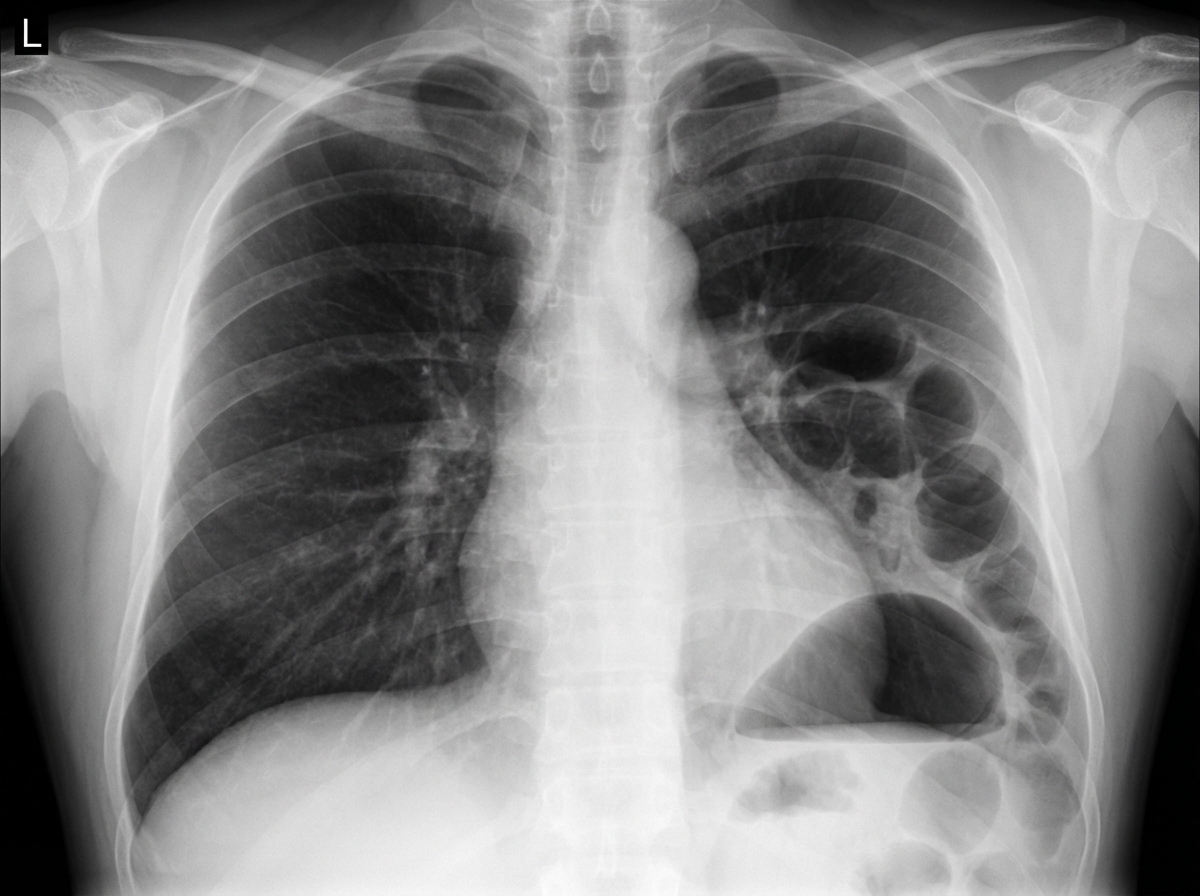
A 24-year-old man is brought by ambulance to the emergency department after a motor vehicle accident. He was the front seat driver in a head on collision. He is currently unconscious. The patient’s past medical history is only notable for an allergy to amoxicillin as he developed a rash when it was given for a recent upper respiratory infection 1 week ago. Otherwise, he is a college student in good health. The patient is resuscitated. A FAST exam is notable for free fluid in Morrison’s pouch. An initial assessment demonstrates only minor bruises and scrapes on his body. After further resuscitation the patient becomes responsive and begins vomiting. Which of the following is the most likely diagnosis?
A 17-year-old adolescent male is brought to the emergency department by fire and rescue after being struck by a moving vehicle. The patient reports that he was running through his neighborhood when a car struck him while turning right on a red light. He denies any loss of consciousness. His temperature is 99.0°F (37.2°C), blood pressure is 88/56 mmHg, pulse is 121/min, respirations are 12/min, and SpO2 is 95% on room air. The patient is alert and oriented to person, place and time and is complaining of pain in his abdomen. He has lacerations on his face and extremities. On cardiac exam, he is tachycardic with normal S1 and S2. His lungs are clear to auscultation bilaterally, and his abdomen is soft but diffusely tender to palpation. The patient tenses his abdomen when an abdominal exam is performed. Bowel sounds are present, and he is moving all 4 extremities spontaneously. His skin is cool with delayed capillary refill. After the primary survey, 2 large-bore IVs are placed, and the patient is given a bolus of 2 liters of normal saline. Which of the following is the best next step in management?
A 33-year-old man is brought to the emergency department because of trauma from a motor vehicle accident. His pulse is 122/min and rapid and thready, the blood pressure is 78/37 mm Hg, the respirations are 26/min, and the oxygen saturation is 90% on room air. On physical examination, the patient is drowsy, with cold and clammy skin. Abdominal examination shows ecchymoses in the right flank. The external genitalia are normal. No obvious external wounds are noted, and the rest of the systemic examination values are within normal limits. Blood is sent for laboratory testing and urinalysis shows 6 RBC/HPF. Hematocrit is 22% and serum creatinine is 1.1 mg/dL. Oxygen supplementation and IV fluid resuscitation are started immediately, but the hypotension persists. The focused assessment with sonography in trauma (FAST) examination shows a retroperitoneal fluid collection. What is the most appropriate next step in management?
A 35-year-old male is brought into the emergency department for a trauma emergency. The emergency medical services states that the patient was wounded with a knife on his upper left thigh near the inguinal ligament. Upon examination in the trauma bay, the patient is awake and alert. His physical exam and FAST exam is normal other than the knife wound. Large bore intravenous lines are inserted into the patient for access and fluids are being administered. Pressure on the knife wound is being held by one of the physicians with adequate control of the bleeding, but the physician notices the blood was previously extravasating in a pulsatile manner. His vitals are BP 100/50, HR 110, T 97.8, RR 22. What is the next best step for this patient?
A 56-year-old man is brought to the emergency department after falling 16 feet from a ladder. He has severe pain in both his legs and his right arm. He appears pale and diaphoretic. His temperature is 37.5°C (99.5°F), pulse is 120/min and weak, respirations are 26/min, and blood pressure is 80/50 mm Hg. He opens his eyes and withdraws in response to painful stimuli and makes incomprehensible sounds. The abdomen is soft and nontender. All extremities are cold, with 1+ pulses distally. Arterial blood gas analysis on room air shows: pH 7.29 PCO2 33 mm Hg PO2 65 mm Hg HCO3- 15 mEq/L A CT scan shows displaced fractures of the pelvic ring, as well as fractures of both tibiae, the right distal radius, and right proximal humerus. The patient undergoes emergent open reduction and is admitted to the intensive care unit. Which of the following best indicates inadequate fluid resuscitation?
An 18-year-old man presents to the emergency department after an automobile accident. His vitals have significantly dropped since admission. Upon examination, his abdomen is slightly distended, the ribs on the right side are tender and appear broken, and breath sounds are diminished at the base of the right lung. An abdominal ultrasound and chest X-ray are ordered. Ultrasound shows fluid in the abdominal cavity and trauma to the liver. X-ray confirmed broken ribs and pleural effusion on the right. Based on these findings, the surgeons recommend immediate surgery. Upon entering the abdomen, an exsanguinating hemorrhage is observed. The Pringle maneuver is used to reduce bleeding. What was clamped during this maneuver?
Want unlimited practice?
Get full access to all questions, explanations, and performance tracking.
Scan to download app