
Burns assessment and management — MCQs

A 27-year-old male presents to the emergency department after being brought in from a house fire. The patient has extensive burns covering his body and is conscious but in severe pain. The patient has a past medical history notable for marijuana use. He is not currently on any medications. Physical exam is notable for extensive burns covering the patient's back, chest, thighs, and legs. The patient's oropharynx reveals no signs of damage or extensive smoke inhalation. The patient is breathing on his own and has normal breath sounds bilaterally. His temperature is 99.5°F (37.5°C), pulse is 145/min, blood pressure is 100/70 mmHg, respirations are 27/min, and oxygen saturation is 93% on room air. Which of the following interventions is most likely to reduce mortality in this patient?
A 55-year-old man with a history of IV drug abuse presents to the emergency department with an altered mental status. He was found unconscious in the park by police. His temperature is 100.0°F (37.8°C), blood pressure is 87/48 mmHg, pulse is 150/min, respirations are 17/min, and oxygen saturation is 98% on room air. Physical exam is notable for multiple scars and abscesses in the antecubital fossa. His laboratory studies are ordered as seen below. Serum: Na+: 139 mEq/L Cl-: 105 mEq/L K+: 4.3 mEq/L HCO3-: 19 mEq/L BUN: 20 mg/dL Glucose: 95 mg/dL Creatinine: 1.5 mg/dL Ca2+: 10.2 mg/dL Which of the following is the most appropriate treatment for this patient’s blood pressure and acid-base status?
A 44-year-old man is brought to the emergency department after sustaining high-voltage electrical burns over his left upper limb. On examination, the tip of his left middle finger is charred, and there are 2nd-degree burns involving the whole of the left upper limb. Radial and ulnar pulses are strong, and there are no signs of compartment syndrome. An exit wound is present over the sole of his right foot. His temperature is 37.7°C (99.8°F), the blood pressure is 110/70 mm Hg, the pulse is 105/min, and the respiratory rate is 26/min. His urine is reddish-brown, and urine output is 0.3 mL/kg/h. Laboratory studies show: Hemoglobin 13.9 g/dL Hematocrit 33% Leukocyte count 11,111/mm3 Serum Creatinine 4.6 mg/dL Creatine phosphokinase 15,230 U/L K+ 7.7 mEq/L Na+ 143 mEq/L What is the most likely mechanism for this patient's renal failure?
A 28-year-old soldier is brought back to a military treatment facility 45 minutes after sustaining injuries in a building fire from a mortar attack. He was trapped inside the building for around 20 minutes. On arrival, he is confused and appears uncomfortable. He has a Glasgow Coma Score of 13. His pulse is 113/min, respirations are 18/min, and blood pressure is 108/70 mm Hg. Pulse oximetry on room air shows an oxygen saturation of 96%. Examination shows multiple second-degree burns over the chest and bilateral upper extremities and third-degree burns over the face. There are black sediments seen within the nose and mouth. The lungs are clear to auscultation. Cardiac examination shows no abnormalities. The abdomen is soft and nontender. Intravenous fluid resuscitation is begun. Which of the following is the most appropriate next step in management?
A 35-year-old man is pulled out of a burning building. He is unconscious and severely injured. He is transported to the nearest emergency department. Upon arrival, he is stabilized and evaluated for burns and trauma. Approximately 40% of his body is covered in burns. The burned areas appear blackened and charred but the skin is mostly intact. It is noted that the patient has loss of pain sensation in the burnt areas with minimal blanching on palpation. The affected area is leathery when palpated. What category of burn did the patient most likely to suffer from?
A 35-year-old woman is brought to the emergency department 45 minutes after being rescued from a house fire. On arrival, she appears confused and has shortness of breath. The patient is 165 cm (5 ft 5 in) tall and weighs 55 kg (121 lb); BMI is 20 kg/m2. Her pulse is 125/min, respirations are 29/min, and blood pressure is 105/65 mm Hg. Pulse oximetry on room air shows an oxygen saturation of 97%. Examination shows second and third-degree burns over the anterior surfaces of the chest and abdomen, and the anterior surface of the upper extremities. There is black debris in the mouth and nose. There are coarse breath sounds over the lung bases. Cardiac examination shows no murmurs, rubs, or gallop. Femoral and pedal pulses are palpable bilaterally. Which of the following is the most appropriate fluid regimen for this patient according to the Parkland formula?
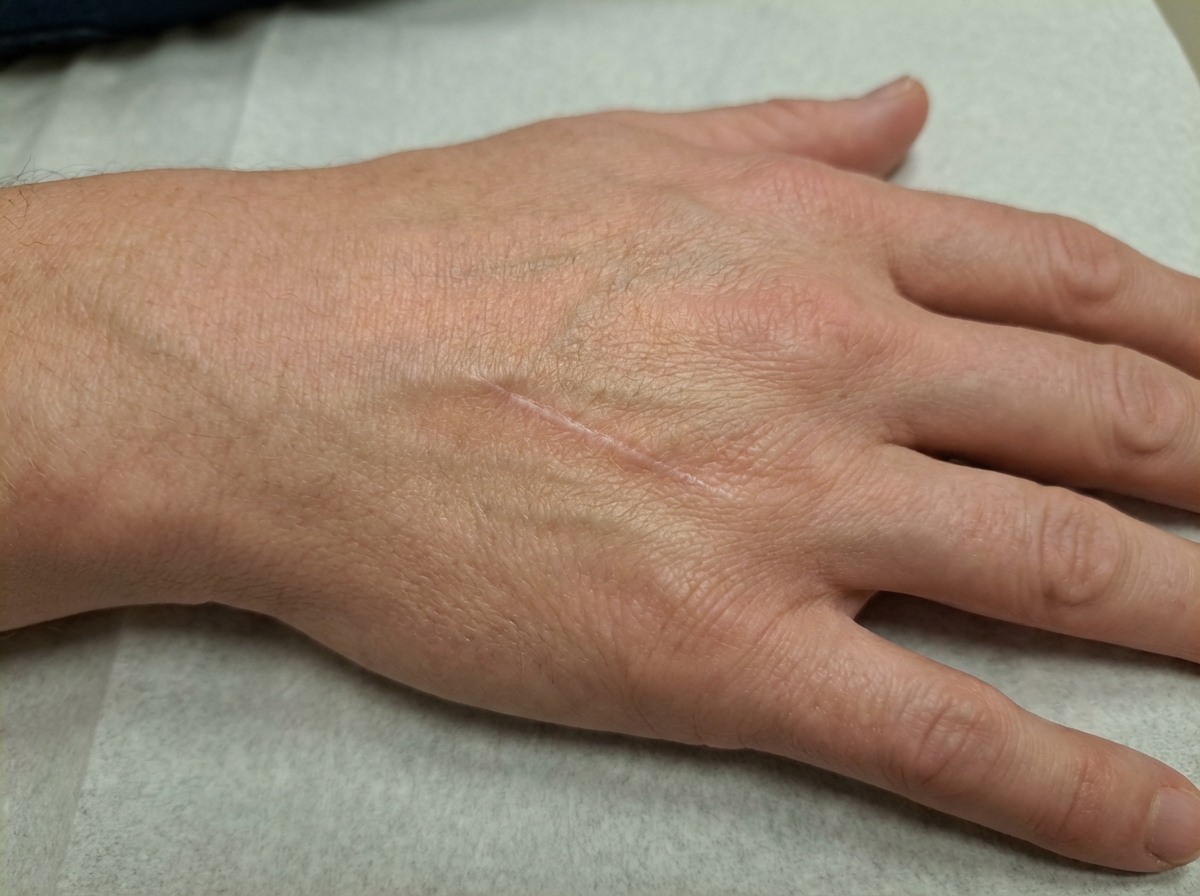
A 16-year-old boy presents to the emergency department after a skateboarding accident. He fell on a broken bottle and received a 4 cm wound on the dorsal aspect of his left hand. His vitals are stable and he was evaluated by the surgeon on call who determined that suturing was not required. After several weeks the wound has almost completely healed (see image). Which of the following is the correct description of this patient's wound before healing?
A 33-year-old man is brought to the emergency department because of trauma from a motor vehicle accident. His pulse is 122/min and rapid and thready, the blood pressure is 78/37 mm Hg, the respirations are 26/min, and the oxygen saturation is 90% on room air. On physical examination, the patient is drowsy, with cold and clammy skin. Abdominal examination shows ecchymoses in the right flank. The external genitalia are normal. No obvious external wounds are noted, and the rest of the systemic examination values are within normal limits. Blood is sent for laboratory testing and urinalysis shows 6 RBC/HPF. Hematocrit is 22% and serum creatinine is 1.1 mg/dL. Oxygen supplementation and IV fluid resuscitation are started immediately, but the hypotension persists. The focused assessment with sonography in trauma (FAST) examination shows a retroperitoneal fluid collection. What is the most appropriate next step in management?
A 67-year-old man comes to the physician for a follow-up examination. He has had lower back pain for several months. The pain radiates down the right leg to the foot. He has no history of any serious illness and takes no medications. His pain increases after activity. The straight leg test is positive on the right. The results of the laboratory studies show: Laboratory test Hemoglobin 14 g/d Leukocyte count 5,500/mm3 with a normal differential Platelet count 350,000/mm3 Serum Calcium 9.0 mg/dL Albumin 3.8 g/dL Urea nitrogen 14 mg/dL Creatinine 0.9 mg/dL Serum immunoelectrophoresis shows an immunoglobulin G (IgG) type monoclonal component of 40 g/L. Bone marrow plasma cells return at 20%. Skeletal survey shows no bone lesions. Magnetic resonance imaging (MRI) shows a herniated disc at the L5. Which of the following is the most appropriate next step?
A 35-year-old man is brought to the emergency department from a kitchen fire. The patient was cooking when boiling oil splashed on his exposed skin. His temperature is 99.7°F (37.6°C), blood pressure is 127/82 mmHg, pulse is 120/min, respirations are 12/min, and oxygen saturation is 98% on room air. He has dry, nontender, and circumferential burns over his arms bilaterally, burns over the anterior portion of his chest and abdomen, and tender spot burns with blisters on his shins. A 1L bolus of normal saline is administered and the patient is given morphine and his pulse is subsequently 80/min. A Foley catheter is placed which drains 10 mL of urine. What is the best next step in management?
Want unlimited practice?
Get full access to all questions, explanations, and performance tracking.
Scan to download app