
Fluid and electrolyte management — MCQs

A 55-year-old man with a history of IV drug abuse presents to the emergency department with an altered mental status. He was found unconscious in the park by police. His temperature is 100.0°F (37.8°C), blood pressure is 87/48 mmHg, pulse is 150/min, respirations are 17/min, and oxygen saturation is 98% on room air. Physical exam is notable for multiple scars and abscesses in the antecubital fossa. His laboratory studies are ordered as seen below. Serum: Na+: 139 mEq/L Cl-: 105 mEq/L K+: 4.3 mEq/L HCO3-: 19 mEq/L BUN: 20 mg/dL Glucose: 95 mg/dL Creatinine: 1.5 mg/dL Ca2+: 10.2 mg/dL Which of the following is the most appropriate treatment for this patient’s blood pressure and acid-base status?
An 8-year-old boy is brought to the emergency department with severe dyspnea, fatigue, and vomiting. His mother reports that he has been lethargic for the last several days with an increase in urine output. She thinks he may even be losing weight, despite eating and drinking more than normal for the last couple weeks. Laboratory results are notable for glucose of 440, potassium of 5.8, pH of 7.14 and HCO3 of 17. After administrating IV fluids and insulin, which of the following would you expect?
A 65-year-old woman is brought to the emergency department by her husband who found her lying unconscious at home. He says that the patient has been complaining of progressively worsening weakness and confusion for the past week. Her past medical history is significant for hypertension, systemic lupus erythematosus, and trigeminal neuralgia. Her medications include metoprolol, valsartan, prednisone, and carbamazepine. On admission, blood pressure is 130/70 mm Hg, pulse rate is 100 /min, respiratory rate is 17/min, and temperature is 36.5°C (97.7ºF). She regained consciousness while on the way to the hospital but is still drowsy and disoriented. Physical examination is normal. Finger-stick glucose level is 110 mg/dl. Other laboratory studies show: Na+ 120 mEq/L (136—145 mEq/L) K+ 3.5 mEq/L (3.5—5.0 mEq/L) CI- 107 mEq/L (95—105 mEq/L) Creatinine 0.8 mg/dL (0.6—1.2 mg/dL) Serum osmolality 250 mOsm/kg (275—295 mOsm/kg) Urine Na+ 70 mEq/L Urine osmolality 350 mOsm/kg She is admitted to the hospital for further management. Which of the following is the next best step in the management of this patient's condition?
An 8-year-old boy is shifted to a post-surgical floor following neck surgery. The surgeon has restricted his oral intake for the next 24 hours. He does not have diarrhea, vomiting, or dehydration. His calculated fluid requirement is 1500 mL/day. However, he receives 2000 mL of intravenous isotonic fluids over 24 hours. Which of the following physiological parameters in the boy’s circulatory system is most likely to be increased?
A 32-year-old man is brought to the Emergency Department after 3 consecutive days of diarrhea, fatigue and weakness. His stool has been soft and mucoid, with no blood stains. The patient just came back from a volunteer mission in Guatemala, where he remained asymptomatic. His personal medical history is unremarkable. Today his blood pressure is 98/60 mm Hg, pulse is 110/min, respiratory rate is 19/min, and his body temperature is 36.7°C (98.1°F). On physical exam, he has sunken eyes, dry mucosa, mild diffuse abdominal tenderness, and hyperactive bowel sounds. Initial laboratory tests are shown below: Serum creatinine (SCr) 1.8 mg/dL Blood urea nitrogen (BUN) 50 mg/dL Serum sodium 132 mEq/L Serum potassium 3.5 mEq/L Serum chloride 102 mEq/L Which of the following phenomena would you expect in this patient?
A 71-year-old male presents to the emergency department after having a generalized tonic-clonic seizure. His son reports that he does not have a history of seizures but has had increasing confusion and weakness over the last several weeks. An electrolyte panel reveals a sodium level of 120 mEq/L and a serum osmolality of 248 mOsm/kg. His urine is found to have a high urine osmolality. His temperature is 37° C (98.6° F), respirations are 15/min, pulse is 67/min, and blood pressure is 122/88 mm Hg. On examination he is disoriented, his pupils are round and reactive to light and accommodation and his mucous membranes are moist. His heart has a regular rhythm without murmurs, his lungs are clear to auscultation bilaterally, the abdomen is soft, and his extremities have no edema but his muscular strength is 3/5 bilaterally. There is hyporeflexia of all four extremities. What is the most likely cause of his symptoms?
Three hours after undergoing open proctocolectomy for ulcerative colitis, a 42-year-old male complains of abdominal pain. The pain is localized to the periumbilical and hypogastric regions. A total of 20 mL of urine has drained from his urinary catheter since the end of the procedure. Temperature is 37.2°C (98.9°F), pulse is 92/min, respirations are 12/min, and blood pressure is 110/72 mm Hg. Pulse oximetry on room air shows an oxygen saturation of 99%. Physical examination shows a 20 cm vertical midline incision and an ileostomy in the right lower quadrant. There is no fluid drainage from the surgical wounds. The urinary catheter flushes easily and is without obstruction. Cardiopulmonary examination shows no abnormalities. Serum studies show a blood urea nitrogen of 30 mg/dL and a creatinine of 1.3 mg/dL. Which of the following is the most appropriate next step in management?
Three days after being admitted to the hospital because of a fall from the roof of a two-story building, a 27-year-old man is being monitored in the intensive care unit. On arrival, the patient was somnolent and not oriented to person, place, or time. A CT scan of the head showed an epidural hemorrhage that was 45 cm3 in size and a midline shift of 7 mm. Emergency surgery was performed with craniotomy and hematoma evacuation on the day of admission. Perioperatively, a bleeding vessel was identified and ligated. Postoperatively, the patient was transferred to the intensive care unit and placed on a ventilator. His temperature is 37°C (98.6°F), pulse is 67/min, and blood pressure is 117/78 mm Hg. The ventilator is set at a FiO2 of 55%, tidal volume of 520 mL, and positive end-expiratory pressure of 5.0 cm H2O. In addition to intravenous administration of fluids, which of the following is the most appropriate next step in managing this patient's nutrition?
A 65-year-old woman comes to the physician because of progressive weight loss for 3 months. Physical examination shows jaundice and a nontender, palpable gallbladder. A CT scan of the abdomen shows an ill-defined mass in the pancreatic head. She is scheduled for surgery to resect the pancreatic head, distal stomach, duodenum, early jejunum, gallbladder, and common bile duct and anastomose the jejunum to the remaining stomach, pancreas, and bile duct. Following surgery, this patient is at the greatest risk for which of the following?
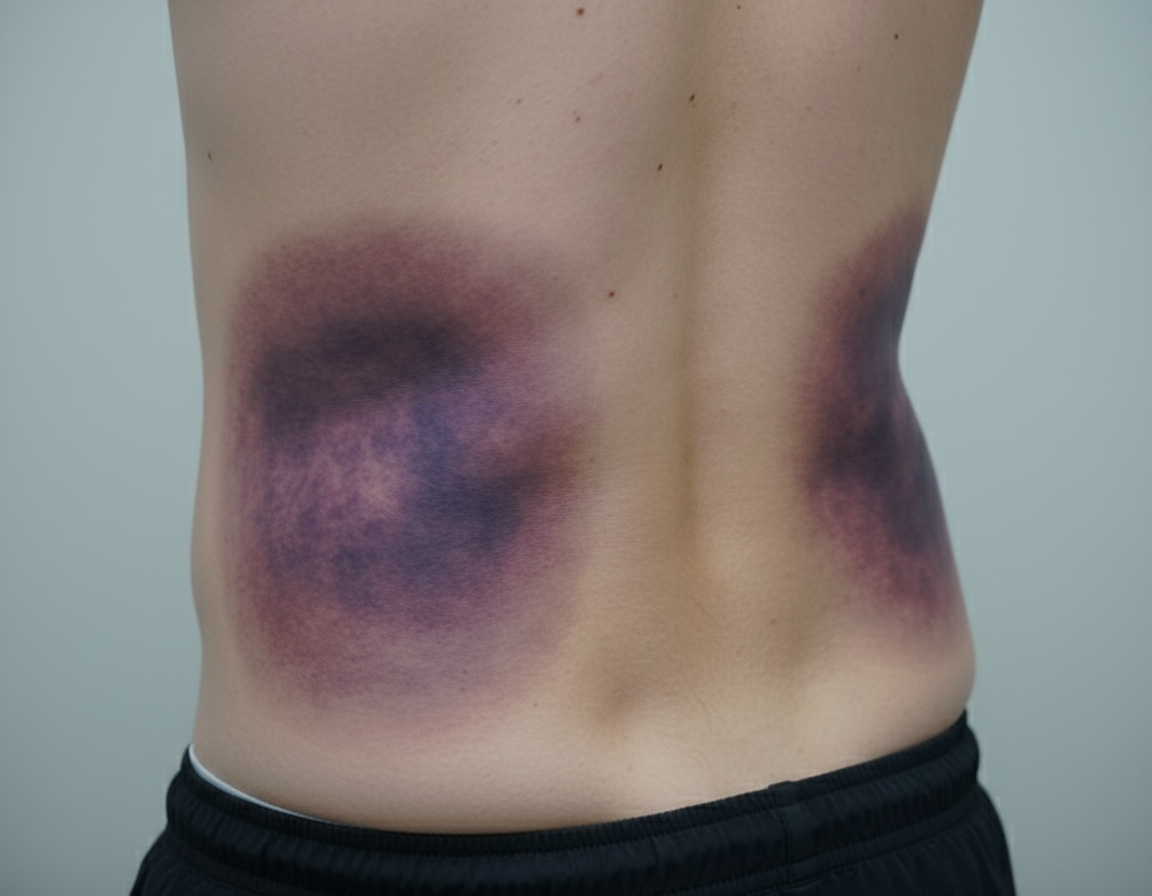
A 55-year-old woman is brought to the emergency department due to sudden onset retrosternal chest pain. An ECG shows ST-segment elevation. A diagnosis of myocardial infarction is made and later confirmed by elevated levels of troponin I. The patient is sent to the cardiac catheter laboratory where she undergoes percutaneous catheterization. She has 2 occluded vessels in the heart and undergoes a percutaneous coronary intervention to place 2 stents in her coronary arteries. Blood flow is successfully restored in the affected arteries. The patient complains of flank pain on post-procedure evaluation a few hours later. A significant drop in hematocrit is observed, as well as a drop in her blood pressure to 90/60 mm Hg. Physical examination reveals extensive ecchymoses in the flanks and loin as seen in the provided image. Which of the following conditions is this patient most likely experiencing?
Want unlimited practice?
Get full access to all questions, explanations, and performance tracking.
Scan to download app