Undescended testis and orchiopexy — MCQs
A 5-year-old boy is brought to the physician for excessive weight gain. The mother reports that her son has been “chubby” since he was a toddler and that he has gained 10 kg (22 lbs) over the last year. During this period, he fractured his left arm twice from falling on the playground. He had cryptorchidism requiring orchiopexy at age 2. He is able to follow 1-step instructions and uses 2-word sentences. He is at the 5th percentile for height and 95th percentile for weight. Vital signs are within normal limits. Physical examination shows central obesity. There is mild esotropia and coarse, dry skin. In addition to calorie restriction, which of the following is the most appropriate next step in management of this patient?
A 30-year-old male presents with a testicular mass of unknown duration. The patient states he first noticed something unusual with his right testicle two weeks ago, but states he did not think it was urgent because it was not painful and believed it would resolve on its own. It has not changed since he first noticed the mass, and the patient still denies pain. On exam, the patient’s right testicle is non-tender, and a firm mass is felt. There is a negative transillumination test, and the mass is non-reducible. Which of the following is the best next step in management?
A 30-year-old man comes to the physician for his annual health maintenance examination. The patient has no particular health concerns. He has a history of bilateral cryptorchidism treated with orchidopexy at 8 months of age. This patient is at increased risk for which of the following?
A 45-year-old man undergoes elective vasectomy for permanent contraception. The procedure is performed under local anesthesia. There are no intra-operative complications and he is discharged home with ibuprofen for post-operative pain. This patient is at increased risk for which of the following complications?
A couple brings their 1-year-old child to a medical office for a follow-up evaluation of his small, empty scrotum. The scrotum has been empty since birth and the physician asked them to follow up with a pediatrician. There are no other complaints. The immunization history is up to date and his growth and development have been excellent. On examination, he is a playful, active child with a left, non-reducible, non-tender inguinal mass, an empty and poorly rugated hemiscrotal sac, and a testis within the right hemiscrotal sac. Which of the following hormones would likely be deficient in this patient by puberty if the condition is left untreated?
A 16-year-old boy comes to the physician because of painless enlargement of his left testis for the past 2 weeks. The patient reports that the enlargement is worse in the evenings, especially after playing soccer. He has not had any trauma to the testes. There is no personal or family history of serious illness. Vital signs are within normal limits. Examination shows multiple cord-like structures above the left testes. The findings are more prominent while standing. The cord-like structures disappear in the supine position. The testes are normal on palpation. The patient is at greatest risk of developing which of the following complications?
A 22-year-old man is brought to the emergency department because of progressive left-sided scrotal pain for 4 hours. He describes the pain as throbbing in nature and 6 out of 10 in intensity. He has vomited once on the way to the hospital. He has had pain during urination for the past 4 days. He has been sexually active with 2 female partners over the past year and uses condoms inconsistently. His father was diagnosed with testicular cancer at the age of 51 years. He appears anxious. His temperature is 36.9°C (98.42°F), pulse is 94/min, and blood pressure is 124/78 mm Hg. Cardiopulmonary examination shows no abnormalities. The abdomen is soft and nontender. Examination shows a tender, swollen left testicle and an erythematous left hemiscrotum. Urine dipstick shows leukocyte esterase; urinalysis shows WBCs. Which of the following is the most appropriate next step in management?
A father brings his 1-year-old son into the pediatrician's office for a routine appointment. He states that his son is well but mentions that he has noticed an intermittent bulge on the right side of his son's groin whenever he cries or strains for bowel movement. Physical exam is unremarkable. The physician suspects a condition that may be caused by incomplete obliteration of the processus vaginalis. Which condition is caused by the same defective process?
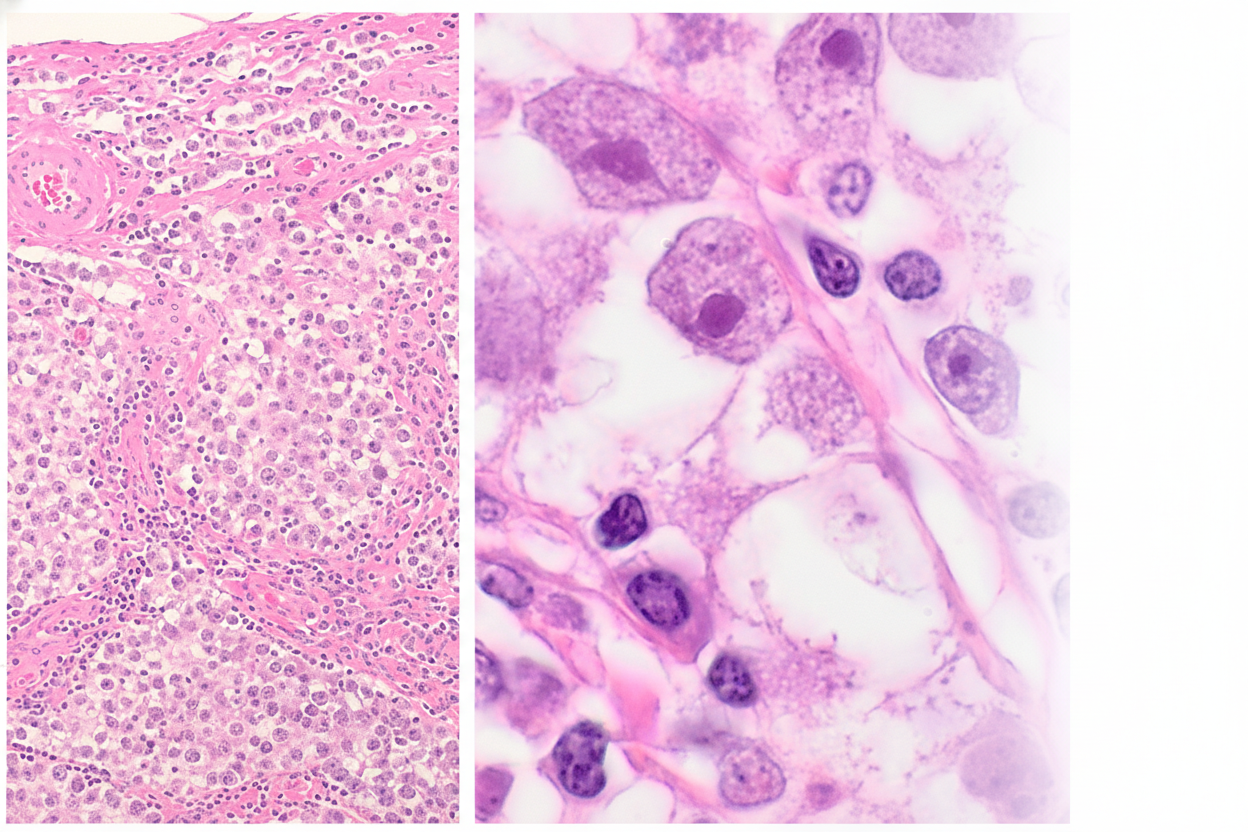
A 22-year-old man comes to the physician for the evaluation of a 2-day history of right testicular pain. At the age of 6 months, he was treated for hypospadias and cryptorchidism. Physical examination shows a rubbery, large right testicle. Orchidectomy is performed. A photomicrograph of a section of the mass is shown. Which of the following additional findings is most likely in this patient?
An 11-year-old boy is brought to the emergency department with sudden and severe pain in the left scrotum that started 2 hours ago. He has vomited twice. He has no dysuria or frequency. There is no history of trauma to the testicles. The temperature is 37.7°C (99.9°F). The left scrotum is swollen, erythematous, and tender. The left testis is elevated and swollen with a transverse lie. The cremasteric reflex is absent. Ultrasonographic examination is currently pending. Which of the following is the most likely diagnosis?
Want unlimited practice?
Get full access to all questions, explanations, and performance tracking.
Scan to download app