
Congenital heart defects requiring surgery — MCQs

A 5-week-old infant born at 36 weeks' gestation is brought to the physician for a well-child examination. Her mother reports that she previously breastfed her for 15 minutes every 2 hours but now feeds her for 40 minutes every 4 hours. The infant has six wet diapers and two stools daily. She currently weighs 3500 g (7.7 lb) and is 52 cm (20.4 in) in length. Vital signs are with normal limits. Cardiopulmonary examination shows a grade 4/6 continuous murmur heard best at the left infraclavicular area. After confirming the diagnosis via echocardiography, which of the following is the most appropriate next step in management of this patient?
A 2-week-old newborn is brought to the physician for a follow-up examination. He was born at term and the pregnancy was uncomplicated. His mother says he has been feeding well and passing adequate amounts of urine. He appears healthy. He is at the 60th percentile for length and 40th percentile for weight. His temperature is 37.3°C (99.1°F), pulse is 130/min, respirations are 49/min and blood pressure is 62/40 mm Hg. A thrill is present over the third left intercostal space. A 5/6 holosystolic murmur is heard over the left lower sternal border. An echocardiography shows a 3-mm membranous ventricular septal defect. Which of the following is the most appropriate next step in management?
A 9-year-old boy is brought to the office due to exertional dyspnea and fatigability. He tires easily when walking or playing. His parents say that he was diagnosed with a congenital heart disease during his infancy, but they refused any treatment. They do not remember much about his diagnosis. The patient also had occasional respiratory infections throughout childhood that did not require hospitalization. He takes no medications. The patient has no family history of heart disease. His vital signs iclude: heart rate 98/min, respiratory rate 16/min, temperature 37.2°C (98.9°F), and blood pressure of 110/80 mm Hg. Physical examination shows toe cyanosis and clubbing but no finger abnormalities. Cardiac auscultation reveals a continuous machine-like murmur. All extremity pulses are full and equal. Which of the following is the most likely diagnosis?
Cardiac surgery is consulted on a newborn with a large ventricular septal defect. The child has poor weight gain and feeding difficulties. He requires furosemide and captopril to avoid dyspnea. On physical examination his temperature is 36.9°C (98.4°F), pulse rate is 158/min, respiratory rate is 30/min, and blood pressure is 94/62 mm Hg. Chest auscultation reveals a holosystolic murmur along the left lower sternal border and a mid-diastolic low-pitched rumble at the apex. Abdominal examination reveals the presence of hepatomegaly. An echocardiogram confirms a diagnosis of a membranous VSD while hemodynamic studies show a Qp:Qs ratio of 2.8:1. Which of the following is the best management option?
Over the course of a year, 5 children with identical congenital heart defects were referred to a pediatric cardiac surgeon for evaluation. All 5 children had stable vital signs and were on appropriate medication. Upon review of medical records, all of them had a loud holosystolic murmur over the third intercostal space at the left sternal border. The surgeon ordered echocardiograms for all 5 children and recommended surgical closure of the defect in one of them. Which of the following patients required surgical repair of their defect?
A 4-year-old Caucasian male suffers from cyanosis and dyspnea relieved by squatting. Which of the following abnormalities is most likely present?
A 5-year-old child has central cyanosis and episodes of worsening cyanosis during exertion that improve when he squats. Examination shows digital clubbing, a right ventricular heave, a single S2, and a harsh systolic ejection murmur at the left upper sternal border. The chest radiograph shown was obtained during an unrelated evaluation of enteric tubing; it shows no pulmonary edema or focal lung disease. Which congenital heart defect most likely explains the child's clinical findings?
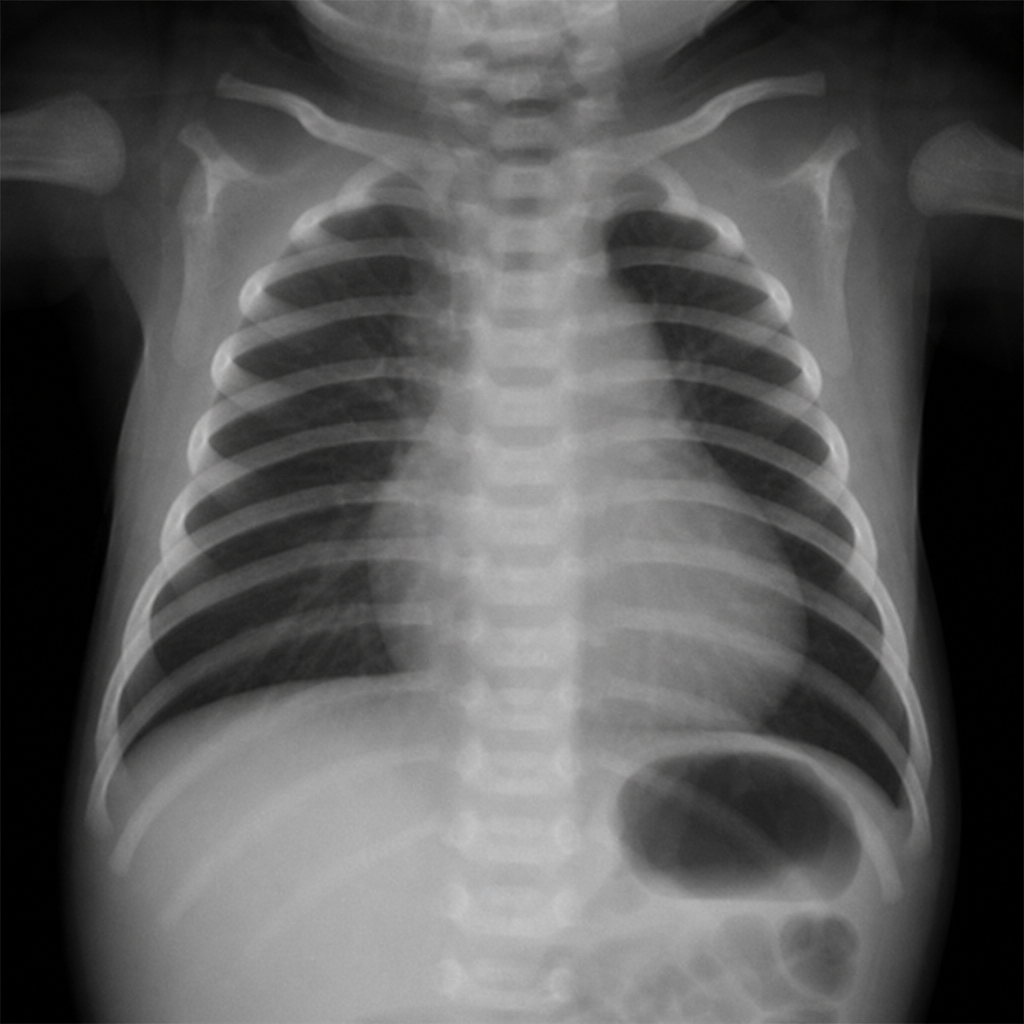
A 1-day-old infant in the general care nursery, born at full term by uncomplicated cesarean section delivery, is noted to have a murmur, but otherwise appears well. On examination, respiratory rate is 40/min and pulse oximetry is 96%. Precordium is normoactive. With auscultation, S1 is normal, S2 is single, and a 2/6 systolic ejection murmur is heard at the left upper sternal border. Echocardiography shows infundibular pulmonary stenosis, overriding aorta, ventricular septal defect and concentric right ventricular hypertrophy. Which of the following correlate with the presence or absence of cyanosis in this baby?
A 3-year-old boy is brought to a respiratory specialist. The family physician referred the child because of recurrent respiratory infections over the past 2 years. Chest X-rays showed a lesion of < 2 cm that includes glands and cysts in the upper lobe of the right lung. Diseases affecting the immune system were investigated and ruled out. No family history of any pulmonary disease or congenital malformations exists. He was born at full term via a normal vaginal delivery with an APGAR score of 10. Which of the following should be highly considered for effective management of this child’s condition?
A 62-year-old man presents to his primary care physician. He was brought in by his daughter as he has refused to see a physician for the past 10 years. The patient has been having worsening abdominal pain. He claims that it was mild initially but has gotten worse over the past week. The patient has been eating lots of vegetables recently to help with his pain. The patient has a past medical history of constipation and a 50 pack-year smoking history. He is not currently taking any medications. On review of systems, the patient endorses trouble defecating and blood that coats his stool. His temperature is 99.5°F (37.5°C), blood pressure is 197/128 mmHg, pulse is 100/min, respirations are 17/min, and oxygen saturation is 98% on room air. On abdominal exam, the patient complains of right upper quadrant tenderness and a palpable liver edge that extends 4 cm beneath the costal margin. Murphy's sign is positive. HEENT exam is notable for poor dentition, normal sclera, and normal extraocular movements. There are no palpable lymph nodes. Laboratory studies are ordered as seen below. Hemoglobin: 9 g/dL Hematocrit: 30% Leukocyte count: 7,500/mm^3 with normal differential Platelet count: 199,000/mm^3 Serum: Na+: 140 mEq/L Cl-: 101 mEq/L K+: 4.0 mEq/L HCO3-: 23 mEq/L BUN: 29 mg/dL Glucose: 197 mg/dL Creatinine: 1.4 mg/dL Ca2+: 10.2 mg/dL Total bilirubin: 1.1 mg/dL AST: 150 U/L ALT: 112 U/L Which of the following is the most likely diagnosis?
Want unlimited practice?
Get full access to all questions, explanations, and performance tracking.
Scan to download app