
Amputation indications and techniques — MCQs

A 26-year-old man presents with a 2-day history of worsening right lower leg pain. He states that he believes his right leg is swollen when compared to his left leg. Past medical history is significant for generalized anxiety disorder, managed effectively with psychotherapy. He smokes a pack of cigarettes daily but denies alcohol and illicit drug use. His father died of a pulmonary embolism at the age of 43. His vital signs include: temperature 36.7°C (98.0°F), blood pressure 126/74 mm Hg, heart rate 74/min, respiratory rate 14/min. On physical examination, the right lower leg is warmer than the left, and dorsiflexion of the right foot produces pain. Which of the following conditions is most likely responsible for this patient’s presentation?
A 70-year-old man with a recent above-the-knee amputation of the left lower extremity, due to wet gangrene secondary to refractory peripheral artery disease, presents with weakness and dizziness. He says that the symptoms began acutely 24 hours after surgery and have not improved. The amputation was complicated by substantial blood loss. He was placed on empiric antibiotic therapy with ciprofloxacin and clindamycin before the procedure, and blood and wound culture results are still pending. The medical history is significant for type 2 diabetes mellitus and hypertension. Current medications are metformin and lisinopril. The family history is significant for type 2 diabetes mellitus in both parents. Review of symptoms is significant for palpitations and a mild headache for the past 24 hours. His temperature is 38.2°C (100.8°F); blood pressure, 120/70 mm Hg (supine); pulse, 102/min; respiratory rate, 16/min; and oxygen saturation, 99% on room air. When standing, the blood pressure is 90/65 mm Hg and the pulse is 115/min. On physical examination, the patient appears pale and listless. The surgical amputation site does not show any signs of ongoing blood loss or infection. Laboratory tests and an ECG are pending. Which of the following is the next best step in management?
An 8-year-old boy and his 26-year-old babysitter are brought into the emergency department with severe injuries caused by a motor vehicle accident. The child is wheeled to the pediatric intensive care unit with a severe injury to his right arm, as well as other external and internal injuries. He is hemorrhaging and found to be hemodynamically unstable. He subsequently requires transfusion and surgery, and he is currently unconscious. The pediatric trauma surgeon evaluates the child’s arm and realizes it will need to be amputated at the elbow. Which of the following is the most appropriate course of action to take with regards to the amputation?
A 53-year-old Asian woman comes to the physician because of a 2-month history of severe pain in her right leg while walking. She used to be able to walk a half-mile (800-m) to the grocery store but has been unable to walk 200 meters without stopping because of the pain over the past month. She can continue to walk after a break of around 5 minutes. She has hypertension, atrial fibrillation, and type 2 diabetes mellitus. She has smoked one pack of cigarettes daily for the past 32 years. Current medications include metformin, enalapril, aspirin, and warfarin. Vital signs are within normal limits. Examination shows an irregularly irregular pulse. The right lower extremity is cooler than the left lower extremity. The skin over the right leg appears shiny and dry. Femoral pulses are palpated bilaterally; pedal pulses are diminished on the right side. Which of the following is the most appropriate next step in management?
A 73-year-old man comes to the physician because of worsening bilateral lower extremity pain for the past 8 months. The pain begins after walking one to two blocks and radiates bilaterally down the buttocks with cramping and tingling. He reports that the pain is worse while walking downhill and is relieved by sitting and leaning forward. He has hypertension, hyperlipidemia, and type 2 diabetes mellitus. He had a myocardial infarction at the age of 55 years and an abdominal aortic aneurysm repair at the age of 60 years. He has smoked one pack of cigarettes daily for the past 30 years. He does not drink alcohol or use illicit drugs. His current medications include sitagliptin, metformin, atorvastatin, metoprolol succinate, amlodipine, and hydrochlorothiazide. His temperature is 37.5°C (99.5°F), pulse is 82/min, respirations are 17/min, and blood pressure is 150/87 mm Hg. Examination shows full muscle strength. Sensation is reduced bilaterally in the feet and toes. Straight leg raise is negative. X-ray of the spine shows degenerative changes. Which of the following is the most appropriate next step in diagnosis?
An 11-year-old boy with a history of attention deficit disorder presents to a general medicine clinic with leg pain. He is accompanied by his mother. He reports dull, throbbing, diffuse pain in his bilateral lower extremities. He reports that the pain feels deep in his muscles. He has awakened several times at night with the pain, and his symptoms tend to be better during the daylight hours. He denies fatigue, fever, or pain in his joints. On physical examination, his vital signs are stable, and he is afebrile. Physical examination reveals full range of motion in the hip and knee joints without pain. He has no joint effusions, erythema, or warmth. What is the next best step in management?
A 31-year-old man presents to the Emergency Department with severe left leg pain and paresthesias 4 hours after his leg got trapped by the closing door of a bus. Initially, he had a mild pain which gradually increased to unbearable levels. Past medical history is noncontributory. In the Emergency Department, his blood pressure is 130/80 mm Hg, heart rate is 87/min, respiratory rate is 14/min, and temperature is 36.8℃ (98.2℉). On physical exam, his left calf is firm and severely tender on palpation. The patient cannot actively dorsiflex his left foot, and passive dorsiflexion is limited. Posterior tibial and dorsalis pedis pulses are 2+ in the right leg and 1+ in the left leg. Axial load does not increase the pain. Which of the following is the best next step in the management of this patient?
A 25-year-old patient is brought into the emergency department after he was found down by the police in 5 degree celsius weather. The police state the patient is a heroin-user and is homeless. The patient's vitals are T 95.3 HR 80 and regular BP 150/90 RR 10. After warming the patient, you notice his left lower leg is now much larger than his right leg. On exam, the patient has a loss of sensation on his left lower extremity. There is a faint palpable dorsalis pedal pulse, but no posterior tibial pulse. The patient is unresponsive to normal commands, but shrieks in pain upon passive stretch of his left lower leg. What is the most probable cause of this patient's condition?
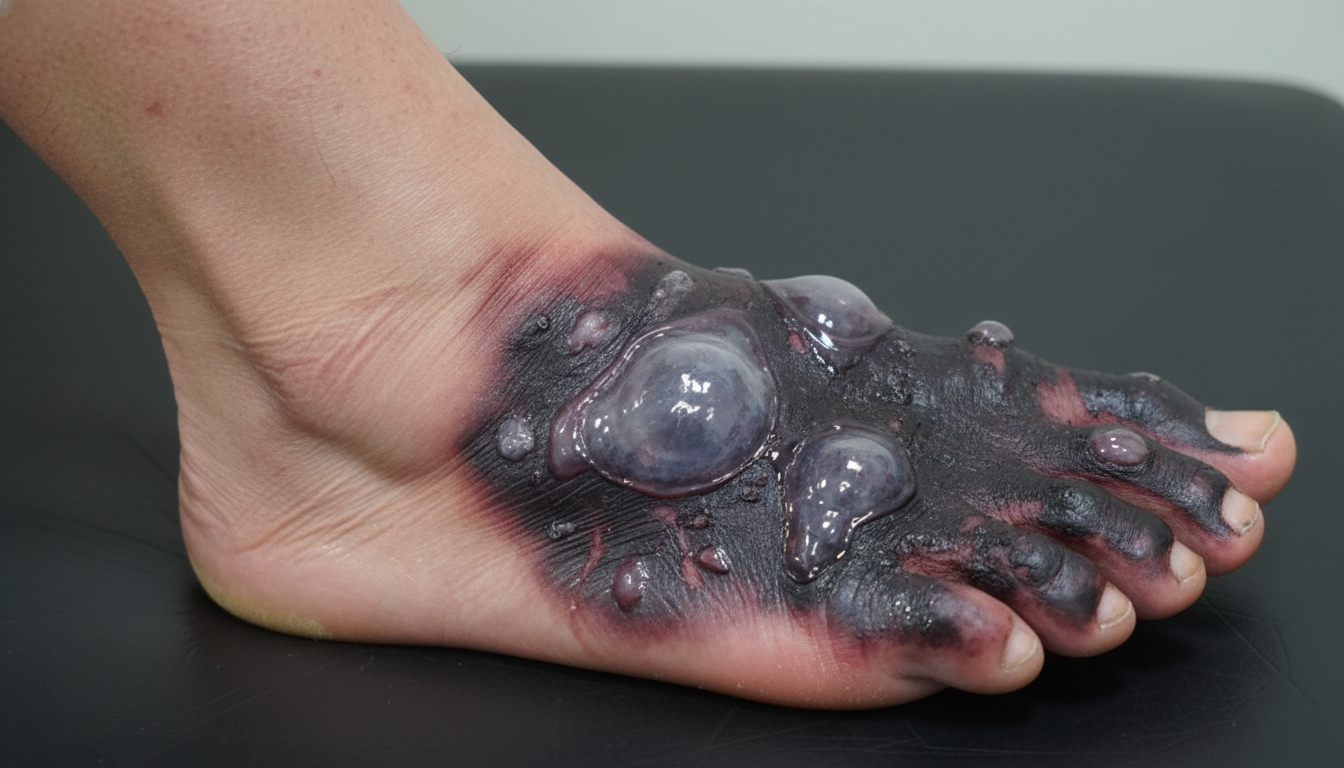
A 60-year-old man presents with pain, swelling, and a purulent discharge from his left foot. He says that the symptoms began 7 days ago with mild pain and swelling on the medial side of his left foot, but have progressively worsened. He states that there has been a foul-smelling discharge for the past 2 days. The medical history is significant for type 2 diabetes mellitus that was diagnosed 10 years ago and is poorly managed, and refractory peripheral artery disease that failed revascularization 6 months ago. The current medications include aspirin (81 mg orally daily) and metformin (500 mg orally twice daily). He has a 20-pack-year smoking history but quit 6 months ago. The family history is significant for type 2 diabetes mellitus in both parents and his father died of a myocardial infarction at 50 years of age. His temperature is 38.9°C (102°F); blood pressure 90/65 mm Hg; pulse 102/min; respiratory rate 22/min; and oxygen saturation 99% on room air. On physical examination, he appears ill and diaphoretic. The skin is flushed and moist. There is 2+ pitting edema of the left foot with blistering and black discoloration (see picture). The lower legs are hairless and the lower extremity peripheral pulses are 1+ bilaterally. Laboratory tests are pending. Blood cultures are positive for Staphylococcus aureus. Which of the following findings is the strongest indication for amputation of the left lower extremity in this patient?
Paramedics are called to a 35-year-old man who had accidentally amputated his left index finger tip with a knife. He has no significant past medical history. His temperature is 37.2°C (99°F), pulse is 96/min, and blood pressure is 112/72 mm Hg. Pulse oximetry on room air shows an oxygen saturation of 99%. His left index finger is amputated distal to the distal interphalangeal joint at the level of the nail bed, and exposed bone is visible. There is profuse bleeding from the wound site. His ability to flex, extend, abduct, and adduct the joints is preserved and sensation is intact. The remainder of the examination shows no abnormalities. Which of the following is the most appropriate next step prior to transporting this patient to the emergency department?
Want unlimited practice?
Get full access to all questions, explanations, and performance tracking.
Scan to download app