
Patient selection for minimally invasive approaches — MCQs

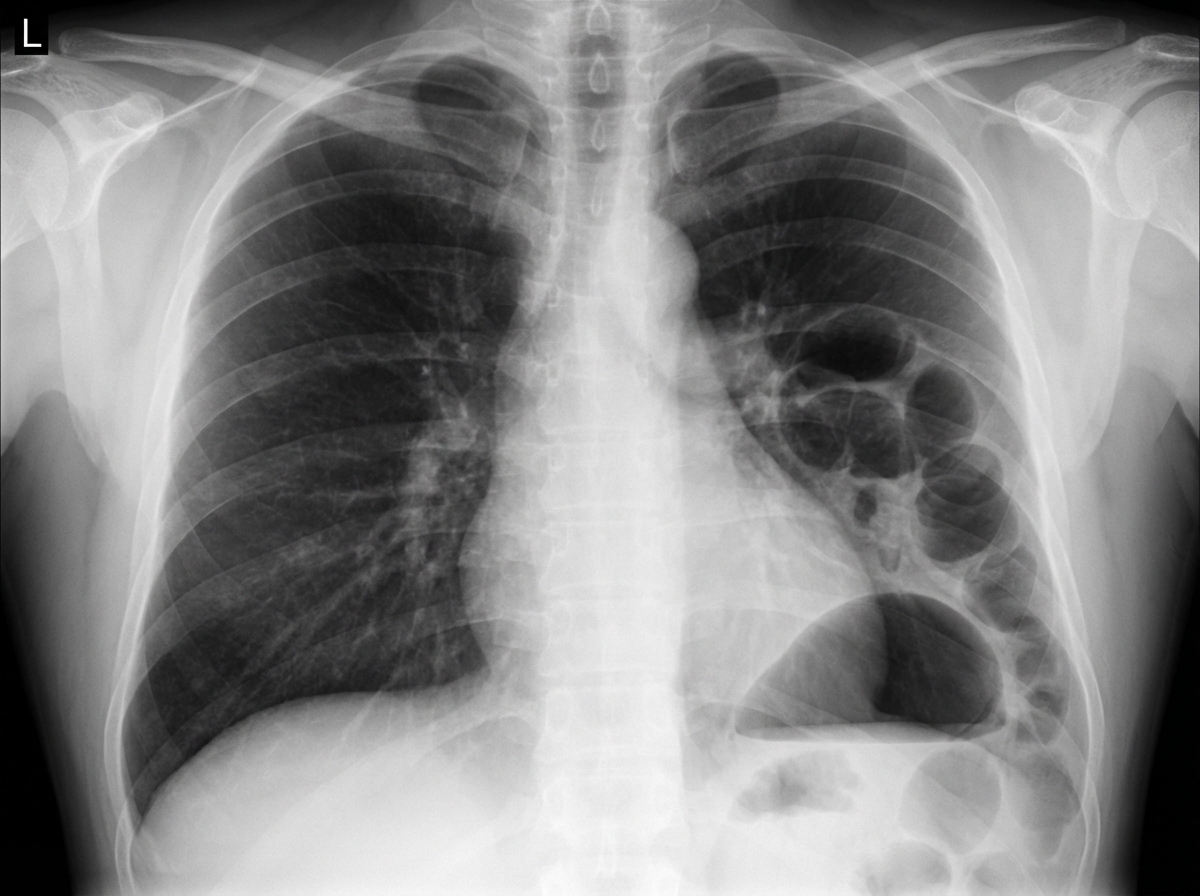
A 28-year-old man is brought to the emergency department with shortness of breath and chest pain, 35 minutes after he was involved in a high-speed motor vehicle collision. He was the helmeted driver of a scooter hit by a truck. On arrival, he is alert and oriented with a Glasgow Coma Scale rating of 14. His temperature is 37.3°C (99.1°F), pulse is 103/min, respirations are 33/min and blood pressure is 132/88 mm Hg. Pulse oximetry on room air shows an oxygen saturation of 94%. Examination shows multiple abrasions over his abdomen and extremities. There is a 2.5-cm (1-in) laceration on the left side of the chest. There are decreased breath sounds over the left base. Cardiac examination shows no abnormalities. The abdomen is soft and there is tenderness to palpation over the left upper quadrant. Bowel sounds are normal. His hemoglobin concentration is 13.6 g/dL, leukocyte count is 9,110/mm3, and platelet count is 190,000/mm3. A chest x-ray is shown. Which of the following is the most likely diagnosis?
A 62-year-old man comes to the physician in May for a routine health maintenance examination. He feels well. He underwent a right inguinal hernia repair 6 months ago. He has hypertension and type 2 diabetes mellitus. There is no family history of serious illness. Current medications include metformin, sitagliptin, enalapril, and metoprolol. He received the zoster vaccine 1 year ago. He received the PPSV23 vaccine 4 years ago. His last colonoscopy was 7 years ago and was normal. He smoked a pack of cigarettes a day for 20 years but quit 17 years ago. He drinks two to three alcoholic beverages on weekends. He is allergic to amoxicillin. He is scheduled to visit Australia and New Zealand in 2 weeks to celebrate his 25th wedding anniversary. He appears healthy. Vital signs are within normal limits. An S4 is heard at the apex. The remainder of the examination shows no abnormalities. Which of the following is the most appropriate recommendation at this time?
A 27-year-old man presents to the emergency department after being stabbed. The patient was robbed at a local pizza parlor and was stabbed over 10 times with a large kitchen knife with an estimated 7 inch blade in the ventral abdomen. His temperature is 97.6°F (36.4°C), blood pressure is 74/54 mmHg, pulse is 180/min, respirations are 19/min, and oxygen saturation is 98% on room air. The patient is intubated and given blood products and vasopressors. Physical exam is notable for multiple stab wounds over the patient's abdomen inferior to the nipple line. Which of the following is the best next step in management?
A 68-year-old man comes to the physician because of recurrent episodes of nausea and abdominal discomfort for the past 4 months. The discomfort is located in the upper abdomen and sometimes occurs after eating, especially after a big meal. He has tried to go for a walk after dinner to help with digestion, but his complaints have only increased. For the past 3 weeks he has also had symptoms while climbing the stairs to his apartment. He has type 2 diabetes mellitus, hypertension, and stage 2 peripheral arterial disease. He has smoked one pack of cigarettes daily for the past 45 years. He drinks one to two beers daily and occasionally more on weekends. His current medications include metformin, enalapril, and aspirin. He is 168 cm (5 ft 6 in) tall and weighs 126 kg (278 lb); BMI is 45 kg/m2. His temperature is 36.4°C (97.5°F), pulse is 78/min, and blood pressure is 148/86 mm Hg. On physical examination, the abdomen is soft and nontender with no organomegaly. Foot pulses are absent bilaterally. An ECG shows no abnormalities. Which of the following is the most appropriate next step in diagnosis?
A 25-year-old woman presents to a physician for a new patient physical exam. Aside from occasional shin splints, she has a relatively unremarkable medical history. She takes oral contraceptive pills as scheduled and a multivitamin daily. She reports no known drug allergies. All of her age appropriate immunizations are up to date. Her periods have been regular, occurring once every 28 to 30 days with normal flow. She is sexually active with two partners, who use condoms routinely. She works as a cashier at the local grocery store. Her mother has diabetes and coronary artery disease, and her father passed away at age 45 after being diagnosed with colon cancer at age 40. Her grand-aunt underwent bilateral mastectomies after being diagnosed with breast cancer at age 60. Her physical exam is unremarkable. Which of the following is the best recommendation for this patient?
A 32-year-old man is brought to the emergency department after a skiing accident. The patient had been skiing down the mountain when he collided with another skier who had stopped suddenly in front of him. He is alert but complaining of pain in his chest and abdomen. He has a past medical history of intravenous drug use and peptic ulcer disease. He is a current smoker. His temperature is 97.4°F (36.3°C), blood pressure is 77/53 mmHg, pulse is 127/min, and respirations are 13/min. He has a GCS of 15 and bilateral shallow breath sounds. His abdomen is soft and distended with bruising over the epigastrium. He is moving all four extremities and has scattered lacerations on his face. His skin is cool and delayed capillary refill is present. Two large-bore IVs are placed in his antecubital fossa, and he is given 2L of normal saline. His FAST exam reveals fluid in Morison's pouch. Following the 2L normal saline, his temperature is 97.5°F (36.4°C), blood pressure is 97/62 mmHg, pulse is 115/min, and respirations are 12/min. Which of the following is the best next step in management?
A 68-year-old man comes to the emergency department because of sudden onset abdominal pain for 6 hours. On a 10-point scale, he rates the pain as a 8 to 9. The abdominal pain is worst in the right upper quadrant. He has atrial fibrillation and hyperlipidemia. His temperature is 38.7° C (101.7°F), pulse is 110/min, and blood pressure is 146/86 mm Hg. The patient appears acutely ill. Physical examination shows a distended abdomen and tenderness to palpation in all quadrants with guarding, but no rebound. Murphy's sign is positive. Right upper quadrant ultrasound shows thickening of the gallbladder wall, sludging in the gallbladder, and pericolic fat stranding. He is admitted for acute cholecystitis and grants permission for cholecystectomy. His wife is his healthcare power of attorney (POA), but she is out of town on a business trip. He is accompanied today by his brother. After induction and anesthesia, the surgeon removes the gallbladder but also finds a portion of the small intestine is necrotic due to a large thromboembolism occluding a branch of the superior mesenteric artery. The treatment is additional surgery with small bowel resection and thromboendarterectomy. Which of the following is the most appropriate next step in management?
A 63-year-old man undergoes workup for nocturnal dyspnea and what he describes as a "choking" sensation while sleeping. He also endorses fatigue and dyspnea on exertion. Physical exam reveals a normal S1, loud P2, and a neck circumference of 17 inches (43 cm) (normal < 14 inches (< 35 cm)). His temperature is 98.8°F (37°C), blood pressure is 128/82 mmHg, pulse is 86/min, and respirations are 19/min. He undergoes spirometry, which is unrevealing, and polysomnography, which shows 16 hypopneic and apneic events per hour. Mean pulmonary arterial pressure is 30 mmHg. Which of the following complications is this patient most at risk for?
A 45-year-old woman comes to the emergency department complaining of abdominal pain for the past day. The pain is situated in the right upper quadrant, colicky, 8/10, and radiates to the tip of the right shoulder with no aggravating or relieving factors. The pain is associated with nausea but no vomiting. She tried to take over-the-counter antacids which relieved her pain to a certain extent, but not entirely. She does not smoke cigarettes or drink alcohol. She has no past medical illness. Her father died of pancreatic cancer at the age of 75, and her mother has diabetes controlled with medications. Temperature is 38°C (100.4°F), blood pressure is 125/89 mm Hg, pulse is 104/min, respiratory rate is 20/min, and BMI is 29 kg/m2. On abdominal examination, her abdomen is tender to shallow and deep palpation of the right upper quadrant. Laboratory test Complete blood count Hemoglobin 13 g/dL WBC 15,500/mm3 Platelets 145,000/mm3 Basic metabolic panel Serum Na+ 137 mEq/L Serum K+ 3.6 mEq/L Serum Cl- 95 mEq/L Serum HCO3- 25 mEq/L BUN 10 mg/dL Serum creatinine 0.8 mg/dL Liver function test Total bilirubin 1.3 mg/dL AST 52 U/L ALT 60 U/L Ultrasonography of the abdomen shows normal findings. What is the best next step in management of this patient?
A 32-year-old woman undergoes laparoscopic excision of ovarian endometrioma. During surgery with the patient in Trendelenburg position and pneumoperitoneum at 15 mmHg, the anesthesiologist notes peak airway pressures rising from 25 to 40 cmH2O, oxygen saturation dropping to 88%, and blood pressure decreasing. Apply the appropriate immediate intervention.
Want unlimited practice?
Get full access to all questions, explanations, and performance tracking.
Scan to download app