
Endoscopic procedures overview — MCQs

A 62-year-old man comes to the office complaining of dysphagia that started 4-5 months ago. He reports that he initially had difficulty swallowing only solid foods. More recently, he has noticed some trouble swallowing liquids. The patient also complains of fatigue, a chronic cough that worsens at night, and burning chest pain that occurs after he eats. He says that he has used over-the-counter antacids for "years" with mild relief. He denies any change in diet, but says he has "gone down a pant size or 2." The patient has hypertension and hyperlipidemia. He takes amlodipine and atorvastatin. He smoked 1 pack of cigarettes a day for 12 years while in the military but quit 35 years ago. He drinks 1-2 beers on the weekend while he is golfing with his friends. His diet consists mostly of pasta, pizza, and steak. The patient's temperature is 98°F (36.7°C), blood pressure is 143/91 mmHg, and pulse is 80/min. His BMI is 32 kg/m^2. Physical examination reveals an obese man in no acute distress. No masses or enlarged lymph nodes are appreciated upon palpation of the neck. Cardiopulmonary examination is unremarkable. An endoscopy is performed, which identifies a lower esophageal mass. Which of the following is the most likely diagnosis?
A 4-year-old boy presents to the emergency department after his parents found him drinking blue liquid out of an unlabeled bottle in the garage. They have no idea what was in the bottle and are concerned for his health. They have brought the bottle with them to the emergency department. The child's past medical history is not remarkable, and he is currently not taking any medications. The patient's vitals are within normal limits for his age. Physical exam reveals a crying child who is drooling. A radiograph is performed, and the child's vitals are closely monitored. It is determined that the blue liquid is a strong alkali. Which of the following is the best next step in management?
A 28-year-old graduate student visits the university health clinic for 3-weeks of epigastric pain that worsens with meals, associated with retrosternal pain, early satiety, and bloating. She denies vomiting blood or blood in her stool. She has been consuming large volumes of caffeinated-drinks and fast-food for a month, as she has been studying for her tests. Her family and personal history are unremarkable with no history of gastrointestinal cancer. Her vital signs are within normal limits. Physical examination is only positive for a mild epigastric tenderness. Which of the following is the most appropriate approach in this case?
A 66-year-old man was referred for endoscopic evaluation due to iron deficiency anemia. He has had anorexia and weight loss for two months. Three years ago, the patient had coronary artery bypass grafting and aortic mechanical valve replacement. He has a 12-year history of diabetes mellitus and hypertension. He takes warfarin, lisinopril, amlodipine, metformin, aspirin, and carvedilol. His blood pressure is 115/65 mm Hg, pulse is 68/min, respirations are 14/min, temperature is 36.8°C (98.2°F), and blood glucose is 220 mg/dL. Conjunctivae are pale. Heart examination reveals a metallic click just before the carotid pulse. Which of the following is the most appropriate switch in this patient’s drug therapy before the endoscopy?
A 45-year-old man undergoes elective vasectomy for permanent contraception. The procedure is performed under local anesthesia. There are no intra-operative complications and he is discharged home with ibuprofen for post-operative pain. This patient is at increased risk for which of the following complications?
A 55-year-old man presents to his primary care physician for trouble swallowing. The patient claims that he used to struggle when eating food if he did not chew it thoroughly, but now he occasionally struggles with liquids as well. He also complains of a retrosternal burning sensation whenever he eats. He also claims that he feels his throat burns when he lays down or goes to bed. Otherwise, the patient has no other complaints. The patient has a past medical history of obesity, diabetes, constipation, and anxiety. His current medications include insulin, metformin, and lisinopril. On review of systems, the patient endorses a 5 pound weight loss recently. The patient has a 22 pack-year smoking history and drinks alcohol with dinner. His temperature is 99.5°F (37.5°C), blood pressure is 177/98 mmHg, pulse is 90/min, respirations are 17/min, and oxygen saturation is 98% on room air. On physical exam, you note an overweight man in no current distress. Abdominal exam is within normal limits. Which of the following is the best next step in management?
A 65-year-old African-American man presents to your office with dysphagia. He reports that he has found it progressively more difficult to swallow food over the past year. At the time of presentation, he is able to eat only soup. Social history is significant for asbestos exposure, multiple daily drinks of hard alcohol, and a 70 pack-year smoking history. What would you most expect to see on an esophageal biopsy of this patient?
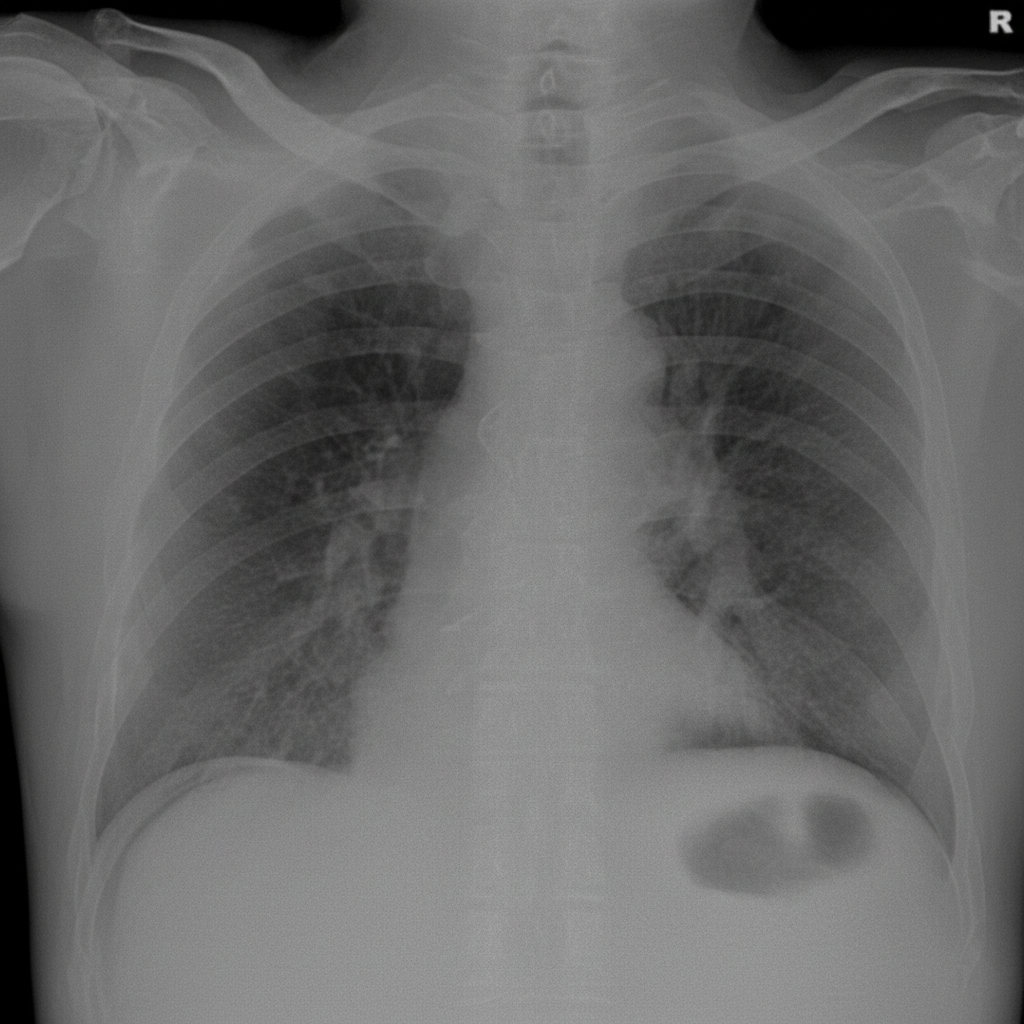
A 56-year-old man is brought to the emergency department after 4 hours of severe abdominal pain with an increase in its intensity over the last hour. His personal history is relevant for peptic ulcer disease and H. pylori infection that is being treated with clarithromycin triple therapy. Upon admission his vital signs are as follows: pulse of 120/min, a respiratory rate of 20/min, body temperature of 39°C (102.2°F), and blood pressure of 90/50 mm Hg. Physical examination reveals significant tenderness over the abdomen. A chest radiograph taken when the patient was standing erect is shown. Which of the following is the next best step in the management of this patient?
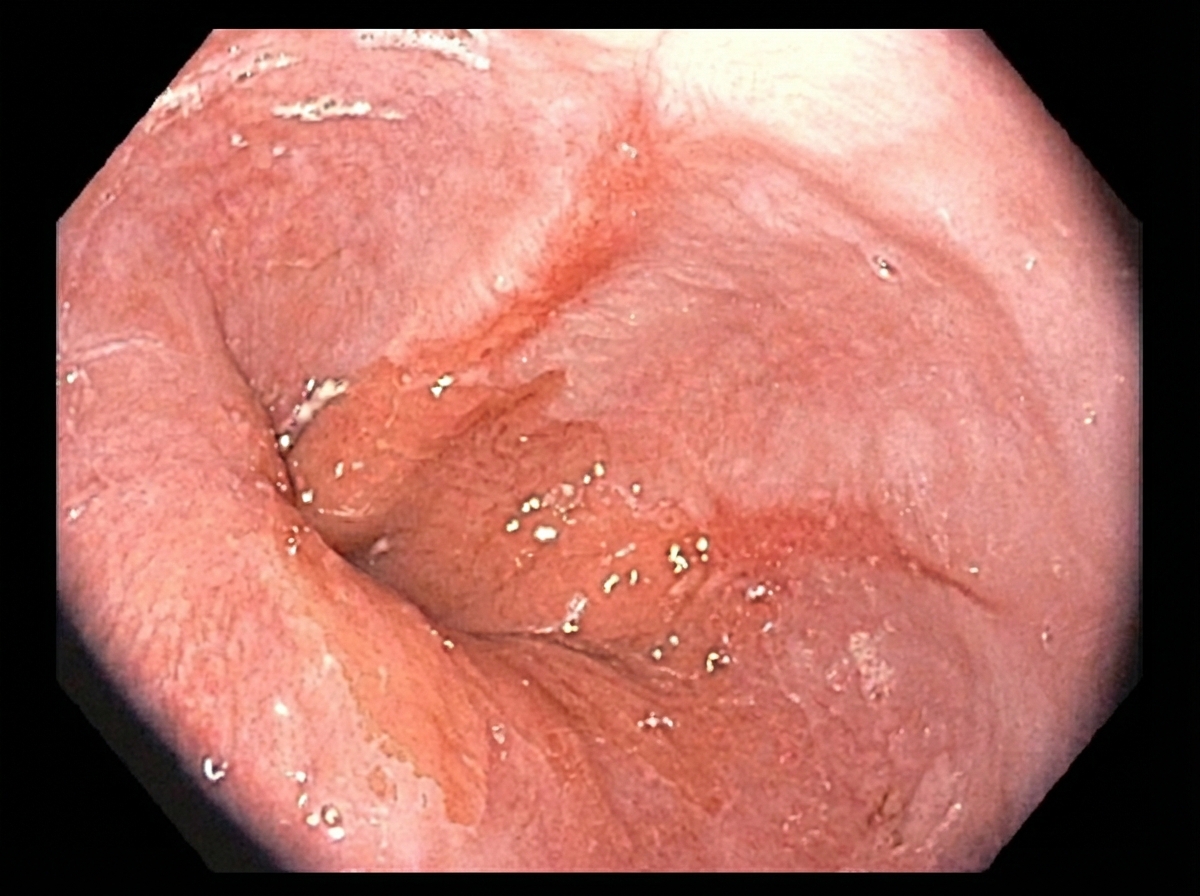
A 55-year-old man comes to the physician because of heartburn for the past 2 years. He has no chest pain, dysphagia, weight loss, or fever. He has no history of any serious illnesses. He takes omeprazole daily. Vital signs are within normal limits. Body mass index (BMI) is 34 kg/m2. Physical exam shows no abnormalities. An endoscopic image of the lower esophageal sphincter is shown. Which of the following is the most important next step in management?
A 50-year-old male presents to the emergency with abdominal pain. He reports he has had abdominal pain associated with meals for several months and has been taking over the counter antacids as needed, but experienced significant worsening pain one hour ago in the epigastric region. The patient reports the pain radiating to his shoulders. Vital signs are T 38, HR 120, BP 100/60, RR 18, SpO2 98%. Physical exam reveals diffuse abdominal rigidity with rebound tenderness. Auscultation reveals hypoactive bowel sounds. Which of the following is the next best step in management?
Want unlimited practice?
Get full access to all questions, explanations, and performance tracking.
Scan to download app