
Conversion to open surgery criteria — MCQs

A 43-year-old Caucasian woman is admitted to the hospital with acute onset right upper quadrant (RUQ) pain. The pain started 6 hours ago after the patient had a large meal at a birthday party and has progressively worsened. She recalls having similar pain before but not so intense. No significant past medical history. Current medications are only oral contraceptive. Vitals are blood pressure 140/80 mm Hg, heart rate 79/min, respiratory rate 14/min, and temperature 37.6℃ (99.7℉). The patient’s BMI is 36.3 kg/m2. On exam, the patient appears slightly jaundiced. Her cardiac and respiratory examinations are within normal limits. Abdominal palpation reveals tenderness to palpation in the RUQ with no rebound or guarding, and there is an inspiratory arrest on deep palpation in this region. The remainder of the examination is within normal limits. Laboratory tests are significant for the following: RBC count 4.1 million/mm3 Hb 13.4 mg/dL Leukocyte count 11,200/mm3 ESR 22 mm/hr Platelet count 230,000/mm3 Total bilirubin 2 mg/dL Direct bilirubin 1.1 mg/dL ALT 20 IU/L AST 18 IU/L Amylase 33 IU/L Ultrasound of the abdomen shows the following result (see image): The common bile duct (CBD) (not shown in the image) is not dilated. Which of the following procedures is most appropriate for the treatment of this patient?
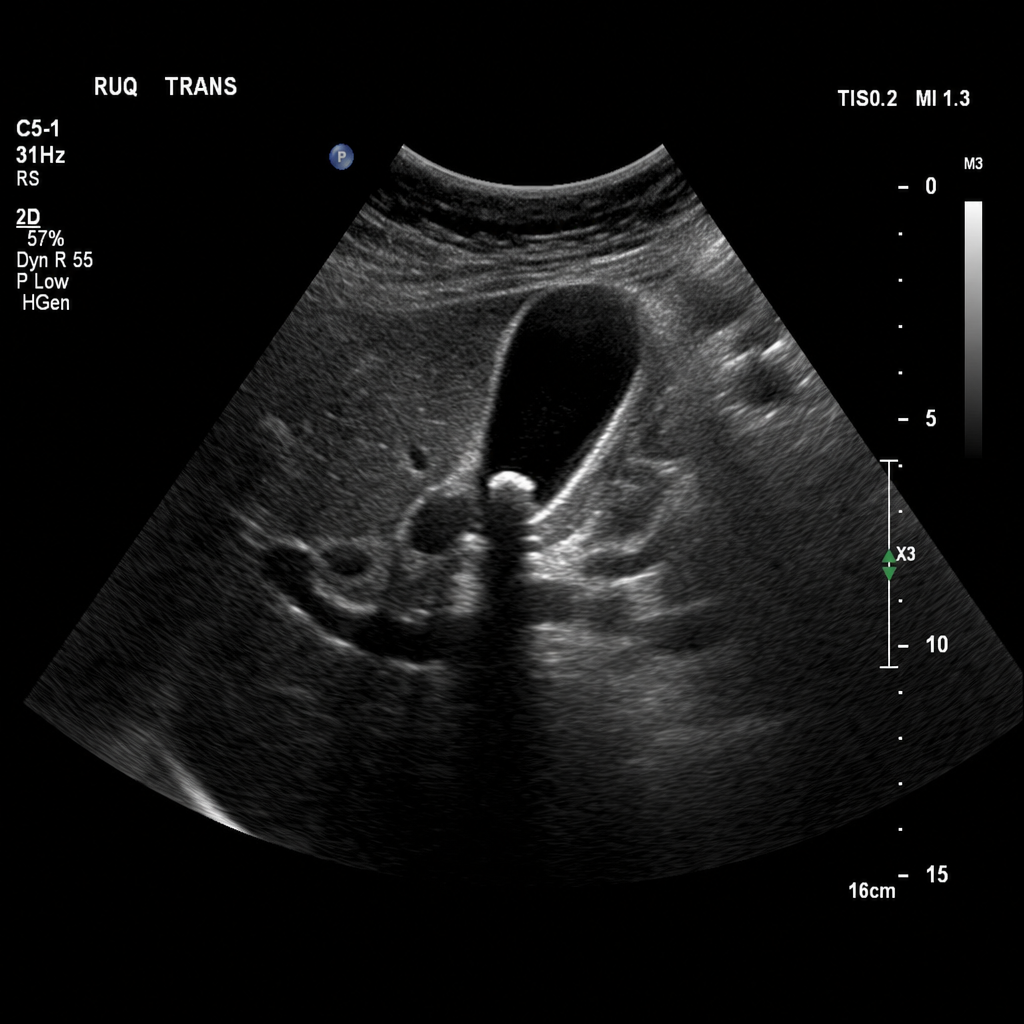
A 34-year-old patient presents with severe pain in the right upper quadrant that radiates to the right shoulder. During laparoscopic cholecystectomy, which of the following anatomical spaces must be carefully identified to prevent bile duct injury?
A 63-year-old woman is brought to the emergency department because of severe abdominal pain and vomiting for 3 hours. She had previous episodes of abdominal pain that lasted for 10–15 minutes and resolved with antacids. She lives with her daughter and grandchildren. She divorced her husband last year. She is alert and oriented. Her temperature is 37.3°C (99.1°F), pulse is 134/min, and blood pressure is 90/70 mm Hg. The abdomen is rigid and diffusely tender. Guarding and rebound tenderness are present. Rectal examination shows a collapsed rectum. Infusion of 0.9% saline is begun and a CT of the abdomen shows intestinal perforation. The surgeon discusses the need for emergent exploratory laparotomy with the patient and she agrees to it. Written informed consent is obtained. While in the holding area awaiting emergent transport to the operating room, she calls for the surgeon and informs him that she no longer wants the surgery. He explains the risks of not performing the surgery to her and she indicates she understands but is adamant about not proceeding with surgery. Which of the following is the most appropriate next step in management?
An epidemiologist is evaluating the efficacy of Noxbinle in preventing HCC deaths at the population level. A clinical trial shows that over 5 years, the mortality rate from HCC was 25% in the control group and 15% in patients treated with Noxbinle 100 mg daily. Based on this data, how many patients need to be treated with Noxbinle 100 mg to prevent, on average, one death from HCC?
A 62-year-old woman presents to her primary care physician for a routine physical exam. The patient has no specific complaints but does comment on some mild weight gain. She reports that she recently retired from her job as a math teacher and has taken up hiking. Despite the increase in activity, she believes her pants have become "tighter." She denies headaches, urinary symptoms, or joint pains. She has a history of hypertension, type 2 diabetes, and rheumatoid arthritis. Her medications include aspirin, lisinopril, rovastatin, metformin, and methotrexate. She takes her medications as prescribed and is up to date with her vaccinations. A colonoscopy two years ago and a routine mammography last year were both normal. The patient’s last menstrual period was 10 years ago. The patient has a father who died of colon cancer at 71 years of age and a mother who has breast cancer. Her temperature is 98.7°F (37°C), blood pressure is 132/86 mmHg, pulse is 86/min, respirations are 14/min and oxygen saturation is 98% on room air. Physical exam is notable for a mildly distended abdomen and a firm and non-mobile right adnexal mass. What is the next step in the management of this patient?
A 68-year-old man comes to the emergency department because of sudden onset abdominal pain for 6 hours. On a 10-point scale, he rates the pain as a 8 to 9. The abdominal pain is worst in the right upper quadrant. He has atrial fibrillation and hyperlipidemia. His temperature is 38.7° C (101.7°F), pulse is 110/min, and blood pressure is 146/86 mm Hg. The patient appears acutely ill. Physical examination shows a distended abdomen and tenderness to palpation in all quadrants with guarding, but no rebound. Murphy's sign is positive. Right upper quadrant ultrasound shows thickening of the gallbladder wall, sludging in the gallbladder, and pericolic fat stranding. He is admitted for acute cholecystitis and grants permission for cholecystectomy. His wife is his healthcare power of attorney (POA), but she is out of town on a business trip. He is accompanied today by his brother. After induction and anesthesia, the surgeon removes the gallbladder but also finds a portion of the small intestine is necrotic due to a large thromboembolism occluding a branch of the superior mesenteric artery. The treatment is additional surgery with small bowel resection and thromboendarterectomy. Which of the following is the most appropriate next step in management?
A 28-year-old male presents to his primary care physician with complaints of intermittent abdominal pain and alternating bouts of constipation and diarrhea. His medical chart is not significant for any past medical problems or prior surgeries. He is not prescribed any current medications. Which of the following questions would be the most useful next question in eliciting further history from this patient?
A 32-year-old male asks his physician for information regarding a vasectomy. On further questioning, you learn that he and his wife have just had their second child and he asserts that they no longer wish to have additional pregnancies. You ask him if he has discussed a vasectomy with his wife to which he replies, "Well, not yet, but I'm sure she'll agree." What is the next appropriate step prior to scheduling the patient's vasectomy?
A 31-year-old woman is brought to the emergency department 25 minutes after sustaining a gunshot wound to the neck. She did not lose consciousness. On arrival, she has severe neck pain. She appears anxious. Her temperature is 37°C (98.6°F), pulse is 105/min, respirations are 25/min, and blood pressure is 100/70 mm Hg. Pulse oximetry on room air shows an oxygen saturation of 96%. She is oriented to person, place, and time. Examination shows a bullet entrance wound in the right posterior cervical region of the neck. There is no exit wound. Carotid pulses are palpable bilaterally. There are no carotid bruits. Sensation to pinprick and light touch is normal. The lungs are clear to auscultation. Cardiac examination shows no murmurs, rubs, or gallops. In addition to intravenous fluid resuscitation, which of the following is the most appropriate next step in the management of this patient?
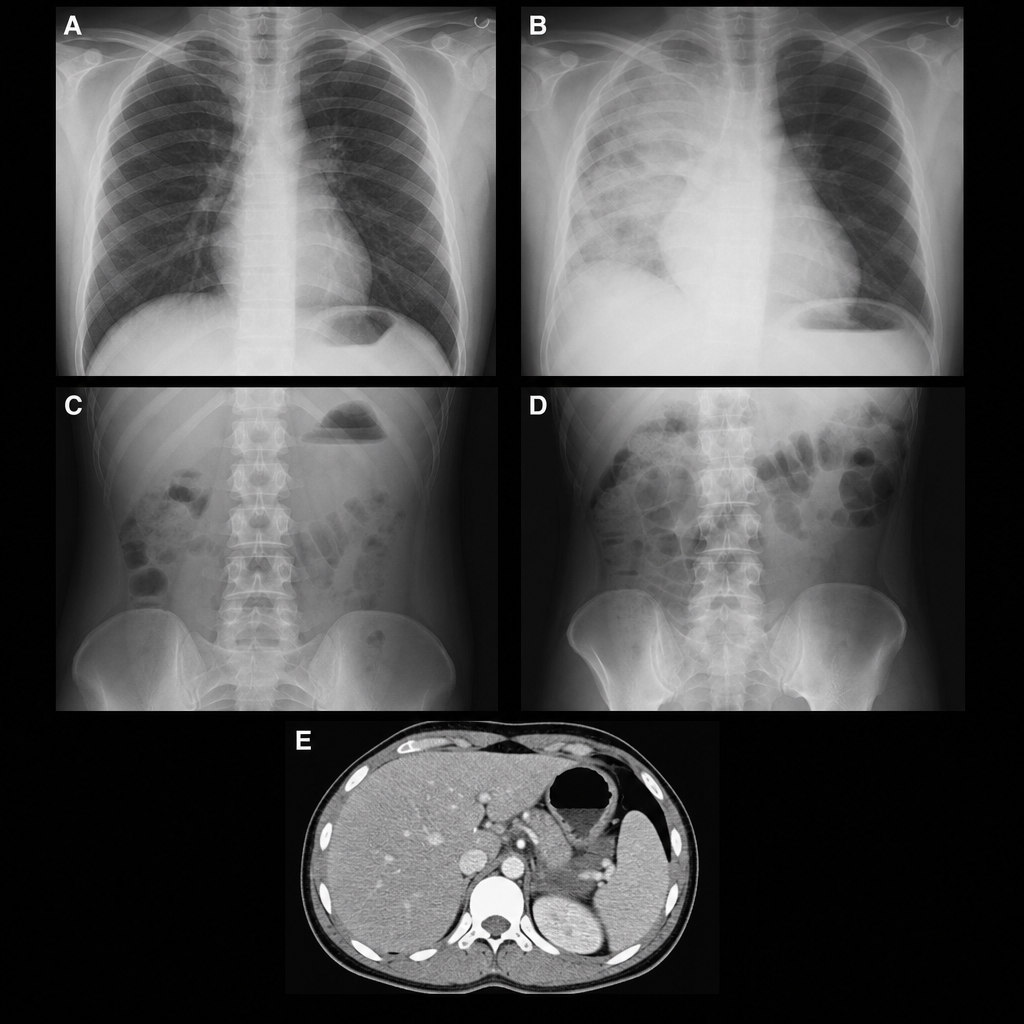
A 24-year-old male is brought in by fire rescue after being the restrained driver in a motor vehicle accident. There was a prolonged extraction. At the scene, the patient was GCS 13. The patient was boarded and transported. In the trauma bay, vitals are T 97.2°F, HR 132 bpm, BP 145/90 mmHg, RR 22/min, and O2 Sat 100%. ABCs are intact with a GCS of 15, and on secondary survey you note the following (Figure F). FAST exam is positive at Morrison's pouch. Abdominal exam shows exquisite tenderness to palpation with rebound and guarding. Which of the following radiographs is most likely to be present in this patient?
Want unlimited practice?
Get full access to all questions, explanations, and performance tracking.
Scan to download app