
Complications of minimally invasive surgery — MCQs

A 33-year-old woman comes to the emergency department because of a 1-hour history of severe pelvic pain and nausea. She was diagnosed with a follicular cyst in the left ovary 3 months ago. The cyst was found incidentally during a fertility evaluation. A pelvic ultrasound with Doppler flow shows an enlarged, edematous left ovary with no blood flow. Laparoscopic evaluation shows necrosis of the left ovary, and a left oophorectomy is performed. During the procedure, blunt dissection of the left infundibulopelvic ligament is performed. Which of the following structures is most at risk of injury during this step of the surgery?
A 63-year-old woman is brought to the emergency department because of severe abdominal pain and vomiting for 3 hours. She had previous episodes of abdominal pain that lasted for 10–15 minutes and resolved with antacids. She lives with her daughter and grandchildren. She divorced her husband last year. She is alert and oriented. Her temperature is 37.3°C (99.1°F), pulse is 134/min, and blood pressure is 90/70 mm Hg. The abdomen is rigid and diffusely tender. Guarding and rebound tenderness are present. Rectal examination shows a collapsed rectum. Infusion of 0.9% saline is begun and a CT of the abdomen shows intestinal perforation. The surgeon discusses the need for emergent exploratory laparotomy with the patient and she agrees to it. Written informed consent is obtained. While in the holding area awaiting emergent transport to the operating room, she calls for the surgeon and informs him that she no longer wants the surgery. He explains the risks of not performing the surgery to her and she indicates she understands but is adamant about not proceeding with surgery. Which of the following is the most appropriate next step in management?
A 34-year-old woman is recovering in the post-operative unit following a laparoscopic procedure for chronic endometriosis. She had initially presented with complaints of painful menstrual cramps that kept her bedridden most of the day. She also mentioned to her gynecologist that she had been diagnosed with endometriosis 4 years ago, and she could not find a medication or alternative therapeutic measure that helped. Her medical history was significant for surgery she had 6 years ago to remove tumors she had above her kidneys, after which she was prescribed hydrocortisone. An hour after the laparoscopic procedure, she calls the nurse because she is having difficulty breathing. The nurse records her vital signs include: blood pressure 85/55 mm Hg, respirations 20/min, and pulse 115/min. The patient suddenly loses consciousness. Intravenous fluids are started immediately. She gains consciousness, but her blood pressure is unchanged. Which of the following is the most likely cause of the hypotension?
Two hours after undergoing elective cholecystectomy with general anesthesia, a 41-year-old woman is evaluated for decreased mental status. BMI is 36.6 kg/m2. Respirations are 18/min and blood pressure is 126/73 mm Hg. Physical examination shows the endotracheal tube in normal position. She does not respond to sternal rub and gag reflex is absent. Arterial blood gas analysis on room air shows normal PO2 and PCO2 levels. Which of the following anesthetic properties is the most likely cause of these findings?
A 52-year-old woman is brought to the emergency department by fire and rescue after being involved in a motor vehicle accident. The paramedics report that the patient’s car slipped off the road during a rainstorm and rolled into a ditch. The patient was restrained and the airbags deployed during the crash. The patient has a past medical history of hypertension, hyperlipidemia, hypothyroidism, and gout. Her home medications include hydrochlorothiazide, simvastatin, levothyroxine, and allopurinol. The patient is alert on the examination table. Her temperature is 98.2°F (36.8°C), blood pressure is 83/62 mmHg, pulse is 131/min, respirations are 14/min, and SpO2 is 96%. She has equal breath sounds in all fields bilaterally. Her skin is cool with diffuse bruising over her abdomen and superficial lacerations, and her abdomen is diffusely tender to palpation. She is moving all four extremities equally. The patient’s FAST exam is equivocal. She is given several liters of intravenous fluid during her trauma evaluation but her blood pressure does not improve. Which of the following is the best next step?
A 63-year-old man is brought to the emergency department, 30 minutes after being involved in a high-speed motor vehicle collision. He is obtunded on arrival. He is intubated and mechanical ventilation is begun. The ventilator is set at a FiO2 of 60%, tidal volume of 440 mL, and positive end-expiratory pressure of 4 cm H2O. On the third day of intubation, his temperature is 37.3°C (99.1°F), pulse is 91/min, and blood pressure is 103/60 mm Hg. There are decreased breath sounds over the left lung base. Cardiac examination shows no abnormalities. The abdomen is soft and not distended. Arterial blood gas analysis shows: pH 7.49 pCO2 29 mm Hg pO2 73 mm Hg HCO3- 20 mEq/L O2 saturation 89% Monitoring shows a sudden increase in the plateau airway pressure. An x-ray of the chest shows deepening of the costophrenic angle on the left side. Which of the following is the most appropriate next step in management?
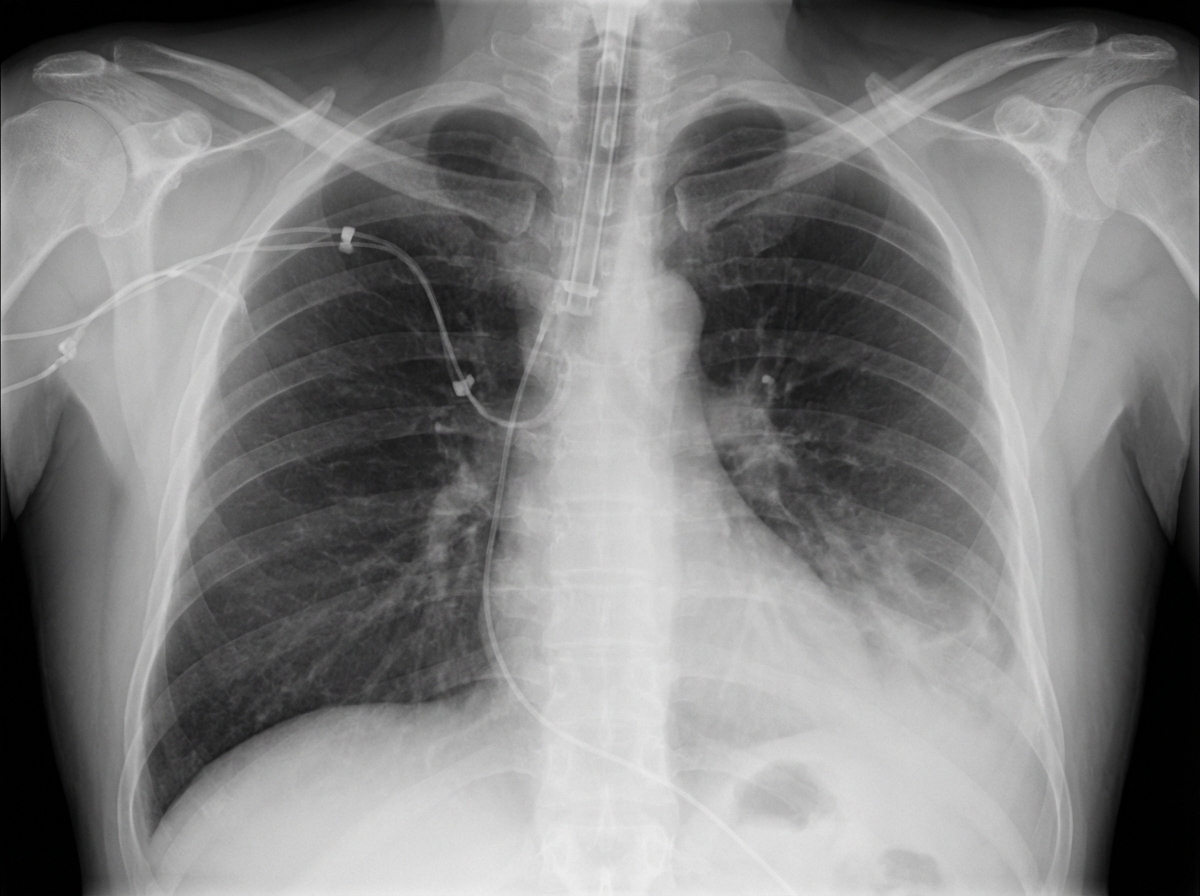
A 35-year-old man presents to pulmonary function clinic for preoperative evaluation for a right pneumonectomy. His arterial blood gas at room air is as follows: pH: 7.34 PaCO2: 68 mmHg PaO2: 56 mmHg Base excess: +1 O2 saturation: 89% What underlying condition most likely explains these findings?
A 32-year-old man is brought to the emergency department after a skiing accident. The patient had been skiing down the mountain when he collided with another skier who had stopped suddenly in front of him. He is alert but complaining of pain in his chest and abdomen. He has a past medical history of intravenous drug use and peptic ulcer disease. He is a current smoker. His temperature is 97.4°F (36.3°C), blood pressure is 77/53 mmHg, pulse is 127/min, and respirations are 13/min. He has a GCS of 15 and bilateral shallow breath sounds. His abdomen is soft and distended with bruising over the epigastrium. He is moving all four extremities and has scattered lacerations on his face. His skin is cool and delayed capillary refill is present. Two large-bore IVs are placed in his antecubital fossa, and he is given 2L of normal saline. His FAST exam reveals fluid in Morison's pouch. Following the 2L normal saline, his temperature is 97.5°F (36.4°C), blood pressure is 97/62 mmHg, pulse is 115/min, and respirations are 12/min. Which of the following is the best next step in management?
A 30-year-old male gang member is brought to the emergency room with a gunshot wound to the abdomen. The patient was intubated and taken for an exploratory laparotomy, which found peritoneal hemorrhage and injury to the small bowel. He required 5 units of blood during this procedure. Following the operation, the patient was sedated and remained on a ventilator in the surgical intensive care unit (SICU). The next day, a central line is placed and the patient is started on total parenteral nutrition. Which of the following complications is most likely in this patient?
A 45-year-old man presents to the emergency department because of fever and scrotal pain for 2 days. Medical history includes diabetes mellitus and morbid obesity. His temperature is 40.0°C (104.0°F), the pulse is 130/min, the respirations are 35/min, and the blood pressure is 90/68 mm Hg. Physical examination shows a large area of ecchymosis, edema, and crepitus in his perineal area. Fournier gangrene is suspected. A right internal jugular central venous catheter is placed without complication under ultrasound guidance for vascular access in preparation for the administration of vasopressors. Which of the following is the most appropriate next step?
Want unlimited practice?
Get full access to all questions, explanations, and performance tracking.
Scan to download app