
Ostomy creation and management — MCQs

A 14-year-old girl is brought to the physician because she frequently experiences cramping and pain in her legs during school sports. She is at the 10th percentile for height. Her blood pressure is 155/90 mm Hg. Examination shows a high-arched palate with maloccluded teeth and a low posterior hairline. The patient has a broad chest with widely spaced nipples. Pelvic examination shows normal external female genitalia with scant pubic hair. Without appropriate treatment, this patient is at the greatest risk of developing which of the following complications?
A 56-year-old man is seen in the hospital for a chief complaint of intense thirst and polyuria. His history is significant for recent transsphenoidal resection of a pituitary adenoma. With regard to the man's fluid balance, which of the following would be expected?
An 82-year-old woman presents with 2 months of foul-smelling, greasy diarrhea. She says that she also has felt very tired recently and has had some associated bloating and flatus. She denies any recent abdominal pain, nausea, melena, hematochezia, or vomiting. She also denies any history of recent travel and states that her home has city water. Which of the following tests would be most appropriate to initially work up the most likely diagnosis in this patient?
A 36-year-old African American G1P0010 presents to her gynecologist for an annual visit. She has a medical history of hypertension, for which she takes hydrochlorothiazide. The patient’s mother had breast cancer at age 68, and her sister has endometriosis. At this visit, the patient’s temperature is 98.6°F (37.0°C), blood pressure is 138/74 mmHg, pulse is 80/min, and respirations are 13/min. Her BMI is 32.4 kg/m^2. Pelvic exam reveals a nontender, 16-week sized uterus with an irregular contour. A transvaginal ultrasound is performed and demonstrates a submucosal leiomyoma. This patient is at most increased risk of which of the following complications?
A 63-year-old woman comes to the physician because of diarrhea and weakness after her meals for 2 weeks. She has the urge to defecate 15–20 minutes after a meal and has 3–6 bowel movements a day. She also has palpitations, sweating, and needs to lie down soon after eating. One month ago, she underwent a distal gastrectomy for gastric cancer. She had post-operative pneumonia, which was treated with cefotaxime. She returned from a vacation to Brazil 6 weeks ago. Her immunizations are up-to-date. She is 165 cm (5 ft 5 in) tall and weighs 51 kg (112 lb); BMI is 18.6 kg/m2. Vital signs are within normal limits. Examination shows a well-healed abdominal midline surgical scar. The abdomen is soft and nontender. Bowel sounds are hyperactive. Rectal examination is unremarkable. Which of the following is the most appropriate next step in management?
A 54-year-old man comes to the physician because of diarrhea that has become progressively worse over the past 4 months. He currently has 4–6 episodes of foul-smelling stools per day. Over the past 3 months, he has had fatigue and a 5-kg (11-lb) weight loss. He returned from Bangladesh 6 months ago after a year-long business assignment. He has osteoarthritis and hypertension. Current medications include amlodipine and naproxen. He appears pale and malnourished. His temperature is 37.3°C (99.1°F), pulse is 76/min, and blood pressure is 140/86 mm Hg. Examination shows pale conjunctivae and dry mucous membranes. Angular stomatitis and glossitis are present. The abdomen is distended but soft and nontender. Rectal examination shows no abnormalities. Laboratory studies show: Hemoglobin 8.9 g/dL Leukocyte count 4100/mm3 Platelet count 160,000/mm3 Mean corpuscular volume 110 μm3 Serum Na+ 133 mEq/L Cl- 98 mEq/l K+ 3.3 mEq/L Creatinine 1.1 mg/dL IgA 250 mg/dL Anti-tissue transglutaminase, IgA negative Stool culture and studies for ova and parasites are negative. Test of the stool for occult blood is negative. Fecal fat content is 22 g/day (N < 7). Fecal lactoferrin is negative and elastase is within normal limits. Which of the following is the most appropriate next step in diagnosis?
A 28-year-old male presents to his primary care physician with complaints of intermittent abdominal pain and alternating bouts of constipation and diarrhea. His medical chart is not significant for any past medical problems or prior surgeries. He is not prescribed any current medications. Which of the following questions would be the most useful next question in eliciting further history from this patient?
A 63-year-old man comes to the emergency department because of pain in his left groin for the past hour. The pain began soon after he returned from a walk. He describes it as 8 out of 10 in intensity and vomited once on the way to the hospital. He has had a swelling of the left groin for the past 2 months. He has chronic obstructive pulmonary disease and hypertension. Current medications include amlodipine, albuterol inhaler, and a salmeterol-fluticasone inhaler. He appears uncomfortable. His temperature is 37.4°C (99.3°F), pulse is 101/min, and blood pressure is 126/84 mm Hg. Examination shows a tender bulge on the left side above the inguinal ligament that extends into the left scrotum; lying down or applying external force does not reduce the swelling. Coughing does not make the swelling bulge further. There is no erythema. The abdomen is distended. Bowel sounds are hyperactive. Scattered rhonchi are heard throughout both lung fields. Which of the following is the most appropriate next step in management?
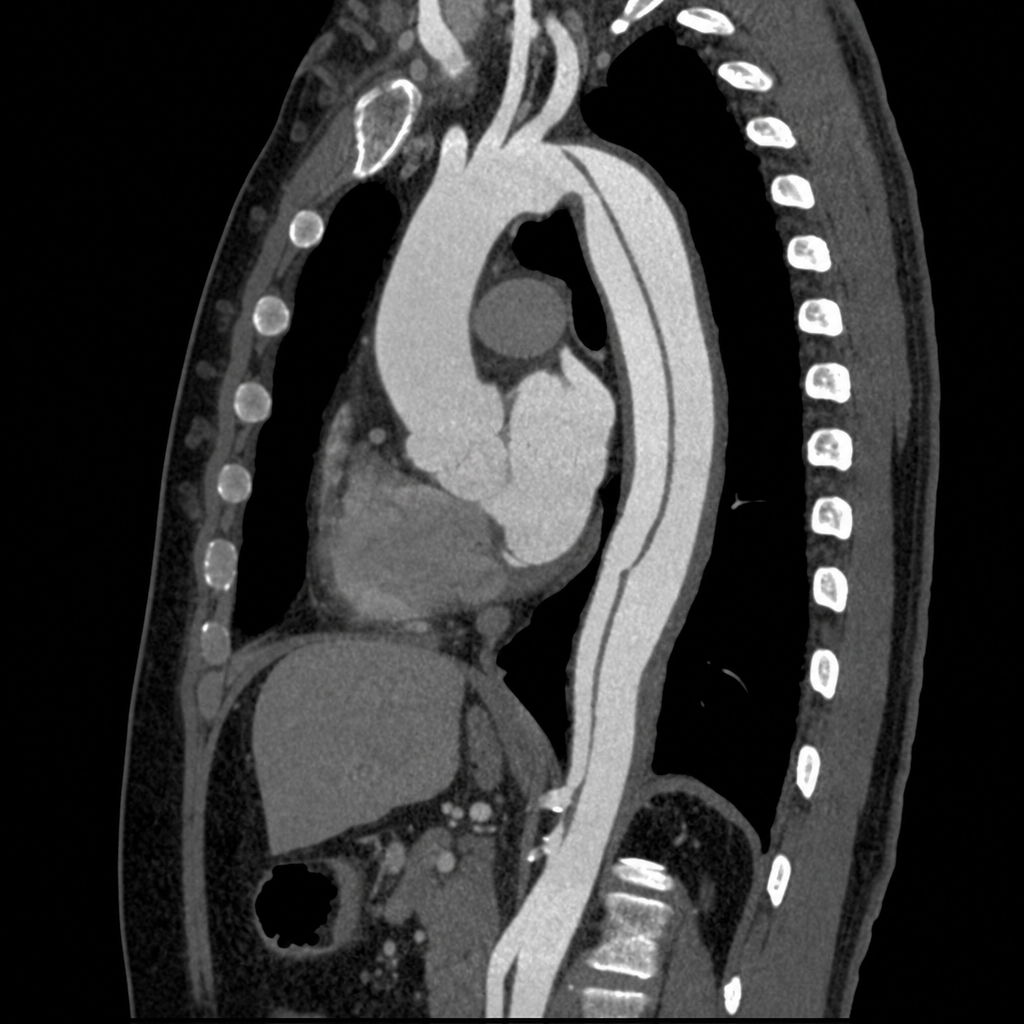
A 55-year-old man presents to the emergency department with sudden-onset tearing chest pain radiating to the interscapular region. He has a history of poorly controlled hypertension. BP is 178/96 mmHg in the right arm and 142/80 mmHg in the left arm. He is diaphoretic and in moderate distress. A CT angiogram of the chest is obtained. The image demonstrates an intimal flap originating 3 cm distal to the left subclavian artery with the false lumen extending through the descending thoracic aorta to the level of the renal arteries; the ascending aorta and aortic root appear normal. Which of the following is the most appropriate management?
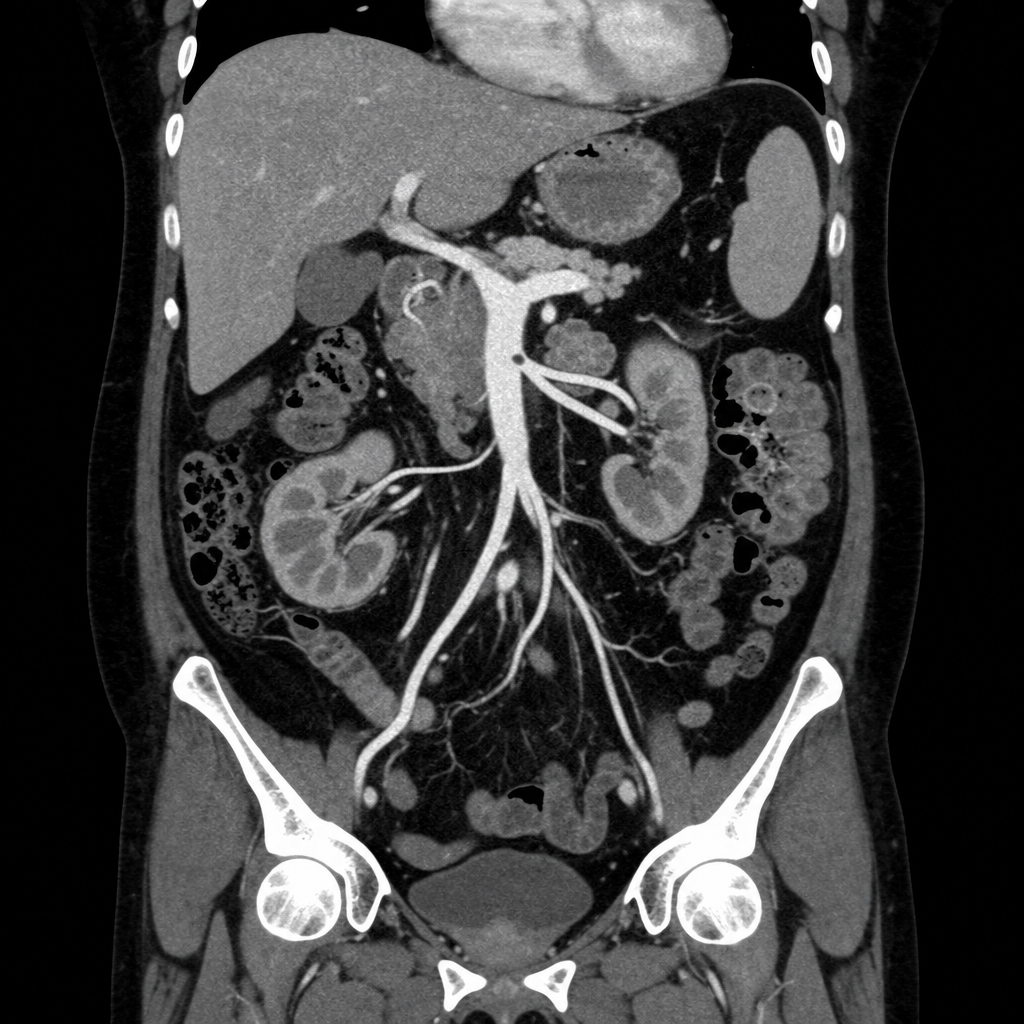
A 67-year-old woman with a history of atrial fibrillation on warfarin presents with sudden-onset severe periumbilical pain out of proportion to physical examination findings. She has a heart rate of 110 bpm, blood pressure of 88/60 mmHg, and temperature of 37.2°C. Her abdomen is rigid with diffuse tenderness, guarding, and rebound on palpation. Serum lactate is 4.8 mmol/L. CT angiography of the abdomen with contrast demonstrates a filling defect at the origin of the superior mesenteric artery consistent with embolus, pneumatosis intestinalis of the small bowel, and portal venous gas. Which of the following is the most appropriate next step in management?
Want unlimited practice?
Get full access to all questions, explanations, and performance tracking.
Scan to download app