
Replacement of ongoing losses — MCQs

A 62-year-old man presents to the emergency department with confusion. The patient’s wife states that her husband has become more somnolent over the past several days and now is very confused. The patient has no complaints himself, but is answering questions inappropriately. The patient has a past medical history of diabetes and hypertension. His temperature is 98.3°F (36.8°C), blood pressure is 127/85 mmHg, pulse is 138/min, respirations are 14/min, and oxygen saturation is 99% on room air. Physical exam is notable for a confused man with dry mucous membranes. Initial laboratory studies are ordered as seen below. Serum: Na+: 135 mEq/L Cl-: 100 mEq/L K+: 3.0 mEq/L HCO3-: 23 mEq/L BUN: 30 mg/dL Glucose: 1,299 mg/dL Creatinine: 1.5 mg/dL Ca2+: 10.2 mg/dL Which of the following is the most appropriate initial treatment for this patient?
A 17-year-old male presents to your office complaining of polyuria, polydipsia, and unintentional weight loss of 12 pounds over the past 3 months. On physical examination, the patient is tachypneic with labored breathing. Which of the following electrolyte abnormalities would you most likely observe in this patient?
A 28-year-old research assistant is brought to the emergency department for severe chemical burns 30 minutes after accidentally spilling hydrochloric acid on himself. The burns cover both hands and forearms. His temperature is 37°C (98.6°F), pulse is 112/min, respirations are 20/min, and blood pressure is 108/82 mm Hg. Initial stabilization and resuscitation is begun, including respiratory support, fluid resuscitation, and cardiovascular stabilization. The burned skin is irrigated with saline water to remove the chemical agent. Which of the following is the most appropriate method to verify adequate fluid infusion in this patient?
A 23-year-old man presents to the emergency department for altered mental status after a finishing a marathon. He has a past medical history of obesity and anxiety and is not currently taking any medications. His temperature is 104°F (40°C), blood pressure is 147/88 mmHg, pulse is 200/min, respirations are 33/min, and oxygen saturation is 99% on room air. Physical exam reveals dry mucous membranes, hot flushed skin, and inappropriate responses to the physician's questions. Laboratory values are ordered as seen below. Hemoglobin: 15 g/dL Hematocrit: 44% Leukocyte count: 8,500/mm^3 with normal differential Platelet count: 199,000/mm^3 Serum: Na+: 165 mEq/L Cl-: 100 mEq/L K+: 4.0 mEq/L HCO3-: 22 mEq/L BUN: 30 mg/dL Glucose: 133 mg/dL Creatinine: 1.5 mg/dL Ca2+: 10.2 mg/dL AST: 12 U/L ALT: 10 U/L Which of the following is the best next step in management?
A 72-year-old female is brought to the emergency department after being found unresponsive in her garage with an open bottle of unmarked fluid. She is confused and is unable to answer questions on arrival. Her medical history is significant for Alzheimer disease, but her family says she has no medical comorbidities. Serum analysis of this patient's blood shows a pH of 7.28 with a high anion gap. The electrolyte that is most likely significantly decreased in this patient follows which of the following concentration curves across the proximal tubule of the kidney?
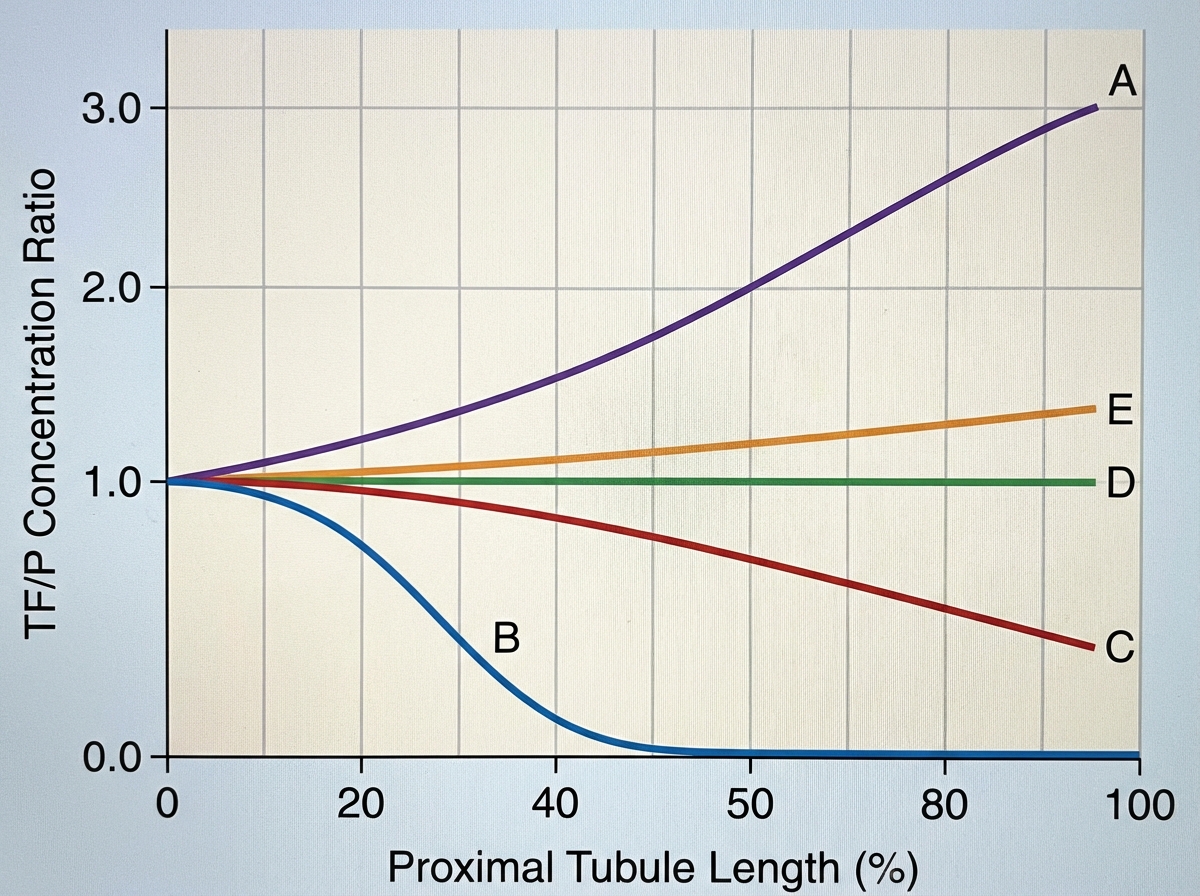
A 48-year-old woman is transferred from her primary care physician's office to the emergency department for further evaluation of hypokalemia to 2.5 mEq/L. She was recently diagnosed with hypertension 2 weeks ago and started on medical therapy. The patient said that she enjoys all kinds of food and exercises regularly, but has not been able to complete her workouts as she usually does. Her temperature is 97.7°F (36.5°C), blood pressure is 107/74 mmHg, pulse is 80/min, respirations are 15/min, and SpO2 is 94% on room air. Her physical exam is unremarkable. Peripheral intravenous (IV) access is obtained. Her basic metabolic panel is obtained below. Serum: Na+: 135 mEq/L Cl-: 89 mEq/L K+: 2.2 mEq/L HCO3-: 33 mEq/L BUN: 44 mg/dL Glucose: 147 mg/dL Creatinine: 2.3 mg/dL Magnesium: 2.0 mEq/L What is the next best step in management?
A 78-year-old male with history of coronary artery disease, status post coronary stent placement currently on aspirin and clopidogrel was found down in his bathroom by his wife. His GCS score was 3 and an accurate physical exam is limited. A stat non-contrast CT scan of his brain demonstrated a large right parietal intracranial hemorrhage with surrounding edema. He was promptly transferred to the intensive care unit (ICU) for monitoring. Over the next day, his mental status continues to worsen but repeat CT scan shows no new bleeding. In addition, the patient’s urinary output has been >200 cc/hr over the last several hours and increasing. His temperature is 99.0 deg F (37.2 deg C), blood pressure is 125/72 mmHg, pulse is 87/min, and respirations are 13/min. Which of the following values would most likely correspond to the patient’s urine specific gravity, urine osmolality, plasma osmolality, and serum sodium?
Three days after being admitted to the hospital because of a fall from the roof of a two-story building, a 27-year-old man is being monitored in the intensive care unit. On arrival, the patient was somnolent and not oriented to person, place, or time. A CT scan of the head showed an epidural hemorrhage that was 45 cm3 in size and a midline shift of 7 mm. Emergency surgery was performed with craniotomy and hematoma evacuation on the day of admission. Perioperatively, a bleeding vessel was identified and ligated. Postoperatively, the patient was transferred to the intensive care unit and placed on a ventilator. His temperature is 37°C (98.6°F), pulse is 67/min, and blood pressure is 117/78 mm Hg. The ventilator is set at a FiO2 of 55%, tidal volume of 520 mL, and positive end-expiratory pressure of 5.0 cm H2O. In addition to intravenous administration of fluids, which of the following is the most appropriate next step in managing this patient's nutrition?
A 58-year-old cirrhotic man with ascites undergoes large volume paracentesis (6 liters removed). Four hours later, he becomes hypotensive (BP 80/50 mmHg) and tachycardic (HR 115/min). Labs show: Cr 2.1 mg/dL (baseline 1.0), Na+ 128 mEq/L, Hct 38%. What is the most appropriate immediate management?
A 42-year-old woman with prolonged vomiting from gastroparesis is admitted with weakness. Labs show: K+ 2.1 mEq/L, pH 7.51, HCO3- 42 mEq/L, Mg2+ 1.4 mg/dL. She receives 80 mEq of IV potassium chloride over 24 hours, but repeat K+ is 2.3 mEq/L. What explains the refractory hypokalemia?
Want unlimited practice?
Get full access to all questions, explanations, and performance tracking.
Scan to download app