
Blood component therapy — MCQs

A 36-year-old woman is brought to the emergency department 20 minutes after being involved in a high-speed motor vehicle collision. On arrival, she is unconscious. Her pulse is 140/min, respirations are 12/min and shallow, and blood pressure is 76/55 mm Hg. 0.9% saline infusion is begun. A focused assessment with sonography shows blood in the left upper quadrant of the abdomen. Her hemoglobin concentration is 7.6 g/dL and hematocrit is 22%. The surgeon decided to move the patient to the operating room for an emergent explorative laparotomy. Packed red blood cell transfusion is ordered prior to surgery. However, a friend of the patient asks for the transfusion to be held as the patient is a Jehovah's Witness. The patient has no advance directive and there is no documentation showing her refusal of blood transfusions. The patient's husband and children cannot be contacted. Which of the following is the most appropriate next best step in management?
A 26-year-old woman is brought to the emergency department after a motor vehicle accident. She was driving on the highway when she was struck by a van. At the hospital she was conscious but was bleeding heavily from an open wound in her left leg. Pulse is 120/min and blood pressure is 96/68 mm Hg. She receives 3 L of intravenous saline and her pulse slowed to 80/min and blood pressure elevated to 116/70 mm Hg. The next morning she is found to have a hemoglobin of 6.2 g/dL. Her team decides to transfuse 1 unit of packed RBCs. Twenty minutes into the transfusion she develops a diffuse urticarial rash, wheezing, fever, and hypotension. The transfusion is immediately stopped and intramuscular epinephrine is administered. Which of the following scenarios is most consistent with this patient's reaction to the blood transfusion?
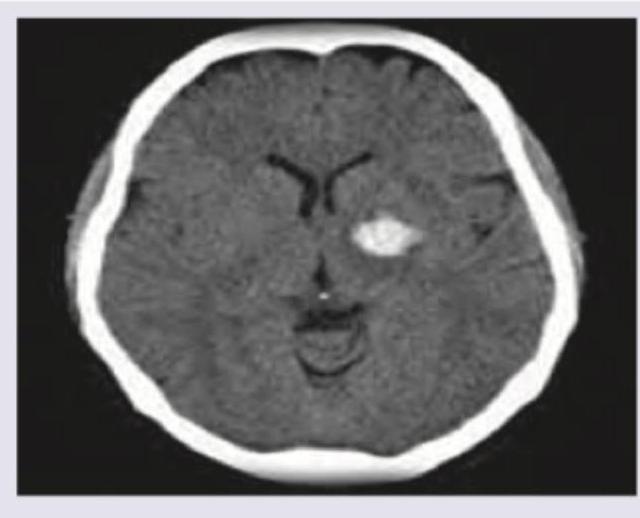
A 70-year-old Caucasian male presents to the emergency room following a fall. The patient's past medical history is significant for myocardial infarction and atrial fibrillation. His home medications are unknown. The patient's head CT is shown in Image A. Laboratory results reveal an International Normalized Ratio (INR) of 6. Which of the following is the most appropriate pharmacologic therapy for this patient?
A 34-year-old primigravida was brought to an obstetric clinic with a chief complaint of painless vaginal bleeding. She was diagnosed with placenta praevia and transfused with 2 units of whole blood. Five hours after the transfusion, she developed a fever and chills. How could the current situation be prevented?
A 55-year-old man with known coronary artery disease presents to the ED with epigastric pain, worsening fatigue, and melena. He takes aspirin and rosuvastatin, but took ibuprofen over the past two weeks for lower back pain. He denies nausea, vomiting, hematemesis, chest pain, fever, and weight loss. Sitting blood pressure is 100/70 mmHg and pulse is 90/min, but standing blood pressure is 85/60 mmHg and pulse is 110/min. Airway is patent. His hands feel cold and clammy. Abdominal exam confirms epigastric pain, but no rebound tenderness or guarding. Despite 2 liters of lactated Ringer's, the blood pressure and pulse have not changed. What hemoglobin (Hb) threshold should be considered if packed red blood cell (pRBC) transfusion is ordered in this patient?
A 65-year-old man presents to the emergency department by ambulance following a motor vehicle accident. He was a restrained passenger. At the hospital, he is bleeding heavily from a large wound in his left leg. A review of medical records reveals a history of atrial fibrillation for which he takes warfarin. His international normalized ratio (INR) 2 days ago was 2.6. On physical exam he is cool and clammy. The vital signs include: heart rate 130/min and blood pressure 96/54 mm Hg. Aggressive resuscitation with intravenous normal saline is begun. Which of the following is the next best step to correct this patient's underlying coagulopathy?
A 23-year-old male presents to the emergency room following a gunshot wound to the leg. On arrival his temperature is 99°F (37.2°C), blood pressure is 90/60 mmHg, pulse is 112/min, respirations are 21/min, and pulse oximetry is 99% on room air. Two large bore IVs are placed and he receives crystalloid fluid replacement followed by 2 units of crossmatched packed red blood cells. Immediately following transfusion, his temperature is 102.2°F (39°C), blood pressure is 93/64 mmHg, pulse is 112/min, respirations are 21/min, and pulse oximetry is 99% on room air. There is oozing from his IV sites. You check the records and realize there was a clerical error with the blood bank. What is the mechanism for his current condition?
Which of the following is true regarding nicotine substitution therapy?
An 18-year-old man presents to a rural emergency department after being stabbed multiple times. The patient's past medical history is notable for obesity, diabetes, chronic upper respiratory infections, a 10 pack-year smoking history, and heart failure. He is protecting his airway and he is oxygenating and ventilating well. His temperature is 97.6°F (36.4°C), blood pressure is 74/34 mmHg, pulse is 180/min, respirations are 24/min, and oxygen saturation is 98% on room air. The patient is started on whole blood and the surgeon on call is contacted to take the patient to the operating room. During the secondary survey, the patient complains of shortness of breath. His blood pressure is 54/14 mmHg, pulse is 200/min, respirations are 24/min, and oxygen saturation is 90% on room air. Physical exam is notable for bilateral wheezing on lung exam. The patient goes into cardiac arrest and after 30 minutes, attempts at resuscitation are terminated. Which of the following is associated with this patient's decompensation during resuscitation?
A 35-year-old man arrives at the emergency department within minutes after a head-on motor vehicle accident. He suffered from blunt abdominal trauma, several lacerations to his face as well as lacerations to his upper and lower extremities. The patient is afebrile, blood pressure is 45/25 mmHg and pulse is 160/minute. A CBC is obtained and is most likely to demonstrate which of the following?
Want unlimited practice?
Get full access to all questions, explanations, and performance tracking.
Scan to download app