
Thyroid nodule evaluation — MCQs

A 36-year-old woman comes to the physician for a follow-up visit after she had a PET scan that showed a nodule on the thyroid gland. She has no difficulty or pain while swallowing. She was treated for non-Hodgkin lymphoma at the age of 28 years, which included external beam radiation to the head and neck and 4 cycles of chemotherapy. She appears healthy. Vital signs are within normal limits. Physical examination shows no abnormalities. Serum studies show: Glucose 82 mg/dL Creatinine 0.7 mg/dL Thyroid-stimulating hormone 3 μU/mL Ultrasound of the neck shows a 1.2-cm (0.5-in) nodule on the left lobe of the thyroid with irregular margins and microcalcifications. A fine-needle aspiration biopsy shows Psammoma bodies and cells with clear, ground-glass, empty nuclei. Which of the following is the most appropriate next step in management?
A 27-year-old man comes to the physician because of worsening abdominal pain over the last several months. He has also had recent feelings of sadness and a lack of motivation at work, where he is employed as a computer programmer. He denies suicidal thoughts. He has a history of multiple kidney stones. He has a family history of thyroid cancer in his father and uncle, who both underwent thyroidectomy before age 30. His temperature is 37°C (98°F), blood pressure is 138/86 mm Hg, and pulse is 87/min. Physical examination shows diffuse tenderness over the abdomen and obesity but is otherwise unremarkable. Serum studies show: Na+ 141 mEq/L K+ 3.6 mEq/L Glucose 144 mg/dL Ca2+ 12.1 mg/dL Albumin 4.1 g/dL PTH 226 pg/mL (normal range 12–88 pg/mL) Results of a RET gene test return abnormal. The physician refers him to an endocrine surgeon. Which of the following is the most appropriate next step in diagnosis?
A 43-year-old female presents to her primary care physician complaining of a gradually enlarging neck mass. She reports that she first developed a firm nodular midline mass on the anterior aspect of her neck two months ago. She is otherwise healthy and takes no medications. A fine-needle aspiration is performed and a histological sample of the specimen is shown. Which of the following is the most likely diagnosis?
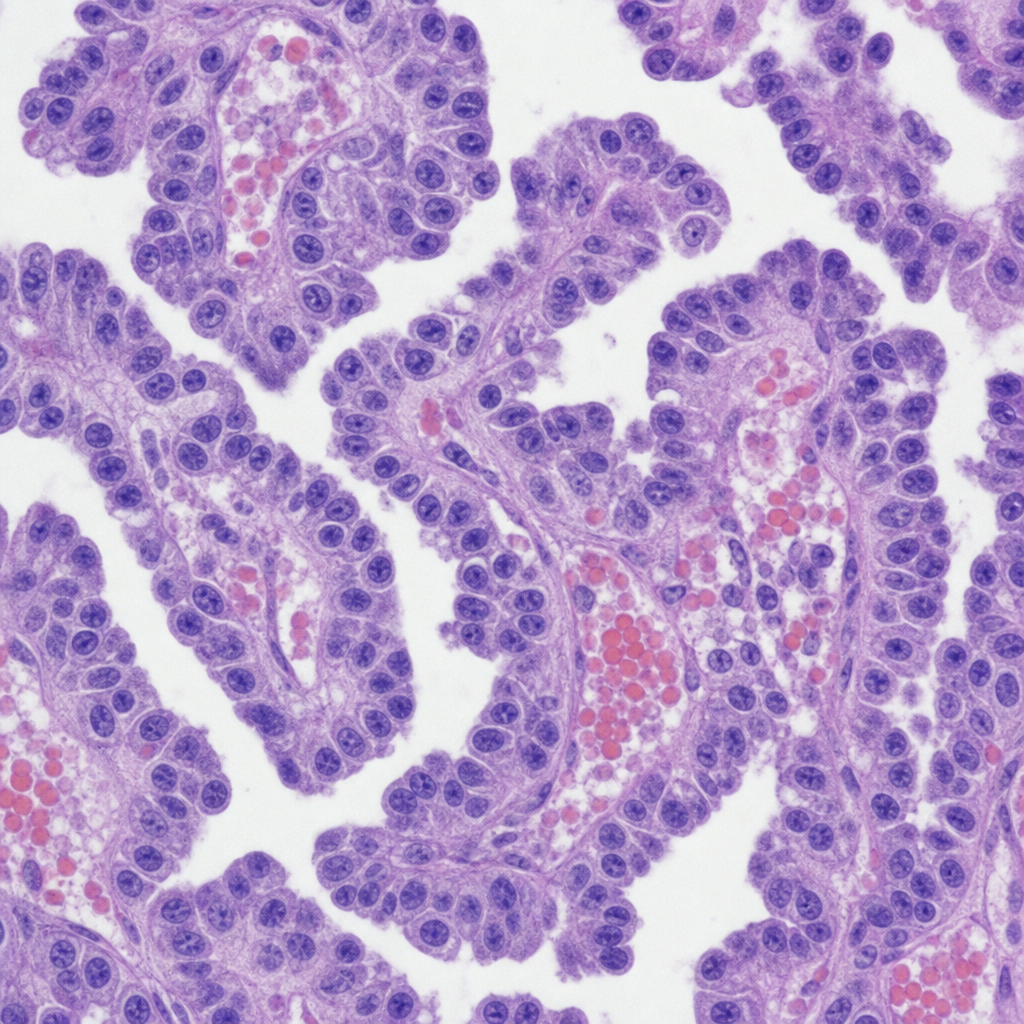
A 65-year-old man with a 40-pack-year smoking history presents with hemoptysis and a persistent cough. Chest CT shows a 3.5 cm centrally located mass in the right main bronchus. Positron emission tomography confirms a malignant nodule. Bronchoscopy with transbronchial biopsy is performed and a specimen sample of the nodule is sent for frozen section analysis. The tissue sample is most likely to show which of the following tumor types?
A 47-year-old woman presents to the clinic complaining of difficulty swallowing that started 1 month ago. The patient also reports a weight loss of 10 lbs during this time, without a change in her appetite. She denies fatigue, cough, hoarseness, pain, or hemoptysis. The patient has a history of childhood lymphoma, which was treated with radiation. She takes no medications. She has smoked 1 pack of cigarettes per day since she was 25 years old. Her physical exam is notable for a palpable nodule on the right side of the thyroid. An ultrasound is performed, which confirms a 1.2 cm hyperechoic nodule in the right lobe. Thyroid function labs are drawn and shown below: Serum TSH: 0.2 mU/L Serum thyroxine (T4): 187 nmol/L Serum triiodothyronine (T3): 3.3 nmol/L Which of the following is the next best step in management?
A 75-year-old woman comes to the physician because of a 3-month history of involuntary weight loss and a painless lump on her neck. Physical examination shows a firm, irregular swelling on the right side of the neck. Ultrasonography of the thyroid gland shows a 2-cm nodule with irregular margins and microcalcifications in the right thyroid lobe. A biopsy of the thyroid nodule is performed. Which of the following changes would be most consistent with anaplasia?
A 45-year-old man comes to the physician for the evaluation of difficulty swallowing that has worsened over the past year. He also reports some hoarseness and generalized bone, muscle, and joint pain. During the past six months, he has had progressive constipation and two episodes of kidney stones. He also reports recurrent episodes of throbbing headaches, diaphoresis, and palpitations. He does not smoke or drink alcohol. He takes no medications. His vital signs are within normal limits. Physical examination and an ECG show no abnormalities. Laboratory studies show calcium concentration of 12 mg/dL, phosphorus concentration of 2 mg/dL, alkaline phosphatase concentration of 100 U/L, and calcitonin concentration of 11 pg/mL (N < 8.8). Ultrasonography of the neck shows hypoechoic thyroid lesions with irregular margins and microcalcifications. Which of the following is the most likely underlying cause of this patient's condition?
A 27-year-old woman comes to the physician for a routine health maintenance examination. She feels well. She had a chlamydia infection at the age of 22 years that was treated. Her only medication is an oral contraceptive. She has smoked one pack of cigarettes daily for 6 years. She has recently been sexually active with 3 male partners and uses condoms inconsistently. Her last Pap test was 4 years ago and results were normal. Physical examination shows no abnormalities. A Pap test shows atypical squamous cells of undetermined significance. Which of the following is the most appropriate next step in management?
A 62-year-old man comes to the physician for a follow-up examination after having been diagnosed with stage II adenocarcinoma of the left lower lung lobe without evidence of distant metastases 1 week ago following an evaluation for a chronic cough. He has hypertension and type 2 diabetes mellitus. He has smoked one pack of cigarettes daily for the past 40 years. His current medications include metformin, sitagliptin, and enalapril. He is 177 cm (5 ft 10 in) tall and weighs 65 kg (143 lb); BMI is 20.7 kg/m2. He appears lethargic. Vital signs are within normal limits. Pulse oximetry shows an oxygen saturation of 98%. Examination shows inspiratory wheezing at the left lung base. The remainder of the examination shows no abnormalities. A complete blood count and serum concentrations of electrolytes, creatinine, glucose, and liver enzymes are within the reference range. Spirometry shows an FEV1 of 1.6 L. The diffusing lung capacity for carbon monoxide (DLCO) is 66% of predicted. Which of the following is the most appropriate next step in the management of this patient?
A 68-year-old man is brought to the emergency department because of fever, progressive weakness, and cough for the past five days. He experienced a similar episode 2 months ago, for which he was hospitalized for 10 days while visiting his son in Russia. He states that he has never fully recovered from that episode. He felt much better after being treated with antibiotics, but he still coughs often during meals. He sometimes also coughs up undigested food after eating. For the last 5 days, his coughing has become more frequent and productive of yellowish-green sputum. He takes hydrochlorothiazide for hypertension and pantoprazole for the retrosternal discomfort that he often experiences while eating. He has smoked half a pack of cigarettes daily for the last 30 years and drinks one shot of vodka every day. The patient appears thin. His temperature is 40.1°C (104.2°F), pulse is 118/min, respirations are 22/min, and blood pressure is 125/90 mm Hg. Auscultation of the lungs shows right basal crackles. There is dullness on percussion at the right lung base. The remainder of the physical examination shows no abnormalities. Laboratory studies show: Hemoglobin 15.4 g/dL Leukocyte count 17,000/mm3 Platelet count 350,000/mm3 Na+ 139 mEq/L K+ 4.6 mEq/L Cl- 102 mEq/L HCO3- 25 mEq/L Urea Nitrogen 16 mg/dL Creatinine 1.3 mg/dL An x-ray of the chest shows a right lower lobe infiltrate. Which of the following is the most likely explanation for this patient's symptoms?
Want unlimited practice?
Get full access to all questions, explanations, and performance tracking.
Scan to download app