
Sentinel lymph node biopsy — MCQs

A 49-year-old woman presents to her physician with complaints of breast swelling and redness of the skin over her right breast for the past 1 month. She also mentions that the skin above her right breast appears to have thickened. She denies any pain or nipple discharge. The past medical history is significant for a total abdominal hysterectomy at 45 years of age. Her last mammogram 1 year ago was negative for any pathologic changes. On examination, the right breast was diffusely erythematous with gross edema and tenderness and appeared larger than the left breast. The right nipple was retracted and the right breast was warmer than the left breast. No localized mass was palpated. Which of the following statements best describes the patient’s most likely condition?
A 64-year-old woman presents to the surgical oncology clinic as a new patient for evaluation of recently diagnosed breast cancer. She has a medical history of type 2 diabetes mellitus for which she takes metformin. Her surgical history is a total knee arthroplasty 7 years ago. Her family history is insignificant. Physical examination is notable for an irregular nodule near the surface of her right breast. Her primary concern today is which surgical approach will be chosen to remove her breast cancer. Which of the following procedures involves the removal of a portion of a breast?
The patient undergoes a mammogram, which shows a 6.5mm sized mass with an irregular border and spiculated margins. A subsequent core needle biopsy of the mass shows infiltrating ductal carcinoma with HER2-positive, estrogen-negative, and progesterone-negative immunohistochemistry staining. Blood counts and liver function tests are normal. Laboratory studies show: Hemoglobin 12.5 g/dL Serum Na+ 140 mEq/L Cl- 103 mEq/L K+ 4.2 mEq/L HCO3- 26 mEq/L Ca2+ 8.9 mg/dL Urea Nitrogen 12 mg/dL Glucose 110 mg/dL Alkaline Phosphatase 25 U/L Alanine aminotransferase (ALT) 15 U/L Aspartate aminotransferase (AST) 13 U/L Which of the following is the most appropriate next step in management?
A 42-year-old woman presents to the physician because of an abnormal breast biopsy report following suspicious findings on breast imaging. Other than being concerned about her report, she feels well. She has no history of any serious illnesses and takes no medications. She does not smoke. She consumes wine 1–2 times per week with dinner. There is no significant family history of breast or ovarian cancer. Vital signs are within normal limits. Physical examination shows no abnormal findings. The biopsy shows lobular carcinoma in situ (LCIS) in the left breast. Which of the following is the most appropriate next step in management?
A 47-year-old woman comes to the physician for a mass in her left breast she noticed 2 days ago during breast self-examination. She has hypothyroidism treated with levothyroxine. There is no family history of breast cancer. Examination shows large, moderately ptotic breasts. The mass in her left breast is small (approximately 1 cm x 0.5 cm), firm, mobile, and painless. It is located 4 cm from her nipple-areolar complex at the 7 o'clock position. There are no changes in the skin or nipple, and there is no palpable axillary adenopathy. No masses are palpable in her right breast. A urine pregnancy test is negative. Mammogram showed a soft tissue mass with poorly defined margins. Core needle biopsy confirms a low-grade infiltrating ductal carcinoma. The pathological specimen is positive for estrogen receptors and negative for progesterone and human epidermal growth factor receptor 2 (HER2) receptors. Staging shows no distant metastatic disease. Which of the following is the most appropriate next step in management?
A 61-year-old woman presents to a surgical oncologist for consideration of surgical removal of biopsy-confirmed breast cancer. The mass is located in the tail of Spence along the superolateral aspect of the left breast extending into the axilla. The surgical oncologist determines that the optimal treatment for this patient involves radical mastectomy including removal of the axillary lymph nodes. The patient undergoes all appropriate preoperative tests and is cleared for surgery. During the operation, multiple enlarged axillary lymph nodes are present along the superolateral chest wall. While exposing the lymph nodes, the surgeon accidentally nicks a nerve. Which of the following physical examination findings will most likely be seen in this patient following the operation?
A 34-year-old Ethiopian woman who recently moved to the United States presents for evaluation to a surgical outpatient clinic with painful ulceration in her right breast for the last 2 months. She is worried because the ulcer is increasing in size. On further questioning, she says that she also has a discharge from her right nipple. She had her 2nd child 4 months ago and was breastfeeding the baby until the pain started getting worse in the past few weeks, and is now unbearable. According to her health records from Africa, her physician prescribed antimicrobials multiple times with a diagnosis of mastitis, but she did not improve significantly. Her mother and aunt died of breast cancer at 60 and 58 years of age, respectively. On examination, the right breast is enlarged and firm, with thickened skin, diffuse erythema, edema, and an ulcer measuring 3 × 3 cm. White-gray nipple discharge is present. The breast is tender with axillary and cervical adenopathy. Mammography is ordered, which shows a mass with a large area of calcifications, parenchymal distortion, and extensive soft tissue and trabecular thickening in the affected breast. The patient subsequently undergoes core-needle and full-thickness skin punch biospies. The pathology report states a clear dermal lymphatic invasion by tumor cells. Which of the following is the most likely diagnosis?
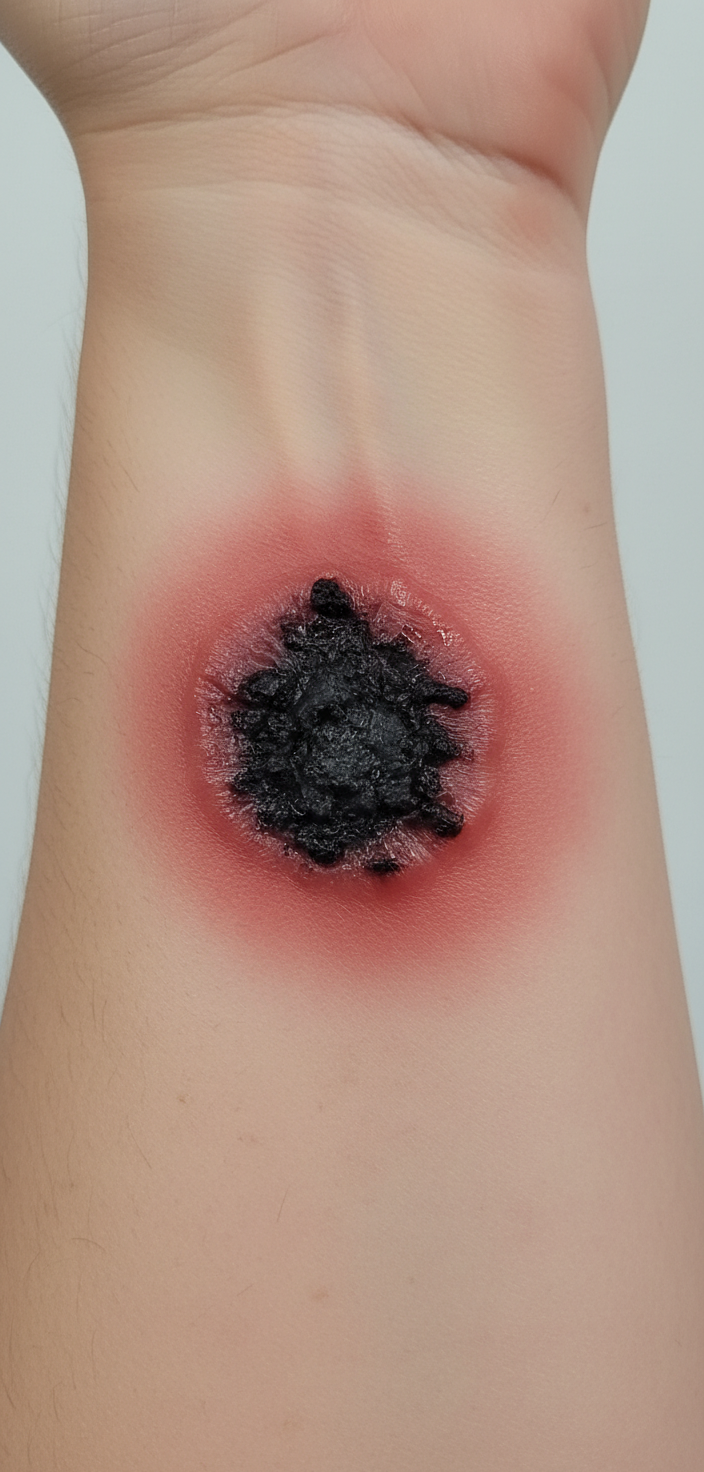
A 49-year-old man comes to the physician for evaluation of several painless, pruritic lesions on his left forearm that he first noticed 4 days ago. They were initially pink marks that progressed into blisters before ulcerating. He has also had a headache for 1 week. His temperature is 38.1°C (100.6°F). A photograph of one of the lesions is shown. There is pronounced edema of the surrounding skin and painless swelling of the left axillary lymph nodes. Which of the following is the greatest risk factor for this patient's condition?
An excisional biopsy is performed and the diagnosis of superficial spreading melanoma is confirmed. The lesion is 1.1 mm thick. Which of the following is the most appropriate next step in management?
A 50-year-old obese woman presents for a follow-up appointment regarding microcalcifications found in her left breast on a recent screening mammogram. The patient denies any recent associated symptoms. The past medical history is significant for polycystic ovarian syndrome (PCOS), for which she takes metformin. Her menarche occurred at age 11, and the patient still has regular menstrual cycles. The family history is significant for breast cancer in her mother at the age of 72. The review of systems is notable for a 6.8 kg (15 lb) weight loss in the past 2 months. The vital signs include: temperature 37.0°C (98.6°F), blood pressure 130/70 mm Hg, pulse 82/min, respiratory rate 17/min, and oxygen saturation 98% on room air. On physical examination, the patient is alert and cooperative. The breast examination reveals no palpable masses, lymphadenopathy, or evidence of skin retraction. A biopsy of the left breast is performed, and histologic examination demonstrates evidence of non-invasive malignancy. Which of the following is the most appropriate definitive treatment for this patient?
Want unlimited practice?
Get full access to all questions, explanations, and performance tracking.
Scan to download app