
Inflammatory breast cancer — MCQs

A 49-year-old woman presents to her physician with complaints of breast swelling and redness of the skin over her right breast for the past 1 month. She also mentions that the skin above her right breast appears to have thickened. She denies any pain or nipple discharge. The past medical history is significant for a total abdominal hysterectomy at 45 years of age. Her last mammogram 1 year ago was negative for any pathologic changes. On examination, the right breast was diffusely erythematous with gross edema and tenderness and appeared larger than the left breast. The right nipple was retracted and the right breast was warmer than the left breast. No localized mass was palpated. Which of the following statements best describes the patient’s most likely condition?
A 52-year-old woman visits your office complaining about discharge from her left nipple for the past 3 months. The discharge looks like gray greenish and its amount is progressively increasing. She appears to be anxious and extremely uncomfortable with this situation as it is embarrassing for her when it occurs outdoors. Past medical history is insignificant. Her family history is negative for breast and ovarian disorders. She tries to stay active by running for 30 minutes every day on a treadmill, staying away from smoking, and by eating a balanced diet. She drinks alcohol occasionally. During physical examination you find a firm, stable mass under an inverted nipple in her left breast; while on the right breast, dilated subareolar ducts can be noted. There is no lymphadenopathy and remaining of the physical exam is normal. A mammogram is performed which reveals tubular calcifications. Which of the following is the most likely diagnosis?
A 42-year-old woman presents to the physician because of an abnormal breast biopsy report following suspicious findings on breast imaging. Other than being concerned about her report, she feels well. She has no history of any serious illnesses and takes no medications. She does not smoke. She consumes wine 1–2 times per week with dinner. There is no significant family history of breast or ovarian cancer. Vital signs are within normal limits. Physical examination shows no abnormal findings. The biopsy shows lobular carcinoma in situ (LCIS) in the left breast. Which of the following is the most appropriate next step in management?
A 40-year-old man presents with a painless firm mass in the right breast. Examination shows retraction of the nipple and the skin is fixed to the underlying mass. The axillary nodes are palpable. Which of the following statements is FALSE regarding the above condition?
An obese 34-year-old primigravid woman at 20 weeks' gestation comes to the physician for a follow-up examination for a mass she found in her left breast 2 weeks ago. Until pregnancy, menses had occurred at 30- to 40-day intervals since the age of 11 years. Vital signs are within normal limits. Examination shows a 3.0-cm, non-mobile, firm, and nontender mass in the upper outer quadrant of the left breast. There is no palpable axillary lymphadenopathy. Pelvic examination shows a uterus consistent in size with a 20-week gestation. Mammography and core needle biopsy confirm an infiltrating lobular carcinoma. The pathological specimen is positive for estrogen and human epidermal growth factor receptor 2 (HER2) receptors and negative for progesterone receptors. Staging shows no distant metastatic disease. Which of the following is the most appropriate management?
A 48-year-old woman with a known past medical history significant for hypertension presents for a second opinion of a left breast lesion. The lesion was characterized as eczema by the patient's primary care physician and improved briefly after a trial of topical steroids. However, the patient is concerned that the lesion has started to grow. On physical examination, there is an erythematous, scaly lesion involving the left breast nipple-areolar complex with weeping drainage. What is the next step in the patient's management?
A 64-year-old woman presents to the surgical oncology clinic as a new patient for evaluation of recently diagnosed breast cancer. She has a medical history of type 2 diabetes mellitus for which she takes metformin. Her surgical history is a total knee arthroplasty 7 years ago. Her family history is insignificant. Physical examination is notable for an irregular nodule near the surface of her right breast. Her primary concern today is which surgical approach will be chosen to remove her breast cancer. Which of the following procedures involves the removal of a portion of a breast?
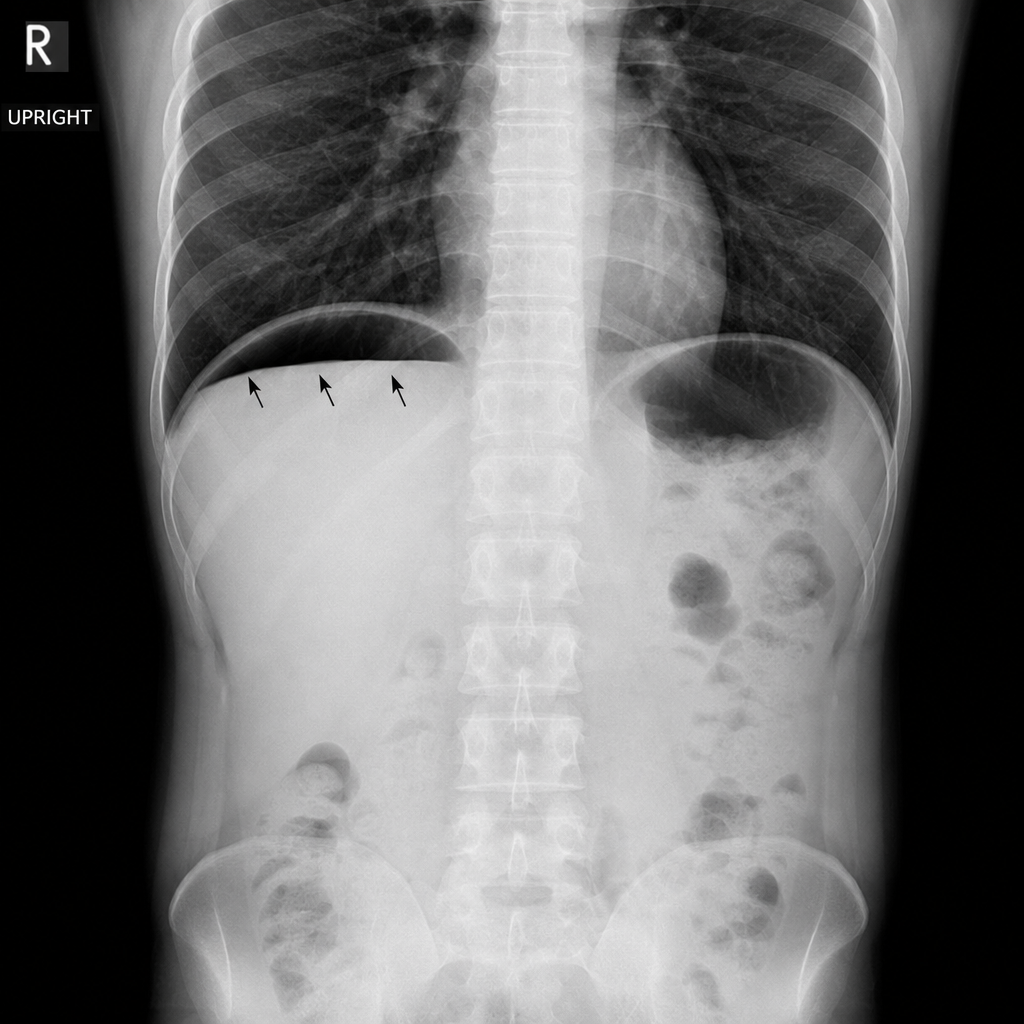
A 45-year-old man presents to the emergency department with a 12-hour history of severe periumbilical pain that has migrated to the right lower quadrant, fever of 38.4°C, and anorexia. On examination, there is point tenderness 2/3 of the way along a line from the umbilicus to the right anterior superior iliac spine. His WBC is 14,200/mm³ with a left shift. A plain abdominal radiograph is obtained. Which of the following findings on this image would most directly indicate perforation requiring urgent surgical intervention?
A 58-year-old woman underwent mastectomy for multicentric DCIS. Final pathology shows high-grade DCIS with comedonecrosis, margins negative by 3 mm, no invasion identified in 40 tissue blocks examined. Sentinel lymph node biopsy shows isolated tumor cells (0.1 mm cluster) positive for cytokeratin. The medical oncologist requests input on systemic therapy. Evaluate the significance of the nodal finding and recommendations.
A 36-year-old woman with BRCA2 mutation and strong family history of breast and ovarian cancer desires risk-reducing surgery. She has 2 young children and plans to have one more child in 2 years. She asks about timing of risk-reducing mastectomy and oophorectomy. Her mother died of ovarian cancer at age 45, and sister diagnosed with breast cancer at age 38. Evaluate the optimal counseling regarding surgical timing.
Want unlimited practice?
Get full access to all questions, explanations, and performance tracking.
Scan to download app