
Breast biopsy techniques — MCQs

A 32-year-old woman, gravida 2, para 2, comes to the physician for the evaluation of a palpable mass in her right breast that she first noticed 1 week ago. She has no associated pain. She has never had a mammogram previously. She has type II diabetes mellitus treated with metformin. She has no family history of breast cancer. She has smoked half a pack of cigarettes daily for 15 years. Her temperature is 37°C (98.6°F), pulse is 78/min, respirations are 14/min, and blood pressure is 125/75 mm Hg. Examination shows a firm, nonpainful, nonmobile mass in the right upper quadrant of the breast. There is no nipple discharge. Examination of the skin and lymph nodes shows no abnormalities. No masses are palpated in the left breast. Which of the following is the most appropriate next step in the management of this patient?
A 44-year-old woman presents for her annual physical checkup. She says she first noticed a mass in her right breast while taking a shower 3 months ago, which has progressively increased in size. She denies any weight loss, fever, night sweats, discharge from or change in her nipples. Her family history is negative for breast, ovarian, and endometrial cancer. She is afebrile, and her vital signs are within normal limits. Physical examination reveals a smooth, multinodular, firm 5 cm x 5 cm mass in the right breast that is mobile and painless. The skin over the mass appears to be stretched and shiny without ulcerations, erythema, or vascular demarcation. On follow-up 6 weeks later, an interval ultrasound of the right breast reveals a well-circumscribed hypoechoic mass with some cystic components that now measures 8 cm x 7 cm. A core needle biopsy of the mass is performed. Which of the following diagnosis is most likely expected to be confirmed by the core needle biopsy in this patient?
A 29-year-old woman, gravida 1, para 1, comes to the physician for the evaluation of a painful mass in her left breast for several days. She has no fevers or chills. She has not noticed any changes in the right breast. She has no history of serious illness. Her last menstrual period was 3 weeks ago. She appears anxious. Her temperature is 37°C (98.6°F), pulse is 80/min, respirations are 13/min, and blood pressure is 130/75 mm Hg. Examination shows a palpable, mobile, tender mass in the left upper quadrant of the breast. Ultrasound shows a 1.75-cm, well-circumscribed anechoic mass with posterior acoustic enhancement. The patient says that she is very concerned that she may have breast cancer and wishes further diagnostic testing. Which of the following is the most appropriate next step in the management of this patient?
A 32-year-old woman presents to her physician concerned about wet spots on the inside part of her dress shirts, which she thinks may be coming from one of her breasts. She states that it is painless and that the discharge is usually blood-tinged. She denies any history of malignancy in her family and states that she has been having regular periods since they first started at age 13. She does not have any children. The patient has normal vitals and denies any cough, fever. On exam, there are no palpable masses, and the patient does not have any erythema or induration. What is the most likely diagnosis?
A 29-year-old nulligravid woman comes to the physician because of a 10-day history of small quantities of intermittent, blood-tinged discharge from her left nipple. There is no personal or family history of serious illness. She has smoked 1 pack of cigarettes daily for 5 years. Her last menstrual period was 12 days ago. She is sexually active and uses condoms inconsistently. Physical examination shows scant serosanguinous fluid expressible from the left nipple. There is no palpable breast mass or axillary lymphadenopathy. Examination shows no other abnormalities. Which of the following is the most appropriate next step in management?
A 27-year-old female presents to her OB/GYN for a check-up. During her visit, a pelvic exam and Pap smear are performed. The patient does not have any past medical issues and has had routine gynecologic care with normal pap smears every 3 years since age 21. The results of the Pap smear demonstrate atypical squamous cells of undetermined significance (ASCUS). Which of the following is the next best step in the management of this patient?
A 59-year-old woman presents to the family medicine clinic with a lump in her breast for the past 6 months. She states that she has been doing breast self-examinations once a month. She has a medical history significant for generalized anxiety disorder and systemic lupus erythematosus. She takes sertraline and hydroxychloroquine for her medical conditions. The heart rate is 102/min, and the rest of the vital signs are stable. On physical examination, the patient appears anxious and tired. Her lungs are clear to auscultation bilaterally. Capillary refill is 2 seconds. There is no axillary lymphadenopathy present. Palpation of the left breast reveals a 2 x 2 cm mass. What is the most appropriate next step given the history of the patient?
An excisional biopsy is performed and the diagnosis of superficial spreading melanoma is confirmed. The lesion is 1.1 mm thick. Which of the following is the most appropriate next step in management?
A 37-year-old man presents to the emergency department after he cut his hand while working on his car. The patient has a past medical history of antisocial personality disorder and has been incarcerated multiple times. His vitals are within normal limits. Physical exam is notable for a man covered in tattoos with many bruises over his face and torso. Inspection of the patient's right hand reveals 2 deep lacerations on the dorsal aspects of the second and third metacarpophalangeal (MCP) joints. The patient is given a tetanus vaccination, and the wound is irrigated. Which of the following is appropriate management for this patient?
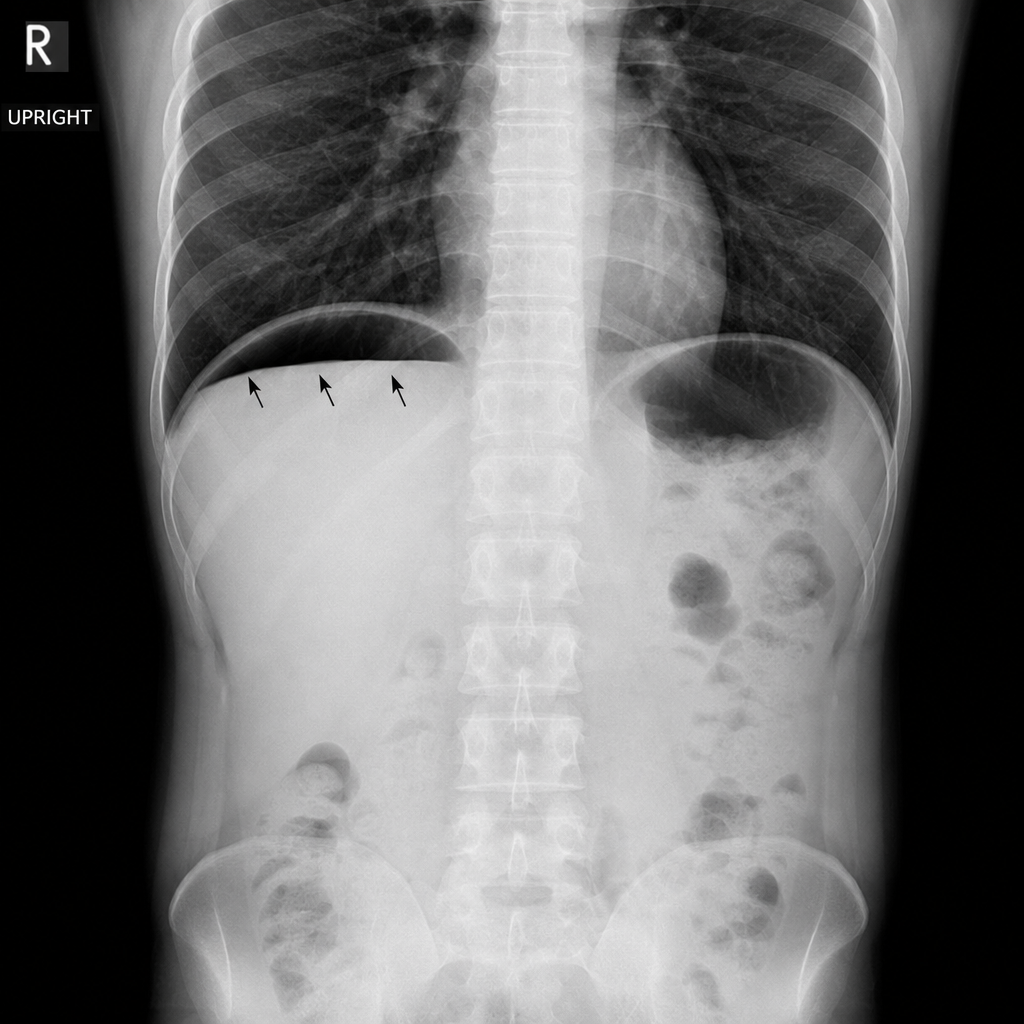
A 45-year-old man presents to the emergency department with a 12-hour history of severe periumbilical pain that has migrated to the right lower quadrant, fever of 38.4°C, and anorexia. On examination, there is point tenderness 2/3 of the way along a line from the umbilicus to the right anterior superior iliac spine. His WBC is 14,200/mm³ with a left shift. A plain abdominal radiograph is obtained. Which of the following findings on this image would most directly indicate perforation requiring urgent surgical intervention?
Want unlimited practice?
Get full access to all questions, explanations, and performance tracking.
Scan to download app