
Trauma team organization — MCQs

A 45-year-old man was a driver in a motor vehicle collision. The patient is not able to offer a medical history during initial presentation. His temperature is 97.6°F (36.4°C), blood pressure is 104/74 mmHg, pulse is 150/min, respirations are 12/min, and oxygen saturation is 98% on room air. On exam, he does not open his eyes, he withdraws to pain, and he makes incomprehensible sounds. He has obvious signs of trauma to the chest and abdomen. His abdomen is distended and markedly tender to palpation. He also has an obvious open deformity of the left femur. What is the best initial step in management?
A 33-year-old man is brought by ambulance to the emergency room after being a passenger in a motor vehicle accident. An empty bottle of whiskey was found in his front seat, and the patient admits to having been drinking all night. He has multiple lacerations and bruising on his face and scalp and a supportive cervical collar is placed. He is endorsing a significant headache and starts vomiting in the emergency room. His vitals, however, are stable, and he is transported to the CT scanner. While there, he states that he does not want to have a CT scan and asks to be released. What is the most appropriate course of action?
A 15-year-old boy is brought to the emergency department one hour after sustaining an injury during football practice. He collided head-on into another player while wearing a mouthguard and helmet. Immediately after the collision he was confused but able to use appropriate words. He opened his eyes spontaneously and followed commands. There was no loss of consciousness. He also had a headache with dizziness and nausea. He is no longer confused upon arrival. He feels well. Vital signs are within normal limits. He is fully alert and oriented. His speech is organized and he is able to perform tasks demonstrating full attention, memory, and balance. Neurological examination shows no abnormalities. There is mild tenderness to palpation over the crown of his head but no signs of skin break or fracture. Which of the following is the most appropriate next step?
A 54-year-old man suffered an anterior wall myocardial infarction that was managed in the cath lab with emergent coronary stenting and revascularization. The patient states that his wife, adult children, and cousins may be disclosed information regarding his care and health information. The patient has been progressing well without any further complications since his initial catheterization. On hospital day #3, a woman stops you in the hall outside of the patient's room whom you recognize as the patient's cousin. She asks you about the patient's prognosis and how the patient is progressing after his heart attack. Which of the following is the most appropriate next step?
A psychiatrist receives a call from a patient who expresses thoughts of harming his ex-girlfriend. The patient describes a detailed plan to attack her at her workplace. Which of the following represents the psychiatrist's most appropriate legal obligation?
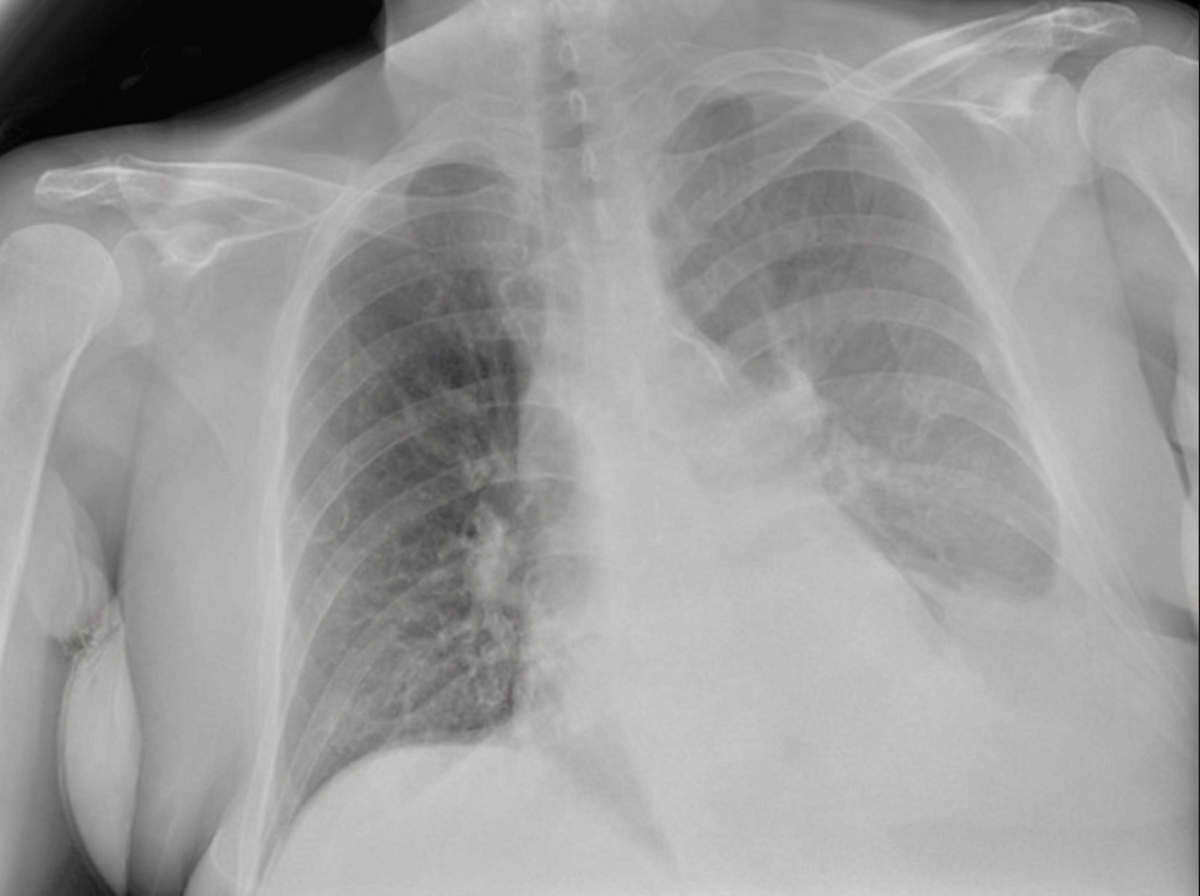
A 27-year-old soldier is brought to the emergency department of a military hospital 20 minutes after being involved in a motor vehicle accident during a training exercise. He was an unrestrained passenger. On arrival, he has shortness of breath and chest pain. He appears pale and anxious. His temperature is 37°C (98.6°F), pulse is 110/min, respirations are 20/min, and blood pressure is 100/65 mm Hg. He is alert and oriented to person, place, and time. Examination shows pale conjunctivae and mucous membranes. There is bruising on the chest, extremities, and abdomen. The lungs are clear to auscultation. He has normal heart sounds and flat neck veins. The abdomen is flat, soft, and mildly tender. The remainder of the physical examination shows no abnormalities. High-flow oxygen is applied, and intravenous fluid resuscitation is begun. A chest x-ray is obtained. Which of the following is the most appropriate next step in management?
A 78-year-old woman is brought to the emergency ward by her son for lethargy and generalized weakness. The patient speaks in short utterances and does not make eye contact with the provider or her son throughout the interview and examination. You elicit that the patient lives with her son and daughter-in-law, and she reports vague weakness for the last couple days. The emergency room provider notices 3-4 healing bruises on the patient's upper extremities; otherwise, examination is not revealing. Routine chemistries and blood counts are unremarkable; non-contrast head CT demonstrates normal age-related changes. Which of the following is the most appropriate next step in management?
A 67-year-old woman is brought by ambulance from home to the emergency department after she developed weakness of her left arm and left face droop. According to her husband, she has a history of COPD, hypertension, and hyperlipidemia. She takes hydrochlorothiazide, albuterol, and atorvastatin. She is not on oxygen at home. She is an active smoker and has smoked a pack a day for 20 years. Her mother died of a heart attack at age 60 and her father died of prostate cancer at age 55. By the time the ambulance arrived, she was having difficulty speaking. Once in the emergency department, she is no longer responsive. Her blood pressure is 125/85 mm Hg, the temperature is 37.2°C (99°F), the heart rate is 77/min, and her breathing is irregular, and she is taking progressively deeper inspirations interrupted with periods of apnea. Of the following, what is the next best step?
A 65-year-old man is admitted to the hospital because of a 1-month history of fatigue, intermittent fever, and weakness. Results from a peripheral blood smear taken during his evaluation are indicative of possible acute myeloid leukemia. Bone marrow aspiration and subsequent cytogenetic studies confirm the diagnosis. The physician sets aside an appointed time-slot and arranges a meeting in a quiet office to inform him about the diagnosis and discuss his options. He has been encouraged to bring someone along to the appointment if he wanted. He comes to your office at the appointed time with his daughter. He appears relaxed, with a full range of affect. Which of the following is the most appropriate opening statement in this situation?
A 28-year-old woman is brought to the emergency department 1 hour after being involved in a motor vehicle collision. She was riding a bike when she lost control and hit a car on the opposite side of the road. On arrival, she is unconscious. She has a history of intravenous heroin use. Her pulse is 56/min, respirations are 8/min and irregular, and blood pressure is 196/102 mm Hg. Examination shows a 2-cm laceration over the left cheek and a 3-cm laceration over the left chest. There are multiple abrasions over her face and chest. She opens her eyes and flexes her extremities to painful stimuli. The pupils are dilated and react sluggishly to light. There are decreased breath sounds over the left lung. The trachea is central. There is no jugular venous distention. Cardiac examination shows no abnormalities. The abdomen is soft and nontender. The left knee and right ankle are swollen; range of motion is limited. Two large-bore peripheral intravenous catheters are inserted. She is intubated and mechanical ventilation is initiated. A focused assessment with sonography in trauma is negative. An occlusive dressing is applied over the left chest wound. She is scheduled for a noncontrast CT scan of the brain. Which of the following is the underlying cause of this patient's hypertension?
Want unlimited practice?
Get full access to all questions, explanations, and performance tracking.
Scan to download app