
Trauma in special populations (pediatric, geriatric) — MCQs

A 45-year-old man was a driver in a motor vehicle collision. The patient is not able to offer a medical history during initial presentation. His temperature is 97.6°F (36.4°C), blood pressure is 104/74 mmHg, pulse is 150/min, respirations are 12/min, and oxygen saturation is 98% on room air. On exam, he does not open his eyes, he withdraws to pain, and he makes incomprehensible sounds. He has obvious signs of trauma to the chest and abdomen. His abdomen is distended and markedly tender to palpation. He also has an obvious open deformity of the left femur. What is the best initial step in management?
A 3-year-old child is brought to the emergency department with multiple bruises in various stages of healing. X-rays reveal several metaphyseal fractures and posterior rib fractures. The parents claim the injuries resulted from normal play activities. Which of the following patterns would most strongly suggest non-accidental trauma?
A 44-year-old man is brought to the emergency department 25 minutes after falling off the roof of a house. He was cleaning the roof when he slipped and fell. He did not lose consciousness and does not have any nausea. On arrival, he is alert and oriented and has a cervical collar on his neck. His pulse is 96/min, respirations are 18/min, and blood pressure is 118/78 mm Hg. Examination shows multiple bruises over the forehead and right cheek. The pupils are equal and reactive to light. There is a 2-cm laceration below the right ear. Bilateral ear canals show no abnormalities. The right wrist is swollen and tender; range of motion is limited by pain. The lungs are clear to auscultation. There is no midline cervical spine tenderness. There is tenderness along the 2nd and 3rd ribs on the right side. The abdomen is soft and nontender. Neurologic examination shows no focal findings. Two peripheral venous catheters are placed. Which of the following is the most appropriate next step in management?
A 7-year-old boy is brought to the emergency department by his mother 1 hour after falling off his bike and landing head-first on the pavement. His mother says that he did not lose consciousness but has been agitated and complaining about a headache since the event. He has no history of serious illness and takes no medications. His temperature is 37.1°C (98.7°F), pulse is 115/min, respirations are 20/min, and blood pressure is 100/65 mm Hg. There is a large bruise on the anterior scalp. Examination, including neurologic examination, shows no other abnormalities. A noncontrast CT scan of the head shows a non-depressed linear skull fracture with a 2-mm separation. Which of the following is the most appropriate next step in management?
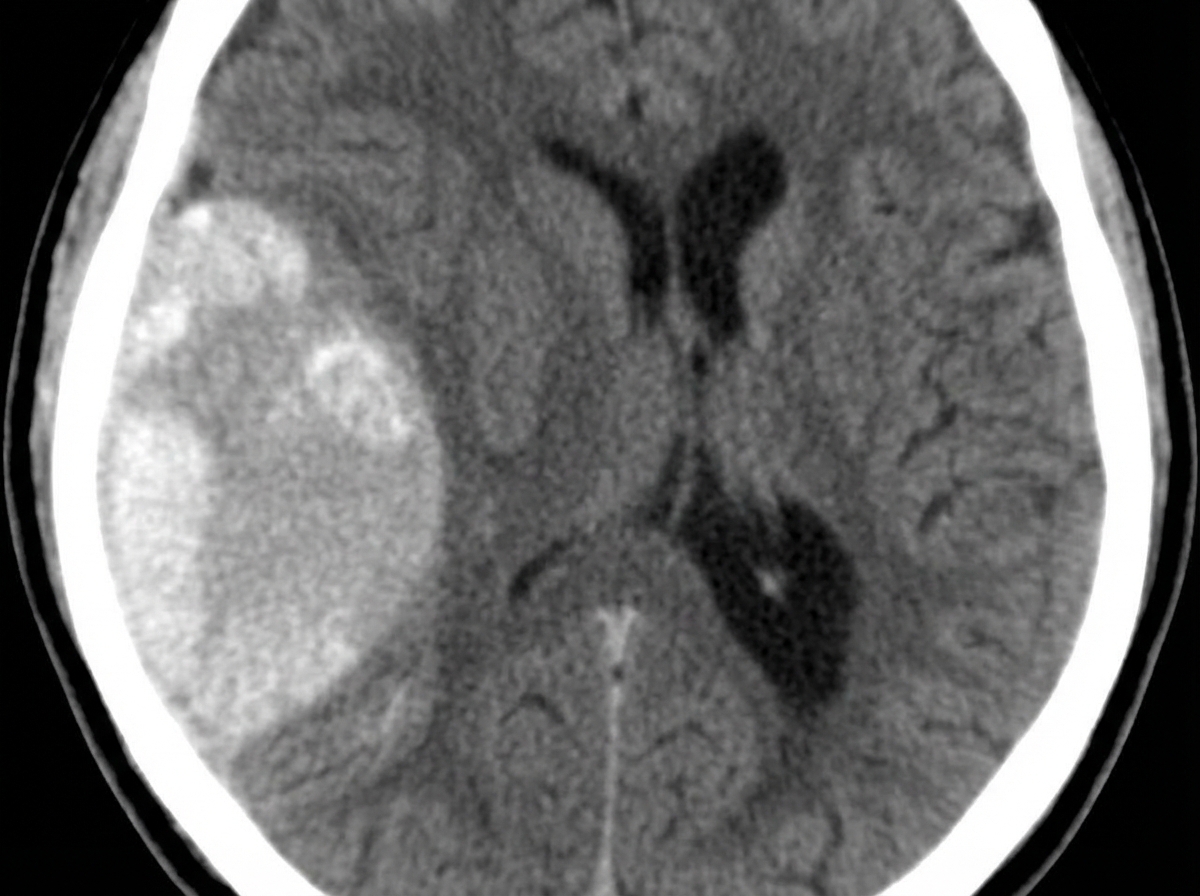
A 23-year-old man presents with a blunt force injury to the head from a baseball bat. He is currently unconscious, although his friends say he was awake and speaking with them en route to the hospital. He has no significant past medical history and takes no current medications. The vital signs include: temperature 37.0°C (98.6°F), blood pressure 165/85 mm Hg, pulse 50/min, and respiratory rate 19/min. On physical examination, there is a blunt force injury to the left temporoparietal region approximately 10.1–12.7 cm (4–5 in) in diameter. There is anisocoria of the left pupil, which is unresponsive to light. The patient is intubated and fluid resuscitation is initiated. A noncontrast computed tomography (CT) scan of the head is acquired and shown in the exhibit (see image). Which of the following is the most appropriate medical treatment for this patient?
A trauma 'huddle' is called. Morphine is administered for pain. Low-flow oxygen is begun. A traumatic diaphragmatic rupture is suspected. Infusion of 0.9% saline is begun. Which of the following is the most appropriate next step in management?
A 25-year-old man is admitted to the emergency department because of an episode of acute psychosis with suicidal ideation. He has no history of serious illness and currently takes no medications. Despite appropriate safety precautions, he manages to leave the examination room unattended. Shortly afterward, he is found lying outside the emergency department. A visitor reports that she saw the patient climbing up the facade of the hospital building. He does not respond to questions but points to his head when asked about pain. His pulse is 131/min, respirations are 22/min, and blood pressure is 95/61 mm Hg. Physical examination shows a 1-cm head laceration and an open fracture of the right tibia. He opens his eyes spontaneously. Pupils are equal, round, and reactive to light. Breath sounds are decreased over the right lung field, and the upper right hemithorax is hyperresonant to percussion. Which of the following is the most appropriate next step in management?
A 60-year-old man is brought to the emergency department 25 minutes after falling and hitting his left flank on a concrete block. He has severe left-sided chest pain and mild shortness of breath. He underwent a right knee replacement surgery 2 years ago. He has type 2 diabetes mellitus. He has smoked one pack of cigarettes daily for 42 years. Current medications include metformin, sitagliptin, and a multivitamin. He appears uncomfortable. His temperature is 37.5°C (99.5°F), pulse is 102/min, respirations are 17/min, and blood pressure is 132/90 mm Hg. Pulse oximetry on room air shows an oxygen saturation of 96%. Examination shows multiple abrasions on his left flank and trunk. The upper left chest wall is tender to palpation and bony crepitus is present. There are decreased breath sounds over both lung bases. Cardiac examination shows no murmurs, rubs, or gallops. The abdomen is soft and nontender. Focused assessment with sonography for trauma is negative. An x-ray of the chest shows nondisplaced fractures of the left 4th and 5th ribs, with clear lung fields bilaterally. Which of the following is the most appropriate next step in management?
A 43-year-old man is brought to the emergency department 25 minutes after being involved in a high-speed motor vehicle collision in which he was a restrained passenger. On arrival, he has shortness of breath and is in severe pain. His pulse is 130/min, respirations are 35/min, and blood pressure is 90/40 mm Hg. Examination shows superficial abrasions and diffuse crepitus at the left shoulder level. Cardiac examination shows tachycardia with no murmurs, rubs, or gallops. The upper part of the left chest wall moves inward during inspiration. Breath sounds are absent on the left. He is intubated and mechanically ventilated. Two large bore intravenous catheters are placed and infusion of 0.9% saline is begun. Which of the following is the most likely cause of his symptoms?
A 75-year-old man is brought to the emergency department because of a 5-hour history of worsening chest pain and dyspnea. Six days ago, he fell in the shower and since then has had mild pain in his left chest. He appears pale and anxious. His temperature is 36.5°C (97.7°F), pulse is 108/min, respirations are 30/min, and blood pressure is 115/58 mm Hg. Pulse oximetry on room air shows an oxygen saturation of 88%. Examination shows decreased breath sounds and dullness to percussion over the left lung base. There is a 3-cm (1.2-in) hematoma over the left lower chest. An x-ray of the chest shows fractures of the left 8th and 9th rib, increased opacity of the left lung, and mild tracheal deviation to the right. Which of the following is the most appropriate next step in management?
Want unlimited practice?
Get full access to all questions, explanations, and performance tracking.
Scan to download app