
Sleep-related breathing disorders — MCQs

A 54-year-old man comes to the physician because of excessive daytime sleepiness for 5 months. He wakes up frequently at night, and his wife says his snoring has become louder. He is 180 cm (5 ft 10 in) tall and weighs 104 kg (230 lb); his BMI is 33 kg/m2. His pulse is 80/min and his respiratory rate is 11/min. His jugular venous pressure is 7 cm H2O. He has 2+ pitting edema of the lower legs and ankles. Arterial blood gas analysis on room air shows a pH of 7.42 and a PCO2 of 41 mm Hg. An x-ray of the chest shows normal findings. Which of the following is the most likely underlying cause of this patient's condition?
A 47-year-old man presents to his primary care physician for headaches. The patient states that he typically has headaches in the morning that improve as the day progresses. Review of systems reveals that he also experiences trouble focusing and daytime fatigue. The patient drinks 2 to 3 alcoholic beverages daily and smokes 1 to 2 cigarettes per day. His past medical history includes diabetes, hypertension, and hypercholesterolemia. His current medications include insulin, metformin, metoprolol, aspirin, and atorvastatin. His temperature is 98.7°F (37.1°C), blood pressure is 157/98 mmHg, pulse is 90/min, respirations are 15/min, and oxygen saturation is 99% on room air. Physical exam reveals a fatigued-appearing obese man with a BMI of 37 kg/m^2. Which of the following is the best initial step in management?
A 65-year-old male with multiple comorbidities presents to your office complaining of difficulty falling asleep. Specifically, he says he has been having trouble breathing while lying flat very shortly after going to bed. He notes it only gets better when he adds several pillows, but that sitting up straight is an uncomfortable position for him in which to fall asleep. What is the most likely etiology of this man's sleeping troubles?
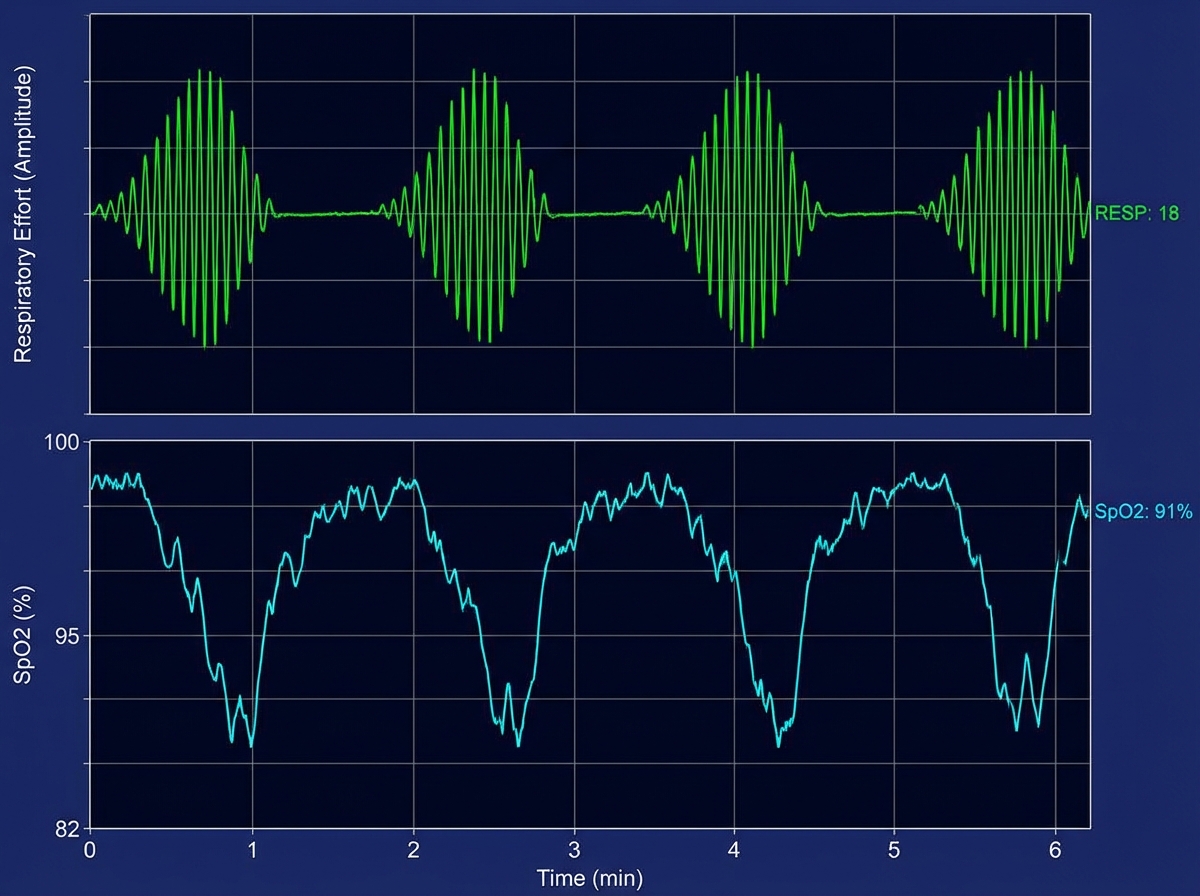
A 66-year-old man is brought to the emergency department because of shortness of breath and confusion. His pulse is 98/min, and blood pressure is 109/73 mm Hg. He is oriented to person but not time or place. A graph of his breathing pattern and oxygen saturation is shown. Which of the following additional findings is most likely present in this patient?
A 37-year-old man presents to his primary care physician because he has been experiencing episodes where he wakes up at night gasping for breath. His past medical history is significant for morbid obesity as well as hypertension for which he takes lisinopril. He is diagnosed with sleep apnea and prescribed a continuous positive airway pressure apparatus. In addition, the physician discusses making lifestyle and behavioral changes such as dietary modifications and exercise. The patient agrees to attempt these behavioral changes. Which of the following is most likely to result in improving patient adherence to this plan?
A 55-year-old man presents to the physician for the evaluation of excessive daytime sleepiness over the past six months. Despite sleeping 8–9 hours a night and taking a nap during the day, he feels drowsy and is afraid to drive. His wife complains of loud snoring and gasping during the night. His blood pressure is 155/95 mm Hg. BMI is 37 kg/m2. Oropharyngeal examination shows a small orifice and an enlarged tongue and uvula. The soft palate is low-lying. The examination of the nasal cavity shows no septal deviation or polyps. Examination of the lungs and heart shows no abnormalities. Polysomnography shows an apnea-hypopnea index of 20 episodes/h. The patient is educated about weight loss, exercise, and regular sleep hours and duration. Which of the following is the most appropriate next step in management?
A 35-year-old woman who was recently ill with an upper respiratory infection presents to the emergency department with weakness in her lower limbs and difficulty breathing. Her symptoms began with a burning sensation in her toes along with numbness. She claims that the weakness has been getting worse over the last few days and now involving her arms and face. Currently, she is unable to get up from the chair without some assistance. Her temperature is 37.0°C (98.6°F), the blood pressure is 145/89 mm Hg, the heart rate is 99/min, the respiratory rate is 12/min, and the oxygen saturation is 95% on room air. On physical examination, she has diminished breath sounds on auscultation of bilateral lung fields with noticeably poor inspiratory effort. Palpation of the lower abdomen reveals a palpable bladder. Strength is 3 out of 5 symmetrically in the lower extremities bilaterally. The sensation is intact. What is the most likely diagnosis?
A 21-year-old woman presents into the clinic worried that she might be pregnant. Her last menstrual period was 4 months ago and recalls that she did have unprotected sex with her boyfriend, despite not having sexual desire. They have since broken up, and she would like to do a pregnancy test. She appears very emaciated but is physically active. She says that she spends a few hours in the gym almost every day but would spend longer if she was to stray from her diet so that she does not gain any weight. Her calculated BMI is 17 kg/m2, and her urine pregnancy test is negative. Which of the following additional findings would most likely be present in this patient?
A 22-year-old college student comes to the physician because of depressed mood and fatigue for the past 5 weeks. He has been feeling sad and unmotivated to attend his college classes. He finds it particularly difficult to get out of bed in the morning. He has difficulty concentrating during lectures and often feels that he is less intelligent compared to his classmates. In elementary school, he was diagnosed with attention deficit hyperactivity disorder and treated with methylphenidate; he stopped taking this medication 4 years ago because his symptoms had improved during high school. He has smoked two packs of cigarettes daily for 8 years; he feels guilty that he has been unable to quit despite numerous attempts. During his last attempt 3 weeks ago, he experienced increased appetite and subsequently gained 3 kg (6 lb 10 oz) in a week. Mental status examination shows psychomotor retardation and restricted affect. There is no evidence of suicidal ideation. Which of the following is the most appropriate pharmacotherapy?
A 50-year-old man with severe obstructive sleep apnea (AHI 65 events/hour) and CPAP intolerance despite multiple mask trials undergoes maxillomandibular advancement surgery. Three months post-operatively, he continues to report excessive daytime sleepiness and his bed partner reports persistent snoring. Post-operative polysomnography shows AHI of 28 events/hour. He has a BMI of 38 kg/m² (unchanged from pre-surgery) and crowded posterior pharynx. Evaluate the next management strategy.
Want unlimited practice?
Get full access to all questions, explanations, and performance tracking.
Scan to download app