
Neurobiology of ADHD — MCQs

A mother brings her 3-year-old son to the doctor because she is worried that he might be harming himself by constantly banging his head on the wall. He has been exhibiting this behavior for a few months. She is also worried because he has started to speak less than he used to and does not respond when his name is called. He seems aloof during playtime with other children and seems to have lost interest in most of his toys. What is the most likely diagnosis?
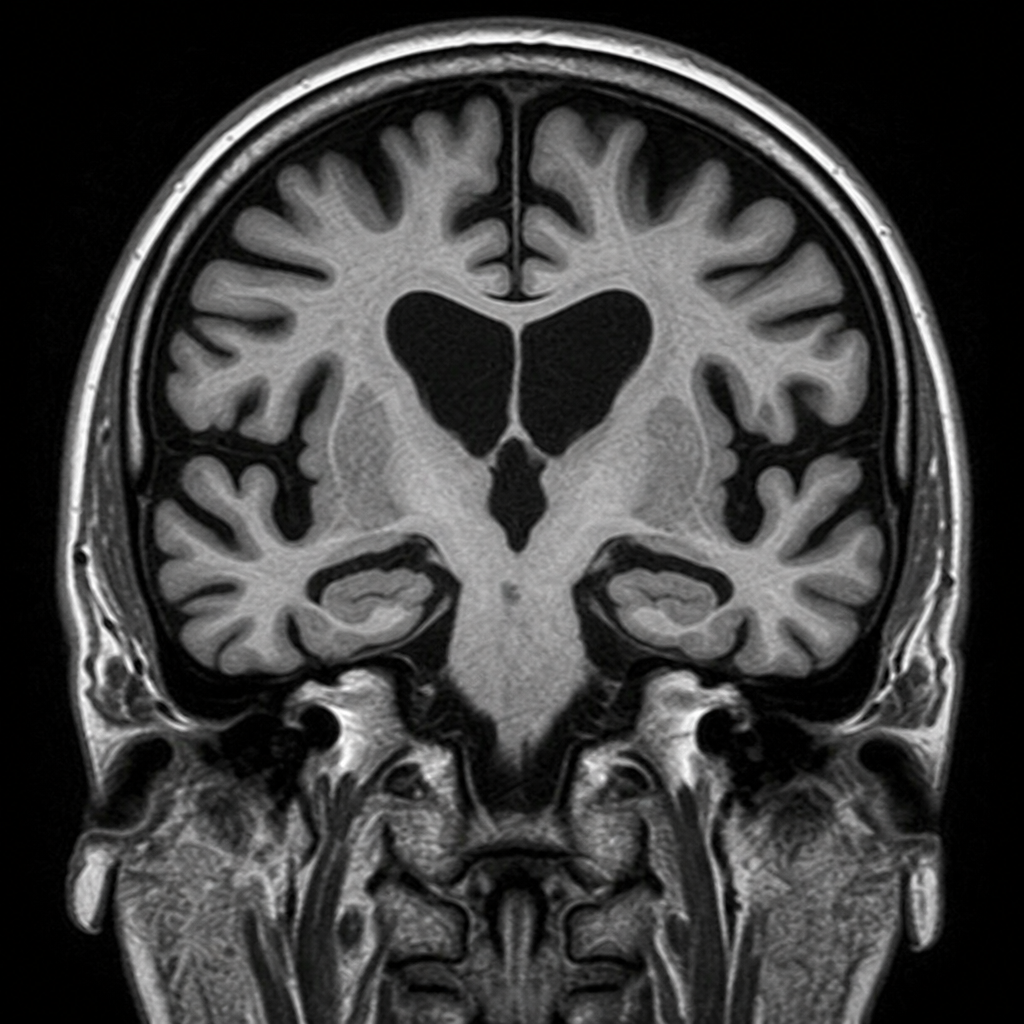
A 73-year-old man is brought to the physician by his daughter for evaluation of increasing forgetfulness during the past 6 months. The daughter reports that he recently got lost while walking home from the grocery store. He has also been more irritable recently. On mental status examination, he has a normal affect. He is oriented to person and place but cannot recall which month it is. He recalls memories from more than 20 years ago in great detail but cannot state his home address or the name of his recently born grandson. His gait is normal and there is no nystagmus. An MRI of the brain is shown. Which of the following is the most likely underlying cause of the radiologic findings?
A 7-year-old boy is brought to the physician because of repetitive, involuntary blinking, shrugging, and grunting for the past year. His mother states that his symptoms improve when he is physically active, while tiredness, boredom, and stress aggravate them. He has felt increasingly embarrassed by his symptoms in school, and his grades have been dropping from average levels. He has met all his developmental milestones. Vital signs are within normal limits. Mental status examination shows intact higher mental functioning and thought processes. Excessive blinking, grunting, and jerking of the shoulders and neck occur while at rest. The remainder of the examination shows no abnormalities. This patient's condition is most likely associated with which of the following findings?
A 14-year-old boy is brought in to the clinic by his parents for weird behavior for the past 4 months. The father reports that since the passing of his son's pet rabbit about 5 months ago, his son has been counting during meals. It could take up to 2 hours for him to finish a meal as he would cut up all his food and arrange it in a certain way. After asking the parents to leave the room, you inquire about the reason for these behaviors. He believes that another family member is going to die a “terrible death” if he doesn’t eat his meals in multiples of 5. He understands that this is unreasonable but just can’t bring himself to stop. Which of the following abnormality is this patient's condition most likely associated with?
A 40-year-old man is brought to the emergency department after sustaining multiple lacerations during a bar fight. The patient’s wife says that he has been showing worsening aggression and has been involved in a lot of arguments and fights for the past 2 years. The patient has no significant past medical or psychiatric history and currently takes no medications. The patient cannot provide any relevant family history since he was adopted as an infant. His vitals are within normal limits. On physical examination, the patient looks apathetic and grimaces repeatedly. Suddenly, his arms start to swing by his side in an uncontrolled manner. Which area of the brain is most likely affected in this patient?
A 22-year-old man is brought to the physician by his mother because of concerns about his recent behavior. Three months ago, the patient first reported hearing loud voices coming from the ceiling of his room. During this time, he has also become increasingly worried that visitors to the house were placing secret surveillance cameras. Mental status examination shows tangential speech with paranoid thoughts. Treatment for this patient's condition predominantly targets which of the following dopaminergic pathways?
A 7-year-old boy is brought in to clinic by his parents with a chief concern of poor performance in school. The parents were told by the teacher that the student often does not turn in assignments, and when he does they are partially complete. The child also often shouts out answers to questions and has trouble participating in class sports as he does not follow the rules. The parents of this child also note similar behaviors at home and have trouble getting their child to focus on any task such as reading. The child is even unable to watch full episodes of his favorite television show without getting distracted by other activities. The child begins a trial of behavioral therapy that fails. The physician then tries pharmacological therapy. Which of the following is most likely the mechanism of action of an appropriate treatment for this child's condition?
An 11-year-old boy is brought to the clinic by his parents for poor academic performance. The patient’s parents say that his teacher told them that he may have to repeat a grade because of his lack of progress, as he does not pay attention to the lessons, tends to fidget about in his seat, and often blurts out comments when it is someone else’s turn to speak. Furthermore, his after-school karate coach says the patient no longer listens to instructions and has a hard time focusing on the activity at hand. The patient has no significant past medical history and is currently not on any medications. The patient has no known learning disabilities and has been meeting all developmental milestones. The parents are vehemently opposed to using any medication with a potential for addiction. Which of the following medications is the best course of treatment for this patient?
A 9-year-old boy is brought to a pediatric psychologist by his mother because of poor academic performance. The patient’s mother mentions that his academic performance was excellent in kindergarten and first grade, but his second and third-grade teachers complain that he is extremely talkative, does not complete schoolwork, and frequently makes careless mistakes. They also complain that he frequently looks at other students or outside the window during the class and is often lost during the lessons. At home, he is very talkative and disorganized. When the pediatrician asks the boy his name, he replies promptly. He was born at full term by spontaneous vaginal delivery. He is up-to-date on all vaccinations and has met all developmental milestones on time. A recent IQ test scored him at 95. His physical examination is completely normal. When he is asked to read from an age-appropriate children’s book, he reads it fluently and correctly. Which of the following is the most likely diagnosis in this patient?
A 19-year-old man presents to the emergency room after a suicidal gesture following a fight with his new girlfriend. He tearfully tells you that she is “definitely the one," unlike his numerous previous girlfriends, who were "all mean and selfish” and with whom he frequently fought. During this fight, his current girlfriend suggested that they spend time apart, so he opened a window and threatened to jump unless she promised to never leave him. You gather that his other relationships have ended in similar ways. He endorses impulsive behaviors and describes his moods as “intense” and rapidly changing in response to people around him. He often feels “depressed” for one day and then elated the next. You notice several superficial cuts and scars on the patient’s arms and wrists, and he admits to cutting his wrists in order to “feel something other than my emptiness.” Which of the following is the most likely diagnosis for this patient?
Want unlimited practice?
Get full access to all questions, explanations, and performance tracking.
Scan to download app