
Learning disorders — MCQs

A mother brings her 3-year-old son to the doctor because she is worried that he might be harming himself by constantly banging his head on the wall. He has been exhibiting this behavior for a few months. She is also worried because he has started to speak less than he used to and does not respond when his name is called. He seems aloof during playtime with other children and seems to have lost interest in most of his toys. What is the most likely diagnosis?
A 4-year-old boy is brought to the physician by his parents because of concerns about his behavior during the past year. His parents report that he often fails to answer when they call him and has regular unprovoked episodes of crying and screaming. At kindergarten, he can follow and participate in group activities, but does not follow his teacher's instructions when these are given to him directly. He is otherwise cheerful and maintains eye contact when spoken to but does not respond when engaged in play. He gets along well with friends and family. He started walking at the age of 11 months and can speak in two-to-three-word phrases. He often mispronounces words. Which of the following is the most likely diagnosis?
A 4-year-old boy is brought to the physician because of non-fluent speech. His mother worries that his vocabulary is limited for his age and because he cannot use simple sentences to communicate. She says he enjoys playing with his peers and parents, but he has always lagged behind in his speaking and communication. His speech is frequently not understood by strangers. He physically appears normal. His height and weight are within the normal range for his age. He responds to his name, makes eye contact, and enjoys the company of his mother. Which of the following is the most appropriate next step in management?
A 9-year-old boy is brought to a pediatric psychologist by his mother because of poor academic performance. The patient’s mother mentions that his academic performance was excellent in kindergarten and first grade, but his second and third-grade teachers complain that he is extremely talkative, does not complete schoolwork, and frequently makes careless mistakes. They also complain that he frequently looks at other students or outside the window during the class and is often lost during the lessons. At home, he is very talkative and disorganized. When the pediatrician asks the boy his name, he replies promptly. He was born at full term by spontaneous vaginal delivery. He is up-to-date on all vaccinations and has met all developmental milestones on time. A recent IQ test scored him at 95. His physical examination is completely normal. When he is asked to read from an age-appropriate children’s book, he reads it fluently and correctly. Which of the following is the most likely diagnosis in this patient?
A 6-year-old boy presents to the pediatrician with his parents. He is fully vaccinated and met most developmental milestones. His fine motor milestones are delayed; at present, he cannot eat by himself and has difficulty in self-dressing. His intelligence quotient (IQ) is 65. He listens quietly while spoken to and engages in play with his classmates. He neither talks excessively nor remains mute, but engages in normal social conversation. There is no history of seizures and he is not on any long-term medical treatment. On his physical examination, his vital signs are stable. His height and weight are normal for his age and sex, but his occipitofrontal circumference is less than the 3rd percentile for his age and sex. His neurologic examination is also normal. Which of the following is the most likely diagnosis?
A 4-year-old boy is brought to a pediatrician by his parents for a consultation after his teacher complained about his inability to focus or make friends at school. They mention that the boy does not interact well with others at home, school, or daycare. On physical examination, his vital signs are stable with normal weight, height, and head circumference for his age and sex. His general examination and neurologic examination are completely normal. A recent audiological evaluation shows normal hearing, and intellectual disability has been ruled out by a clinical psychologist. Which of the following investigations is indicated as part of his diagnostic evaluation at present?
A 3-year-old girl is brought to the physician for a well-child examination. She was born at term and has been healthy since. She can climb up and down the stairs and can pedal a tricycle. She has difficulty using a spoon to feed herself but can copy a line. She speaks in 2- to 3-word sentences that can be understood by most people. She is selfish while playing with children her age and throws tantrums quite often. She cannot put on her own shoes and socks. She does not tolerate separation from her parents. She is at 60th percentile for height and weight. Physical examination including neurologic examination reveals no abnormalities. Which of the following is the most appropriate assessment of her development?
Which of the following features is NOT typically associated with Fragile X syndrome?
True about Fragile X syndrome is
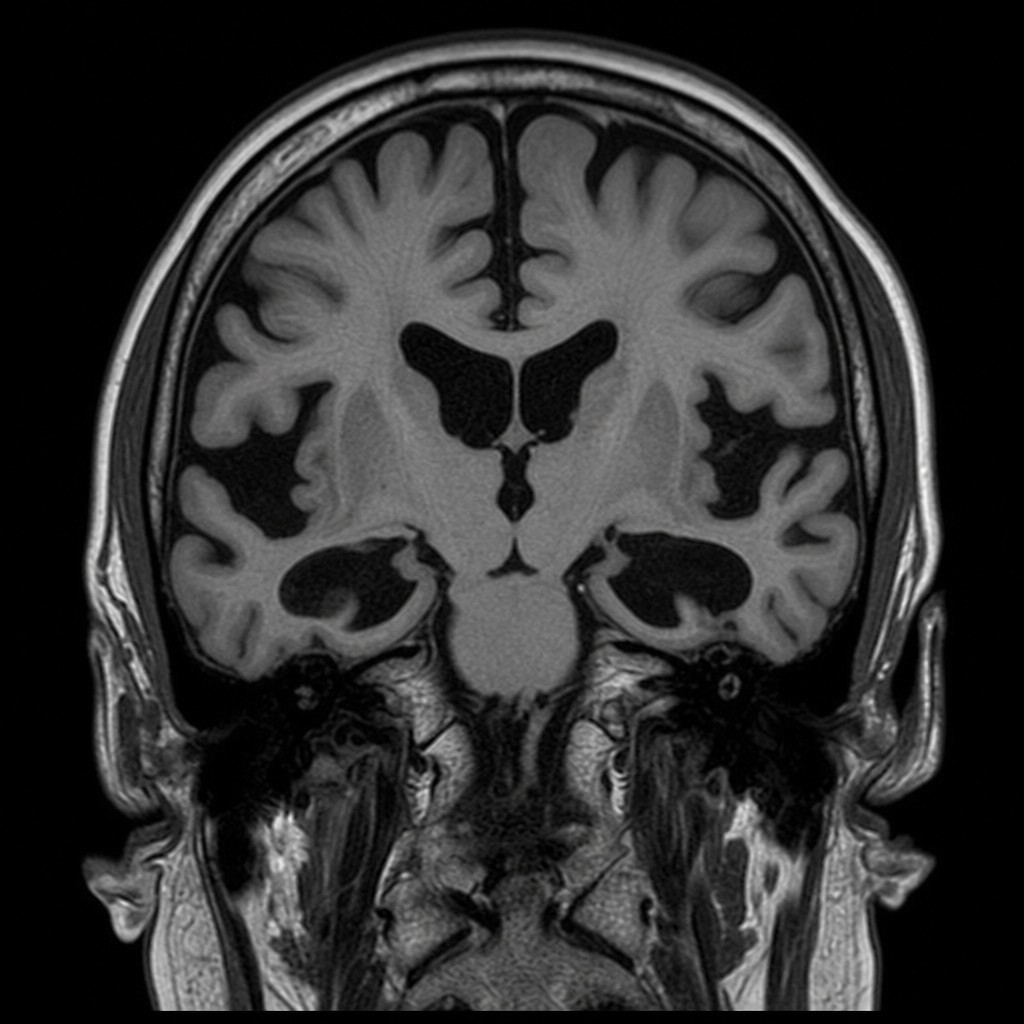
A 67-year-old retired engineer is brought by his daughter for a 14-month history of progressive personality change. She reports he has become disinhibited, made sexually inappropriate comments at family gatherings, and recently shoplifted a candy bar without apparent concern. He scores 24/30 on the MoCA, losing points primarily in the executive function and abstraction domains. Memory is relatively preserved. He has no history of stroke, head trauma, or alcohol use. An MRI of the brain shows frontal and anterior temporal lobe atrophy with relative sparing of the posterior cortex and hippocampi. Which of the following is the most likely underlying diagnosis?
Want unlimited practice?
Get full access to all questions, explanations, and performance tracking.
Scan to download app