
Intellectual disability classification — MCQs

A 4-year-old boy is brought to the physician because of non-fluent speech. His mother worries that his vocabulary is limited for his age and because he cannot use simple sentences to communicate. She says he enjoys playing with his peers and parents, but he has always lagged behind in his speaking and communication. His speech is frequently not understood by strangers. He physically appears normal. His height and weight are within the normal range for his age. He responds to his name, makes eye contact, and enjoys the company of his mother. Which of the following is the most appropriate next step in management?
A 13-month-old girl is brought to the physician for a well-child examination. She was born at 38 weeks' gestation. There is no family history of any serious illnesses. She cannot pull herself to stand from a sitting position. She can pick an object between her thumb and index finger but cannot drink from a cup or feed herself using a spoon. She comes when called by name and is willing to play with a ball. She cries if she does not see her parents in the same room as her. She coos “ma” and “ba.” She is at the 50th percentile for height and weight. Physical examination including neurologic examination shows no abnormalities. Which of the following is the most appropriate assessment of her development?
A 6-year-old boy presents to the pediatrician with his parents. He is fully vaccinated and met most developmental milestones. His fine motor milestones are delayed; at present, he cannot eat by himself and has difficulty in self-dressing. His intelligence quotient (IQ) is 65. He listens quietly while spoken to and engages in play with his classmates. He neither talks excessively nor remains mute, but engages in normal social conversation. There is no history of seizures and he is not on any long-term medical treatment. On his physical examination, his vital signs are stable. His height and weight are normal for his age and sex, but his occipitofrontal circumference is less than the 3rd percentile for his age and sex. His neurologic examination is also normal. Which of the following is the most likely diagnosis?
A 3-year-old girl is brought to the physician for a well-child examination. She was born at term and has been healthy since. She can climb up and down the stairs and can pedal a tricycle. She has difficulty using a spoon to feed herself but can copy a line. She speaks in 2- to 3-word sentences that can be understood by most people. She is selfish while playing with children her age and throws tantrums quite often. She cannot put on her own shoes and socks. She does not tolerate separation from her parents. She is at 60th percentile for height and weight. Physical examination including neurologic examination reveals no abnormalities. Which of the following is the most appropriate assessment of her development?
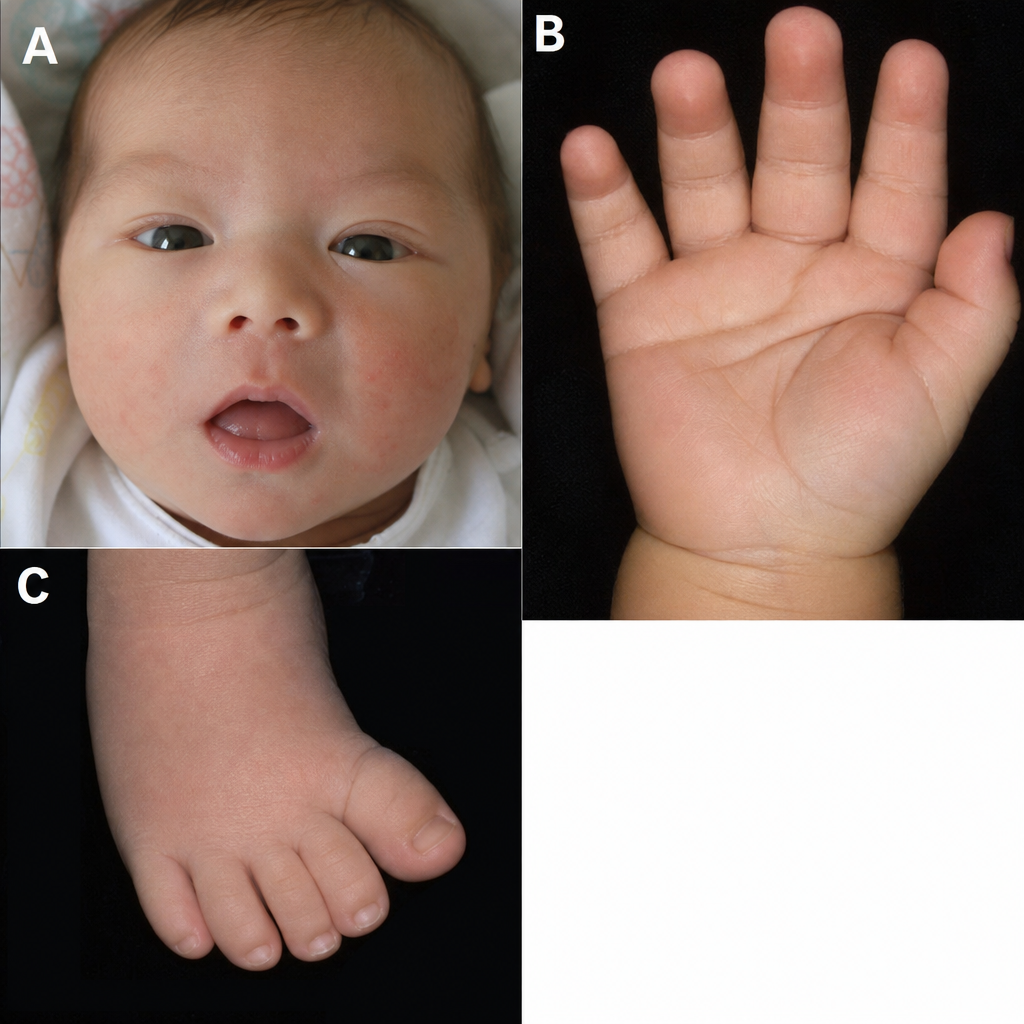
You are called to evaluate a newborn. The patient was born yesterday to a 39-year-old mother. You observe the findings illustrated in Figures A-C. What is the most likely mechanism responsible for these findings?
A 28-year-old male presents to his primary care physician with complaints of intermittent abdominal pain and alternating bouts of constipation and diarrhea. His medical chart is not significant for any past medical problems or prior surgeries. He is not prescribed any current medications. Which of the following questions would be the most useful next question in eliciting further history from this patient?
Which of the following features is NOT typically associated with Fragile X syndrome?
True about Fragile X syndrome is
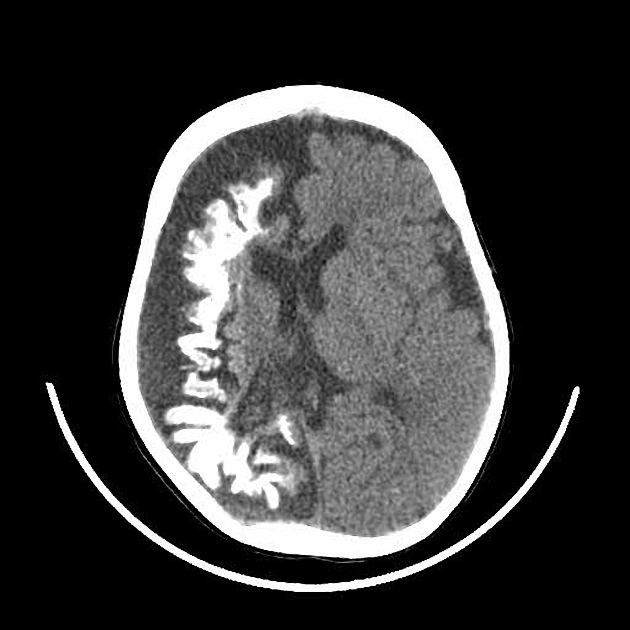
A 10-year-old boy is brought to a family physician by his mother with a history of recurrent headaches. The headaches are moderate-to-severe in intensity, unilateral, mostly affecting the left side, and pulsatile in nature. Past medical history is significant for mild intellectual disability and complex partial seizures that sometimes progress to secondary generalized seizures. He was adopted at the age of 7 days. His birth history and family history are not available. His developmental milestones were slightly delayed. There is no history of fever or head trauma. His vital signs are within normal limits. His height and weight are at the 67th and 54th percentile for his age. Physical examination reveals an area of bluish discoloration on his left eyelid and cheek. The rest of the examination is within normal limits. A computed tomography (CT) scan of his head is shown in the exhibit. Which of the following additional clinical findings is most likely to be present?
Which of the following is not a characteristic of Fragile X syndrome?
Want unlimited practice?
Get full access to all questions, explanations, and performance tracking.
Scan to download app