Acrodermatitis enteropathica is:-
An 8 year old boy complains of increasing muscle weakness. On examination, his calves are bulky and show muscle tightening. His serum creatine kinase levels are increasing with age. Which of the following is the most likely diagnosis?
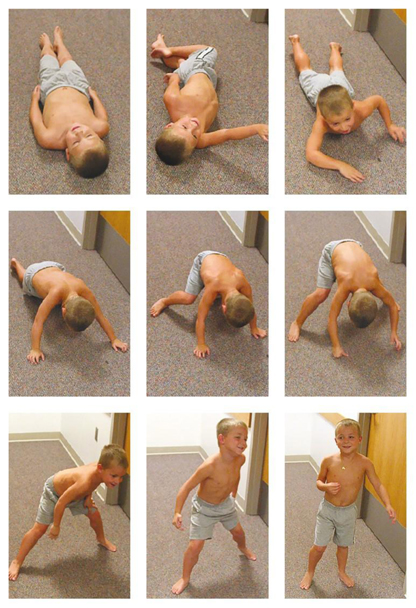
A 7 year old boy with progressive muscle weakness and walking difficulties presented with the following finding. What is the probable diagnosis?

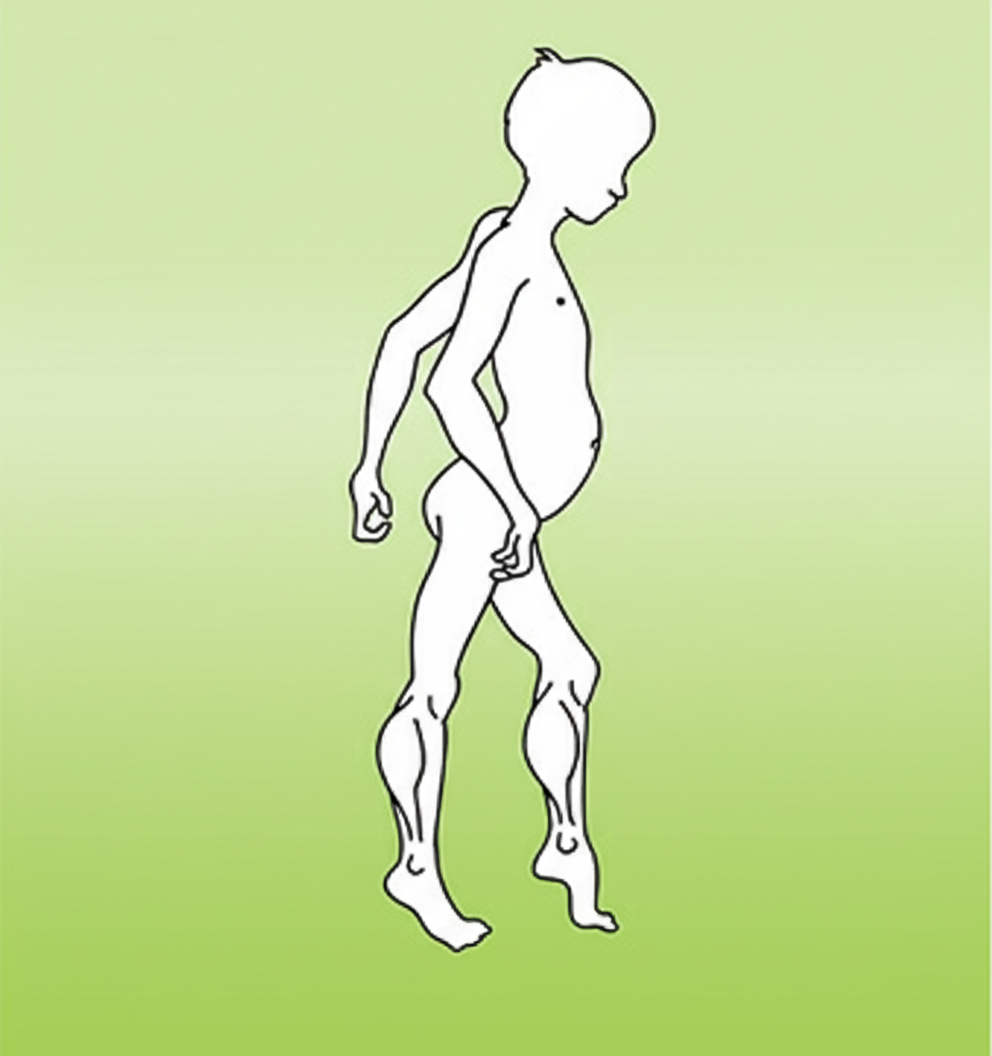
A 2-year- old boy presents with progressive clumsiness and difficulty walking. On physical examination, the child has large calves. He has difficulty walking on his toes and has a waddling gait as shown. Which of the following is the most likely diagnosis?
Ataxia telangiectasia is associated with all of the following except:
10-year old male with poor growth, poor appetite, recurrent chest infection and steatorrhea is likely to have ____________ .
Which of the following syndromes is associated with mental retardation?
A 7-year-old boy has demineralized bones with pseudofractures. Physiologic doses of vitamin D do not result in improvement. Which of the following is most likely to be associated with this syndrome?
4 year old male, recurrent URTI, has difficulty breathing, High arched palate, Failure to grow and impaired hearing, management is
Streak ovaries are seen in: CMC (Vellore) 09
Explanation: ***Inherited disorder of impaired uptake of zinc from body*** - **Acrodermatitis enteropathica** is an **autosomal recessive** genetic disorder characterized by a mutation in the **SLC39A4 gene**, which encodes a zinc transporter protein (ZIP4). - This mutation leads to **impaired absorption of dietary zinc** in the intestine, resulting in severe **zinc deficiency**. - Clinical features include **periorificial and acral dermatitis**, **diarrhea**, and **alopecia** that respond to zinc supplementation. *Inherited disorder of excessive excretion of zinc from body* - This statement is incorrect as Acrodermatitis enteropathica is due to **impaired uptake**, not excessive excretion of zinc. - Excessive excretion of zinc is not the mechanism responsible for the primary deficiency seen in this condition. *Inherited disorder of excessive excretion of copper from body* - This describes conditions like **Wilson's disease**, which involves copper accumulation due to impaired biliary excretion, not zinc deficiency. - Acrodermatitis enteropathica specifically relates to **zinc metabolism**, not copper. *Inherited disorder of impaired uptake of copper from body* - This describes conditions like **Menkes disease**, a rare X-linked recessive disorder characterized by a defect in copper transport and absorption, leading to copper deficiency. - Acrodermatitis enteropathica is distinctly a **zinc metabolism disorder**. *Inherited disorder of impaired excretion of zinc from body* - This would imply zinc accumulation rather than deficiency, which is not the pathophysiology of Acrodermatitis enteropathica. - The condition is characterized by **zinc deficiency due to malabsorption**, not problems with zinc excretion.
Explanation: ***Dystrophin deficiency*** - The presentation of an 8-year-old boy with **increasing muscle weakness**, **bulky calves** (pseudohypertrophy), and **elevated creatine kinase** is highly characteristic of Duchenne muscular dystrophy, which is caused by a dystrophin deficiency. - The muscle tightening and progressive increase in **creatine kinase** over time further support this diagnosis, as muscle breakdown leads to enzyme release. - Duchenne typically presents between **3-5 years** with progressive weakness, wheelchair dependence by early teens, and very high CK levels (10-100x normal). *Becker muscular dystrophy* - While also caused by **dystrophin deficiency** (partial rather than complete), Becker muscular dystrophy has a **later onset** (usually age 10-15 years) and **milder, slower progression**. - The age of 8 years with significant symptoms and the rapid progression described are more consistent with **Duchenne** than Becker. *Congenital myopathy* - While hereditary muscle disorders, congenital myopathies typically present at birth or in early infancy with **generalized hypotonia** and **muscle weakness**, often static or slowly progressive. - They usually do not exhibit the prominent calf pseudohypertrophy seen in Duchenne muscular dystrophy. *Myelin deficiency* - Myelin deficiency disorders primarily affect the **nervous system**, leading to issues with nerve signal transmission rather than direct muscle weakness and pseudohypertrophy. - Symptoms would typically include **neurological deficits** such as sensory loss, ataxia, or spasticity. *Hereditary sensorimotor neuropathy* - These neuropathies (e.g., Charcot-Marie-Tooth disease) involve both **sensory and motor nerves**, leading to muscle weakness, atrophy, and sensory loss, often in the distal limbs. - They do not typically cause **calf pseudohypertrophy** or progressively high creatine kinase levels as seen in primary muscle diseases.
Explanation: ***Duchenne muscular dystrophy*** - The image illustrates the **Gower sign**, where the boy uses his hands to "walk up" his legs to stand from a seated position, indicating **proximal muscle weakness**, a classic feature of Duchenne muscular dystrophy (DMD). - DMD is an X-linked recessive disorder characterized by rapid progressive muscle degeneration, typically presenting in early childhood (3-5 years) with muscle weakness, **waddling gait**, and frequent falls. - The **age of presentation** (7 years) and **severity of weakness** requiring Gower's maneuver are most consistent with DMD rather than the milder Becker variant. *Emery-Dreifuss muscular dystrophy* - This dystrophy primarily affects **skeletal muscles** and the **cardiac muscle**, often presenting with joint contractures, particularly in the elbows, ankles, and neck, which are not explicitly shown or suggested as primary difficulties here. - While it causes muscle weakness, the **pattern of weakness** and specific movements like the Gower sign are more characteristic of DMD in this age group. *Spinal muscular atrophy* - This condition involves the **loss of motor neurons** in the spinal cord, leading to widespread muscle weakness and atrophy, but it typically presents with **floppiness** (hypotonia) in infancy and absence of deep tendon reflexes. - Patients with SMA would likely have significant difficulty achieving the positions seen in the Gower sign, and the muscle weakness is due to **nerve degeneration**, not directly to muscle pathology. *Myotonic dystrophy* - Myotonic dystrophy is characterized by **myotonia** (delayed muscle relaxation), distal muscle weakness, and often involves multiple organ systems. - It usually presents later in childhood or adulthood with distinctive facial weakness, difficulty releasing grip, and is not typically associated with the classic presentation of **Gower sign** in a 7-year-old child. *Becker muscular dystrophy* - Becker muscular dystrophy is an **allelic variant** of DMD with mutations in the same dystrophin gene but producing a partially functional protein. - It typically has a **later onset** (usually after age 10-12) and **slower progression** compared to DMD, making it less likely in a 7-year-old with significant weakness requiring Gower's maneuver. - Patients with Becker can often maintain ambulation into their 20s or later, unlike DMD patients who typically lose ambulation by early teens.
Explanation: ***Duchenne muscular dystrophy*** - This X-linked recessive disorder is characterized by **progressive muscle weakness** and **atrophy**, typically presenting in early childhood with symptoms like **clumsiness, difficulty walking, and a waddling gait**. - **Pseudohypertrophy of the calves**, due to fat and connective tissue infiltration, and walking on toes are classic signs, along with a **Gowers' sign** (using hands to push off the floor to stand). *Myotonic dystrophy* - This autosomal dominant disorder is frequently characterized by **myotonia** (delayed muscle relaxation), which is not described. - Clinical features usually include **distal muscle weakness**, **facial weakness**, **cataracts**, and **cardiac conduction abnormalities**, and symptoms typically begin in adolescence or adulthood, though congenital forms exist with more severe weakness. *Facioscapulohumeral dystrophy* - This genetic disorder has a primary presentation involving weakness of the **facial muscles**, **shoulder girdle**, and **upper arm**, which is not the predominant symptom set. - Onset is typically in adolescence or adulthood, with initial symptoms rarely affecting lower limb ambulation as severely in early childhood. *Becker muscular dystrophy* - While also an X-linked recessive disorder caused by a dystrophin gene mutation, **Becker muscular dystrophy** typically has a **later onset** and a **milder, slower progression** compared to Duchenne muscular dystrophy. - Symptoms usually appear in adolescence or early adulthood, and patients often retain the ability to walk into adulthood, unlike the rapid progression seen in this 2-year-old. *Limb-girdle muscular dystrophy* - This heterogeneous group of disorders primarily affects **proximal muscles** of the pelvic and shoulder girdles. - While it can present with proximal weakness, onset is typically **later in childhood or adolescence**, and **calf pseudohypertrophy** is less prominent than in Duchenne muscular dystrophy. - The age of presentation (2 years) and classic features make Duchenne more likely.
Explanation: ***Increased fraction of IgA immunoglobulins*** - Ataxia-telangiectasia is characterized by **decreased or absent IgA** and **low IgG2 and IgE** levels, leading to immunodeficiency. - The deficiency in IgA contributes to the recurrent sinopulmonary infections often seen in affected individuals. *Insulin resistance* - **Insulin resistance** is a known endocrine manifestation in patients with Ataxia-telangiectasia, often developing later in the disease course. - This is linked to the broader cellular dysfunction caused by the **ATM gene mutation**, which affects processes like DNA repair and cell cycle control. *Recurrent sinopulmonary infections* - Due to the associated **immunodeficiency**, particularly **IgA deficiency**, patients with Ataxia-telangiectasia are highly susceptible to recurrent sinopulmonary infections. - These infections, including **pneumonia and sinusitis**, are a significant cause of morbidity and mortality. *Lymphatic reticular malignancies* - Patients with Ataxia-telangiectasia have a significantly **increased risk of developing various cancers**, particularly **leukemias and lymphomas**. - This predisposition to malignancy is attributed to the defective **ATM gene**, which impairs DNA repair mechanisms and promotes genomic instability. *Decreased alpha-fetoprotein levels* - Ataxia-telangiectasia is actually associated with **elevated alpha-fetoprotein (AFP)** levels, not decreased levels. - **Elevated serum AFP** is a characteristic laboratory finding in A-T and serves as a useful diagnostic marker, though the mechanism is not fully understood.
Explanation: ***High sodium and chloride levels in the sweat*** - The constellation of poor growth, poor appetite, recurrent chest infections, and **steatorrhea** in a child is highly suggestive of **cystic fibrosis (CF)**. - **Cystic fibrosis** is characterized by defective chloride transport, leading to thick, viscous secretions in various exocrine glands, and the diagnostic hallmark is elevated **sweat chloride levels**. *Mental retardation* - While some genetic disorders causing poor growth might be associated with mental retardation, it does not directly explain **recurrent chest infections** or **steatorrhea**. - There is no direct link between mental retardation and the specific exocrine dysfunction seen in this patient's symptoms. *Recurrent skin allergy* - **Recurrent skin allergies** would present with dermatological symptoms like rash, itching, or eczema, which are not mentioned in the patient's primary complaints. - Skin allergies do not account for **poor growth**, **steatorrhea**, or frequent lung infections. *Diabetes mellitus* - **Diabetes mellitus** in children usually presents with symptoms like polyuria, polydipsia, unexplained weight loss, and fatigue, not typically recurrent chest infections or steatorrhea. - Although CF can lead to **CF-related diabetes** later in life due to pancreatic dysfunction, it's not the initial presenting symptom that encompasses all features described here. *Celiac disease* - **Celiac disease** can present with steatorrhea and poor growth due to malabsorption, but it does not typically cause **recurrent chest infections**. - The respiratory symptoms are the key distinguishing feature pointing toward cystic fibrosis rather than a purely gastrointestinal malabsorption disorder.
Explanation: ***Hunter syndrome*** - Hunter syndrome (Mucopolysaccharidosis Type II) is an X-linked recessive disorder characterized by the lysosomal accumulation of **glycosaminoglycans** (dermatan sulfate and heparan sulfate). - It leads to a range of symptoms including coarse facial features, skeletal abnormalities, and **developmental delay** or **intellectual disability** in more severe forms. *Morquio syndrome B* - **Morquio syndrome B** (MPS IVB) is a lysosomal storage disorder caused by a deficiency of the enzyme **beta-galactosidase**. - While it causes skeletal abnormalities and corneal clouding, it is generally **not associated with intellectual disability**. *Natowicz syndrome* - **Natowicz syndrome** is a rare genetic disorder characterized by **spastic paraplegia** and other neurological symptoms. - It is not typically cited as a syndrome primarily associated with widespread mental retardation as a core feature. *Scheie syndrome* - **Scheie syndrome** (Mucopolysaccharidosis Type IS) is a lysosomal storage disorder caused by **alpha-L-iduronidase deficiency**. - It is the mildest form of MPS I and typically presents with skeletal abnormalities, corneal clouding, and cardiac involvement, but **intelligence is usually normal**. *Sly syndrome* - **Sly syndrome** (Mucopolysaccharidosis Type VII) is a rare lysosomal storage disorder caused by a deficiency in **beta-glucuronidase**. - While patients can have skeletal abnormalities and organomegaly, the presence and severity of **intellectual disability are variable** and generally less consistent or severe than in Hunter syndrome.
Explanation: ***low 1,25(OH)2 vitamin D levels*** - The described condition is suggestive of rickets due to **vitamin D-dependent rickets type I** (VDDR-I) or **II (VDDR-II)**, where the body either cannot convert 25-hydroxyvitamin D to its active form (1,25(OH)2D) or has resistance to its effects. - In VDDR-I, there is a deficiency in the enzyme **1-alpha-hydroxylase**, leading to **low levels of active vitamin D** despite sufficient precursor (25-hydroxyvitamin D). *alopecia* - While alopecia can be associated with **vitamin D-dependent rickets type II** (VDDR-II), it is not a universal finding and is more specific to defects in the **vitamin D receptor (VDR)**, rather than just the general presentation of demineralized bones and pseudofractures. - The question describes general features of rickets resistant to physiologic vitamin D doses and doesn't provide enough information to specifically pinpoint VDDR-II over VDDR-I. *osteoporosis* - **Osteoporosis** is characterized by reduced bone mass and structural deterioration, making bones fragile and prone to fractures. - The primary issue here is **demineralization (osteomalacia/rickets)** due to impaired vitamin D metabolism, not primarily a qualitative bone matrix defect as seen in osteoporosis. *hyperphosphatemia* - In rickets due to vitamin D deficiency or resistance, **hypophosphatemia** is typically observed. - **Vitamin D** plays a crucial role in regulating calcium and phosphate absorption from the gut and reabsorption in the kidneys, and its deficiency or impaired action leads to low serum phosphate levels. *elevated parathyroid hormone (PTH)* - While **elevated PTH** is indeed found in vitamin D-dependent rickets due to **secondary hyperparathyroidism** (the body's response to hypocalcemia), it is a **consequence** of the underlying vitamin D deficiency or resistance. - The question asks what is "most likely to be associated with this syndrome," and **low 1,25(OH)2 vitamin D levels** is the **primary pathophysiologic defect** in VDDR-I, making it the more direct and specific answer.
Explanation: ***Referral to ENT and geneticist*** - The constellation of **recurrent URTI**, **high-arched palate**, **failure to grow**, and **impaired hearing** in a 4-year-old child suggests a potential underlying craniofacial anomaly or genetic syndrome. - A **geneticist** can help diagnose underlying genetic conditions, while an **ENT specialist** can address the recurrent upper respiratory tract infections and impaired hearing, which could be related to conditions like **cleft palate** or **CHARGE syndrome**. - This is the **most appropriate initial step** for comprehensive evaluation and diagnosis. *Airway management and feeding support* - While important for immediate stabilization in some cases, these are *supportive measures* that might be necessary *after* a diagnosis is established or to manage acute crises. - They do not address the primary investigation and diagnosis of the complex symptoms presented. *Genetic testing for syndromes* - This is an integral part of the diagnostic process for many syndromes. - However, it's typically performed *after* an initial evaluation by a geneticist and often requires specific indications or panel choices based on clinical findings, rather than being the first and sole management step. *Speech and language therapy* - This is a crucial intervention if speech and language development is affected, which is likely given the impaired hearing and potential palate issues. - However, it addresses a symptom rather than the underlying cause and isn't the initial step for diagnosis or comprehensive management. *Prophylactic antibiotics and immunization* - While recurrent URTIs may warrant consideration of prophylactic measures, this approach treats symptoms without addressing the underlying cause. - Appropriate immunization should already be part of routine care, and prophylactic antibiotics don't address the structural and genetic issues causing the clinical presentation.
Explanation: ***Turner syndrome*** - Females with **Turner syndrome** (45, XO) often have underdeveloped, non-functional **streak ovaries** due to accelerated germ cell atresia. - This leads to **primary amenorrhea** and **infertility** due to **gonadal dysgenesis**. *Down syndrome* - **Down syndrome** (trisomy 21) is characterized by specific facial features, intellectual disability, and congenital heart defects. - While it can affect various organ systems, it is **not typically associated** with streak ovaries. *Klinefelter syndrome* - **Klinefelter syndrome** (47, XXY) affects males, leading to hypogonadism, infertility, and often gynecomastia. - It involves **testicular dysgenesis**, not ovarian abnormalities. *Kallmann syndrome* - **Kallmann syndrome** is a genetic condition characterized by **hypogonadotropic hypogonadism** (impaired production of GnRH) and **anosmia** (inability to smell). - It does not involve structural ovarian abnormalities like streak ovaries but rather a deficiency in hormonal stimulation. *Swyer syndrome* - **Swyer syndrome** (46, XY complete gonadal dysgenesis) also presents with streak gonads, but affected individuals have a **female phenotype with XY karyotype**. - Unlike Turner syndrome, these individuals have **normal stature** and lack the somatic features of Turner syndrome.
Chromosomal Disorders
Practice Questions
Disorders of Amino Acid Metabolism
Practice Questions
Disorders of Carbohydrate Metabolism
Practice Questions
Disorders of Lipid Metabolism
Practice Questions
Genetic Counseling
Practice Questions
Genetic Testing in Pediatrics
Practice Questions
Inborn Errors of Metabolism
Practice Questions
Lysosomal Storage Diseases
Practice Questions
Mitochondrial Disorders
Practice Questions
Multifactorial Inheritance Disorders
Practice Questions
Newborn Screening
Practice Questions
Single Gene Disorders
Practice Questions
Get full access to all questions, explanations, and performance tracking.
Start For Free