The following cost-effective investigations are routinely recommended in the screening of antenatal mothers, EXCEPT:
Which diagnostic tool is preferred for metabolic disease screening in children?
An infant presented with vomiting, malnutrition, blue eyes, blonde hair & fair skin. On investigation, Guthrie test was positive. All are true regarding this disease EXCEPT:
Screening for colorectal cancer is recommended when?
Which of the following is used for initial screening of auditory function in a neonate?
18 weeks pregnant female presents with no high risk of NTD and low risk of trisomy 21 on quad test. What is the most appropriate next step in management?
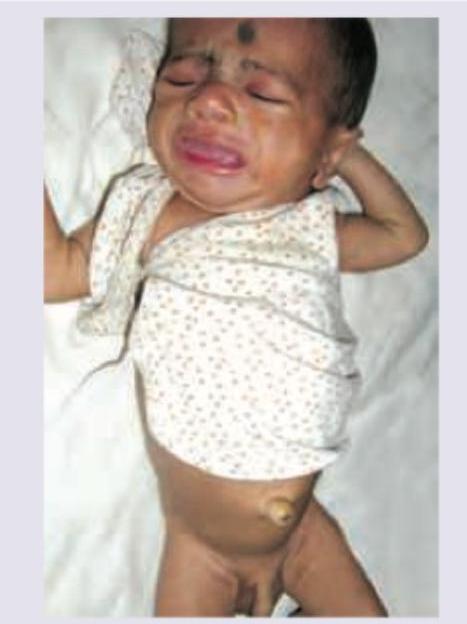
A neonate presents with the clinical features shown in the image below. What is the most likely diagnosis?
Consider the following disorders : 1. Delayed motor milestones 2. Spastic diplegia 3. Nyctalopia 4. Hearing defects Which of the above disorders occur as part of the spectrum of iodine deficiency disorders ?
The image shows a child with virilisation and clitoromegaly. What laboratory finding is typical for this condition, assuming the most common enzyme defect?
4 day old breastfed neonate, otherwise well, term neonate presented with jaundice, on testing the bilirubin level was found to be 18 mg/dl. Which of the following is the best step of management?
Explanation: ***Echocardiography for cardiac disease*** - **Echocardiography** is not a *routinely recommended* screening investigation for all antenatal mothers due to its cost and the relatively low prevalence of significant congenital heart disease requiring universal screening. - It is typically performed only if there are **specific risk factors** or suspicious findings suggesting cardiac pathology. *Blood sugar levels for GDM* - Screening for **gestational diabetes mellitus (GDM)** with blood sugar levels (e.g., glucose challenge test) is routinely recommended due to the potential maternal and fetal complications if untreated. - GDM is a common condition that can be effectively managed with early diagnosis, making screening a **cost-effective** preventive measure. *VDRL for syphilis* - Screening for **syphilis** using tests like VDRL (Venereal Disease Research Laboratory) is a standard and *routinely recommended* antenatal investigation. - Early detection and treatment of syphilis in pregnant women prevent serious adverse outcomes such as **congenital syphilis**, which can cause severe fetal morbidity and mortality. *Urine analysis for bacteriuria* - **Urine analysis** for **asymptomatic bacteriuria** is routinely recommended during pregnancy because untreated bacteriuria can lead to pyelonephritis, preterm labor, and low birth weight. - It is a simple, **cost-effective** test with significant benefits for maternal and fetal health.
Explanation: ***Tandem mass spectrometry*** - **Tandem mass spectrometry (TMS)** is the preferred method for newborn screening of many **inborn errors of metabolism** because it can simultaneously detect a wide range of metabolites from a single dried blood spot. - This technique rapidly identifies multiple **amino acid disorders**, **fatty acid oxidation disorders**, and **organic acidemias**, allowing for early intervention. *Urinalysis* - While urinalysis can detect some metabolic abnormalities (e.g., **ketones**, **glucose**), it is not a comprehensive screening tool for the broad spectrum of inherited metabolic diseases. - It primarily identifies end-products of metabolism rather than specific enzyme deficiencies or precursor compounds. *Genetic testing* - **Genetic testing** is highly specific for known genetic mutations, but it is typically used for confirmatory diagnosis or targeted screening when a specific condition is suspected, not for broad, universal newborn metabolic screening. - It can be expensive and time-consuming for population-wide screening of hundreds of potential metabolic disorders. *Complete Blood count* - A **complete blood count (CBC)** assesses cellular components of the blood (e.g., **red blood cells**, **white blood cells**, **platelets**) and is useful for detecting hematological disorders. - It does not directly screen for metabolic diseases, although some metabolic disorders can secondarily affect blood cell counts. *Plasma amino acid analysis* - **Plasma amino acid analysis** can detect specific aminoacidopathies (e.g., **phenylketonuria**, **maple syrup urine disease**), but it is limited to amino acid disorders only. - Unlike tandem mass spectrometry, it cannot simultaneously screen for fatty acid oxidation disorders and organic acidemias, making it less comprehensive for broad metabolic screening.
Explanation: ***Hypopigmentation due to tryptophan deficiency*** - The characteristic **hypopigmentation** (fair skin, blonde hair, blue eyes) in **phenylketonuria (PKU)** is due to **tyrosine deficiency**, not tryptophan deficiency. - **Phenylalanine hydroxylase (PAH)** deficiency leads to accumulation of phenylalanine, which cannot be converted to **tyrosine**. - **Tyrosine** is the precursor for **melanin synthesis** via the enzyme **tyrosinase**, so tyrosine deficiency results in decreased melanin production and hypopigmentation. *Phenyl acetate positive in urine* - In **phenylketonuria (PKU)**, **phenylalanine** accumulates and is shunted to alternative metabolic pathways, leading to the production and excretion of **phenylacetate, phenylpyruvate, and phenyllactate** in the urine. - The presence of these metabolites gives the urine a characteristic **mousey or musty odor**. *Mental retardation is present* - If **phenylketonuria (PKU)** is left untreated, the accumulation of **phenylalanine** is neurotoxic and leads to severe, **irreversible intellectual disability** and **developmental delay**. - Early detection through newborn screening (the **Guthrie test** detects elevated blood phenylalanine) and dietary phenylalanine restriction are crucial to prevent this outcome. *Due to PAH enzyme defect* - **Phenylketonuria (PKU)** is primarily caused by a deficiency in the enzyme **phenylalanine hydroxylase (PAH)**, which is responsible for converting phenylalanine to tyrosine. - This **autosomal recessive genetic disorder** leads to the accumulation of phenylalanine in the blood and tissues, causing the clinical manifestations.
Explanation: ***Early diagnosis can change the disease course due to effective treatment.*** - Screening is primarily recommended when **early detection** allows for interventions that effectively alter the natural history of the disease, improving prognosis or preventing progression. - For colorectal cancer, early diagnosis through screening allows for timely removal of **precancerous polyps** or early-stage cancers, significantly increasing survival rates. *The condition has a low case fatality rate.* - Conditions with low case fatality rates generally do not warrant extensive screening programs, as the **benefit-to-harm ratio** is often unfavorable. - Colorectal cancer, if undiagnosed and untreated, has a significant **case fatality rate**, making screening beneficial. *Diagnostic tools are not available.* - Screening is only conducted when **reliable, accurate, and cost-effective diagnostic tools** are available to detect the disease or its precursors in asymptomatic individuals. - If diagnostic tools are unavailable, screening would be impossible or ineffective, as there would be no way to identify those with the condition. *There is no effective treatment available.* - Screening is not typically recommended for diseases for which there is **no effective treatment**, as early detection would not improve patient outcomes. - The primary purpose of screening is to identify individuals who can benefit from **early intervention** and treatment to prevent serious morbidity or mortality.
Explanation: ***Otoacoustic emission (OAE)*** - **OAE** is the **gold standard for universal newborn hearing screening (UNHS)** programs worldwide due to its **non-invasive nature**, speed, and cost-effectiveness. - The test measures **sound waves produced by the outer hair cells of the cochlea** in response to auditory stimuli, indicating normal cochlear function. - **Quick to perform (2-3 minutes)**, requires minimal cooperation, and can be done while the infant is sleeping. *Auditory brainstem response (ABR)* - While **ABR** is a definitive diagnostic test for hearing loss, it is typically used as a **second-stage test** if an OAE screening fails, rather than the initial screening tool. - ABR measures the **brain's response to sound**, providing information about the neural pathway from the cochlea to the brainstem. - More **time-consuming and expensive** than OAE, making it less suitable for mass screening. *Pure tone audiometry (PTA)* - **PTA** requires active participation and understanding of instructions, making it **unsuitable for neonates** and young children. - This test is primarily used for **older children (typically >4 years) and adults** to determine hearing thresholds across various frequencies. *Free field audiometry* - **Free field audiometry** involves presenting sounds through loudspeakers to assess hearing, but it is **not suitable for precise threshold determination** in neonates due to their inability to localize sounds reliably or respond consistently. - It's mainly used for behavioral observation audiometry in older infants (6-24 months), but **not as a primary screening method** for neonates.
Explanation: ***Perform a detailed fetal ultrasound.*** - A **detailed fetal ultrasound** (often referred to as an **anatomy scan**) at around 18-22 weeks is a standard component of prenatal care for all pregnant women, regardless of screening test results. - This ultrasound evaluates fetal anatomy for structural anomalies, assesses fetal growth, and confirms gestational age, providing crucial information even with low-risk screening. *Repeat non-invasive screening test.* - Repeating a non-invasive screening test (like another quad screen or NIPT) is generally **not indicated** when initial results show a low risk and there are no other clinical concerns. - Such tests are primarily for screening purposes, and a second low-risk result would offer little additional actionable information, as their positive predictive value is low. *Perform invasive diagnostic testing.* - **Invasive diagnostic testing**, such as **amniocentesis** or **chorionic villus sampling (CVS)**, carries a risk of miscarriage and is reserved for situations with a high risk of chromosomal abnormalities or genetic conditions. - Given the low-risk quad screen results for trisomy 21 and no high risk for NTDs, invasive testing is **not warranted** at this stage. *Perform amniotic fluid analysis.* - **Amniotic fluid analysis** is part of an amniocentesis, an **invasive diagnostic procedure** designed to detect chromosomal abnormalities or genetic disorders. - This procedure is typically reserved for cases where screening tests indicate a high risk or there is a clinical suspicion of a genetic condition; it's **not a routine step** after a low-risk quad screen.
Explanation: ***Congenital hypothyroidism*** - The image shows a neonate with **macroglossia** (large tongue), **umbilical hernia**, and possibly **puffy eyelids** and **dull facies**, all characteristic signs of congenital hypothyroidism. - Other features often include **hypotonia**, **feeding difficulties**, **prolonged jaundice**, and **constipation**. *Down syndrome* - While Down syndrome can present with **hypotonia** and some shared features, the characteristic **epicanthal folds**, **simian crease**, **brushfield spots**, and flattened facial profile are not clearly evident. - Macroglossia is common but other features like an umbilical hernia would be less specific. *Ellis-Van Creveld syndrome* - This syndrome is characterized by **chondroectodermal dysplasia**, typically presenting with **polydactyly**, **short-limbed dwarfism**, **nail dysplasia**, and **cardiac defects**. - These distinct skeletal and ectodermal abnormalities are not visible in the presented image. *Turner syndrome* - Turner syndrome (XO karyotype) primarily affects females and is characterized by **short stature**, **webbed neck**, **lymphedema of hands and feet**, and **cardiac anomalies** (e.g., coarctation of the aorta). - The features shown in the image, such as macroglossia and umbilical hernia, are not typical of Turner syndrome.
Explanation: ***1, 2 and 4*** - **Delayed motor milestones** and **spastic diplegia** are hallmark neurological symptoms of **cretinism**, caused by severe congenital iodine deficiency. The spasticity results from pyramidal tract involvement affecting motor development. - **Hearing defects** (sensorineural deafness) are frequently observed in individuals with iodine deficiency disorders due to impaired thyroid hormone synthesis affecting inner ear development during critical developmental periods. *2, 3 and 4* - **Nyctalopia (night blindness)** is primarily associated with **Vitamin A deficiency**, not iodine deficiency. - While spastic diplegia and hearing defects are linked to iodine deficiency, the inclusion of nyctalopia makes this option incorrect. *1, 2 and 3* - This option correctly identifies delayed motor milestones and spastic diplegia as symptoms of iodine deficiency, but **nyctalopia** is an incorrect association with iodine deficiency. - Therefore, the presence of nyctalopia invalidates this choice. *1 and 3 only* - This option correctly includes **delayed motor milestones** but incorrectly includes **nyctalopia** as an iodine deficiency disorder. - It also omits other significant neurological and developmental problems like spastic diplegia and hearing defects that are part of the IDD spectrum.
Explanation: ***Increased urinary sodium*** - **Congenital adrenal hyperplasia (CAH)** due to **21-hydroxylase deficiency** is the most common cause of virilization and clitoromegaly in female infants, accounting for >90% of CAH cases. - This enzyme defect blocks the conversion of 17-hydroxyprogesterone to 11-deoxycortisol, impairing both **cortisol and aldosterone synthesis**. - The lack of **aldosterone** (mineralocorticoid) results in a **salt-wasting crisis** with renal sodium loss, leading to **hyponatremia, hyperkalemia, and inappropriately elevated urinary sodium excretion** despite low serum sodium. - Among the given options, increased urinary sodium is the characteristic laboratory finding of the salt-wasting form (seen in ~75% of 21-hydroxylase deficiency cases). *Low urinary sodium* - Low urinary sodium would suggest effective renal sodium retention with intact aldosterone function. - This is contrary to the aldosterone deficiency seen in salt-wasting CAH, where the kidneys cannot retain sodium appropriately. *Increased plasma cortisol* - In 21-hydroxylase deficiency, the enzyme block **prevents cortisol synthesis**, leading to **decreased plasma cortisol** levels. - The low cortisol triggers increased ACTH secretion, which drives adrenal androgen overproduction (causing virilization) and accumulation of precursors like 17-hydroxyprogesterone. *Increased aldosterone* - **Aldosterone synthesis is severely impaired** in 21-hydroxylase deficiency, leading to **decreased or absent aldosterone** levels. - Increased aldosterone would cause sodium retention and potassium excretion—the opposite of the salt-wasting crisis observed in this condition.
Explanation: ***Start phototherapy and continue breast feeding*** - For a 4-day-old, otherwise healthy, term neonate with a bilirubin level of 18 mg/dL, **phototherapy** is the recommended initial treatment to lower bilirubin levels and prevent **kernicterus**. - **Breastfeeding should be continued** as it is crucial for hydration and nutrition, and interruption is generally not needed unless the bilirubin levels are extremely high and unresponsive to phototherapy. *Stop breast feeding and do phototherapy* - **Stopping breastfeeding is usually not necessary** for a bilirubin level of 18 mg/dL in a healthy, term neonate, as the benefits of breast milk outweigh the risks associated with this level of jaundice. - While **phototherapy** is appropriate, discontinuing breastfeeding can lead to complications such as dehydration and decreased milk supply. *Initiate exchange transfusion* - **Exchange transfusion** is typically reserved for much higher bilirubin levels (e.g., >25 mg/dL in a term neonate) or when there are signs of **acute bilirubin encephalopathy**, which are not present here. - It is an invasive procedure with potential risks, making it unsuitable as a first-line treatment for this bilirubin level. *Start iv fluids and given phototherapy* - **Intravenous fluids** are generally not indicated for an otherwise well, breastfed neonate unless there are signs of significant dehydration, which is not mentioned in this scenario. - While **phototherapy** is appropriate, routine IV fluid administration can lead to **fluid overload** and is not standard practice in uncomplicated neonatal jaundice.
Get full access to all questions, explanations, and performance tracking.
Start For Free