
Vascular dementia — MCQs

A 48-year-old Caucasian man presents to your office for initial evaluation as he has recently moved to your community and has become your patient. He has no significant past medical history and has not seen a physician in over 10 years. He takes no medications and denies having any allergies. He has been a smoker for the past 20 years and smokes approximately half a pack daily. His brother and father have diabetes; his brother is treated with metformin, whereas, his father requires insulin. His father has experienced two strokes. On presentation, he is a pleasant obese man with a body mass index of 34 kg/m2. On physical examination, his blood pressure is 170/90 mm Hg in the left arm and 168/89 mm Hg in the right arm. The patient is instructed to follow a low-salt diet, quit smoking, perform daily exercise, and diet to lose weight. He returns several weeks later for a follow-up appointment. The patient reports a 1.8 kg (4 lb) weight loss. His blood pressure on presentation is 155/94 mm Hg in both arms. What is the most appropriate next step in management?
A 66-year-old man is brought into the emergency department by his daughter for a change in behavior. Yesterday the patient seemed more confused than usual and was asking the same questions repetitively. His symptoms have not improved over the past 24 hours, thus the decision to bring him in today. Last year, the patient was almost completely independent but he then suffered a "series of falls," after which his ability to care for himself declined. After this episode he was no longer able to cook for himself or pay his bills but otherwise had been fine up until this episode. The patient has a past medical history of myocardial infarction, hypertension, depression, diabetes mellitus type II, constipation, diverticulitis, and peripheral neuropathy. His current medications include metformin, insulin, lisinopril, hydrochlorothiazide, sodium docusate, atorvastatin, metoprolol, fluoxetine, and gabapentin. On exam you note a confused man who is poorly kept. He has bruises over his legs and his gait seems unstable. He is alert to person and place, and answers some questions inappropriately. The patient's pulse is 90/minute and his blood pressure is 170/100 mmHg. Which of the following is the most likely diagnosis?
A 63-year-old woman is brought to the clinic by her husband with complaints of cognitive decline. The patient's husband says that she has had intermittent problems with her memory for the past few years. He says she has occasional 'bad days' where her memory deteriorates to the point where she cannot perform activities of daily living. She is also sometimes found conversing in an empty room and, when inquired, she confirms that she is talking to a friend. There have also been some recent falls. There is no history of fever, recent head trauma, loss of consciousness, or illicit drug use. Past medical history is significant for bronchial asthma and osteoarthritis, both managed medically. Her mother died due to metastatic breast cancer at age 71 and her father was diagnosed with Alzheimer's disease at age 65. The patient is afebrile and her vital signs are within normal limits. Physical examination reveals a tremor present in both her hands that attenuates with voluntary movement. Deep tendon reflexes are 2+ bilaterally. Romberg's sign is negative. She has a slow gait with a mild stooped posture. Her laboratory findings are significant for the following: Hemoglobin 12.9 g/dL White cell count 8,520/mm³ Platelets 295,000/mm³ Serum creatinine 1.0 mg/dL Glucose 94 mg/dL Sodium 141 mEq/L Potassium 3.9 mEq/L Calcium 92 mg/dL Ferritin 125 ng/mL Serum B12 305 ng/L TSH 2.1 µU/mL Ceruloplasmin 45 mg/dL Which of the following is the most appropriate management for this patient?
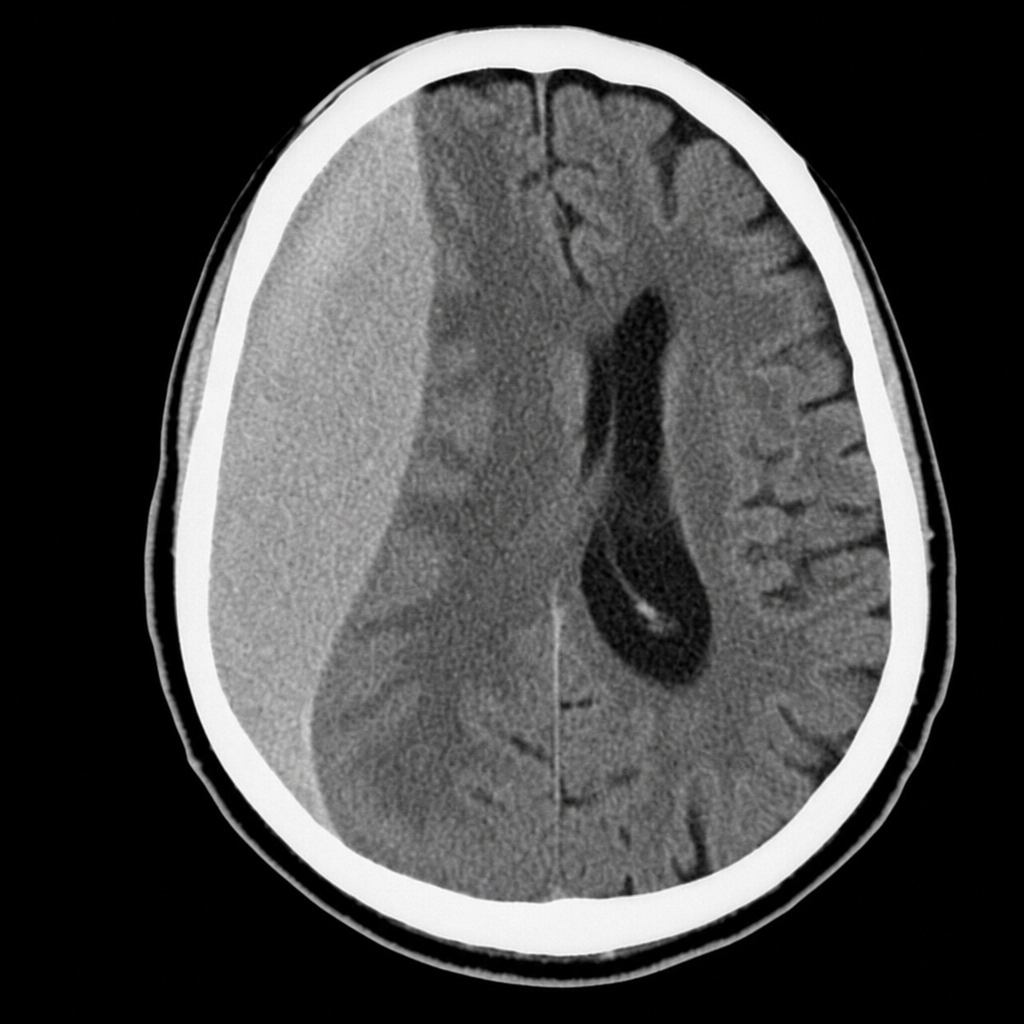
A 68-year-old man is brought to the clinic by his daughter who has noticed behavioral changes and frequent headaches for the past 2 weeks. The patient’s daughter says he has been having memory and simple calculation issues, gets upset easily, and his grip strength has dramatically declined. The patient was completely normal prior to these recent changes and used to be able to perform his activities of daily living without a problem. He has a past medical history significant for hypertension, stable angina, and benign prostatic hypertrophy, as well as frequent falls with the last one occurring 1 month ago. Physical examination is remarkable for dyscalculia, short-term memory deficits, and decreased grip strength (4/5) in his right hand. A noncontrast CT of the head is performed and is shown in the image. Which of the following is the most likely etiology of this patient condition?
A 76-year-old man is brought to his geriatrician by his daughter, who reports that he has been "losing his memory." While the patient previously performed all household duties by himself, he has recently had several bills that were unpaid. He also called his daughter on several occasions after getting lost while driving and having "accidents" before getting to the toilet. On exam, the patient is conversant and alert to person, place, and time, though his gait is wide-based and slow. Which of the following diagnostic procedures would be most appropriate to confirm the suspected diagnosis in this patient?
A 72-year-old woman is brought to the physician by her son for an evaluation of cognitive decline. Her son reports that she has had increased difficulty finding her way back home for the last several months, despite having lived in the same city for 40 years. He also reports that his mother has been unable to recall the names of her relatives and been increasingly forgetting important family gatherings such as her grandchildren's birthdays over the last few years. The patient has hypertension and type 2 diabetes mellitus. She does not smoke or drink alcohol. Her current medications include enalapril and metformin. Her temperature is 37°C (98.6°F), pulse is 70/min, and blood pressure is 140/80 mm Hg. She is confused and oriented only to person and place. She recalls 2 out of 3 words immediately and 1 out of 3 after 5 minutes. Her gait and muscle strength are normal. Deep tendon reflexes are 2+ bilaterally. The remainder of the examination shows no abnormalities. Further evaluation is most likely to reveal which of the following findings?
A 68-year-old man seeks evaluation by a physician with complaints of worsening forgetfulness and confusion for 1 year. According to his wife, he has always been in good health and is generally very happy; however, he has started to forget important things. He recently had his driving license revoked because of multiple tickets, but he cannot recall having done anything wrong. This morning, he neglected to put on his socks and was quite agitated when she pointed this out to him. He denies having a depressed mood, sleep problems, or loss of interest. He occasionally has a glass of wine with dinner and has never smoked or used recreational drugs. His medical history and family medical history are unremarkable. His pulse is 68/min, respirations are 14/min, and blood pressure is 130/84 mm Hg. Except for a mini-mental state examination (MMSE) score of 20/30, the remainder of the physical examination is unremarkable. Imaging studies, including a chest X-ray and CT of the brain, reveal no pathologic findings. An electrocardiogram (ECG) is also normal. Laboratory testing showed the following: Serum glucose (fasting) 76 mg/dL Serum electrolytes: Sodium 140 mEq/L Potassium 4.1 mEq/L Chloride 100 mEq/L Serum creatinine 0.9 mg/dL Blood urea nitrogen 11 mg/dL Cholesterol, total: 180 mg/dL HDL-cholesterol 45 mg/dL LDL-cholesterol 75 mg/dL Triglycerides 135 mg/dL Hemoglobin (Hb%) 16 g/dL Mean corpuscular volume (MCV) 85 fL Reticulocyte count 0.9% Erythrocyte count 5 million/mm³ Thyroid-stimulating hormone 3.5 µU/mL Urinalysis Glucose Negative Ketones Negative Leucocytes Negative Nitrite Negative RBCs Negative Casts Negative Which of the following is the most likely diagnosis?
A 77-year-old woman is brought to the physician for gradually increasing confusion and difficulty walking for the past 4 months. Her daughter is concerned because she has been forgetful and seems to be walking more slowly. She has been distracted during her weekly bridge games and her usual television shows. She has also had increasingly frequent episodes of urinary incontinence and now wears an adult diaper daily. She has hyperlipidemia and hypertension. Current medications include lisinopril and atorvastatin. Her temperature is 36.8°C (98.2°F), pulse is 84/min, respirations are 15/min, and blood pressure is 139/83 mmHg. She is confused and oriented only to person and place. She recalls 2 out of 3 words immediately and 1 out of 3 after five minutes. She has a broad-based gait and takes short steps. Sensation is intact and muscle strength is 5/5 throughout. Laboratory studies are within normal limits. Which of the following is the most likely diagnosis in this patient?
A 10-year-old boy is brought into your clinic by his mother for sunburns that have not been healing. The mother states that he easily gets sunburned. The mother admits she gave birth to him at home and has never taken him to see a doctor. The patient walks with a wide stance gait and appears unstable on his feet. He has an extensive erythematous, scaling, hyperkeratotic rash on his face, neck, arms and legs. After extensive workup, the patient is found to have a genetic disorder that results in defective absorption of an important vitamin. Which of the following is likely to be low if measured?
A 65-year-old woman comes to the physician for the evaluation of several episodes of urinary incontinence over the past several months. She reports that she was not able to get to the bathroom in time. During the past 6 months, her husband has noticed that she is starting to forget important appointments and family meetings. She has type 2 diabetes mellitus treated with metformin. The patient had smoked a pack of cigarettes daily for 45 years. Her vital signs are within normal limits. On mental status examination, she is confused and has short-term memory deficits. She walks slowly taking short, wide steps. Muscle strength is normal. Deep tendon reflexes are 2+ bilaterally. Which of the following is the most likely underlying cause of this patient's urinary incontinence?
Want unlimited practice?
Get full access to all questions, explanations, and performance tracking.
Scan to download app