
Frontotemporal dementia — MCQs

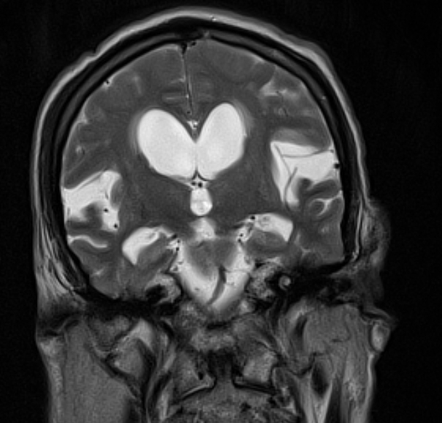
A 73-year-old man is brought in by his wife with a history of progressive personality changes. The patient’s wife says that, over the past 3 years, he has become increasingly aggressive and easily agitated, which is extremely out of character for him. His wife also says that he has had several episodes of urinary incontinence in the past month. He has no significant past medical history. The patient denies any history of smoking, alcohol use, or recreational drug use. The patient is afebrile, and his vital signs are within normal limits. A physical examination is unremarkable. The patient takes the mini-mental status examination (MMSE) and scores 28/30. A T2 magnetic resonance image (MRI) of the head is performed and the results are shown in the exhibit (see image). Which of the following is the next best diagnostic step in the management of this patient?
A 61-year-old woman presents to her primary care doctor with her son who reports that his mother is not acting like herself. She has gotten lost while driving several times in the past 2 months and appears to be talking to herself frequently. Of note, the patient’s husband died from a stroke 4 months ago. The patient reports feeling sad and guilty for causing so much trouble for her son. Her appetite has decreased since her husband died. On examination, she is oriented to person, place, and time. She is inattentive, and her speech is disorganized. She shakes her hand throughout the exam without realizing it. Her gait is slow and appears unstable. This patient’s condition would most likely benefit from which of the following medications?
A 63-year-old woman is brought to the clinic by her husband with complaints of cognitive decline. The patient's husband says that she has had intermittent problems with her memory for the past few years. He says she has occasional 'bad days' where her memory deteriorates to the point where she cannot perform activities of daily living. She is also sometimes found conversing in an empty room and, when inquired, she confirms that she is talking to a friend. There have also been some recent falls. There is no history of fever, recent head trauma, loss of consciousness, or illicit drug use. Past medical history is significant for bronchial asthma and osteoarthritis, both managed medically. Her mother died due to metastatic breast cancer at age 71 and her father was diagnosed with Alzheimer's disease at age 65. The patient is afebrile and her vital signs are within normal limits. Physical examination reveals a tremor present in both her hands that attenuates with voluntary movement. Deep tendon reflexes are 2+ bilaterally. Romberg's sign is negative. She has a slow gait with a mild stooped posture. Her laboratory findings are significant for the following: Hemoglobin 12.9 g/dL White cell count 8,520/mm³ Platelets 295,000/mm³ Serum creatinine 1.0 mg/dL Glucose 94 mg/dL Sodium 141 mEq/L Potassium 3.9 mEq/L Calcium 92 mg/dL Ferritin 125 ng/mL Serum B12 305 ng/L TSH 2.1 µU/mL Ceruloplasmin 45 mg/dL Which of the following is the most appropriate management for this patient?
A 55-year-old man is brought to the physician because of inappropriate behavior for the past 6 months. He has been making inappropriate comments and jokes while talking to friends and family members. He was arrested 3 weeks ago while trying to kiss strangers on the street. He has no interest in talking to his daughter or playing with his grandchildren. During this period, he has developed a strong desire for chocolate pudding and potato chips and has gained 10 kg (22 lb). He appears unkempt. Vital signs are within normal limits. Physical examination is unremarkable. Mental status examination shows apathy and a blunt affect. He avoids answering questions and instead comments on the individuals he saw in the waiting room. Mini-Mental State Examination score is 28/30. A complete blood count and serum concentrations of glucose, creatinine, and electrolytes are within the reference range. Which of the following is the most likely diagnosis?
A 59-year-old man is brought to the physician by his wife for a psychiatric evaluation. Over the past 12 months, his behavior has become increasingly disruptive. His wife no longer brings him along shopping because he has attempted to grope a female cashier on 2 occasions. He has begun to address the mail carrier using a racial epithet. Three years later, the patient dies. Light microscopy of sections of the frontal and temporal lobes shows intracellular inclusions of transactive response DNA binding protein (TDP-43). These proteins are bound to a regulatory molecule that usually marks them for degradation. The regulatory molecule in question is most likely which of the following?
An 81-year-old woman presents to your office accompanied by her husband. She has been doing well except for occasional word finding difficulty. Her husband is concerned that her memory is worsening over the past year. Recently, she got lost twice on her way home from her daughter’s house, was unable to remember her neighbor’s name, and could not pay the bills like she usually did. She has a history of hypertension and arthritis. She has no significant family history. Her medications include a daily multivitamin, hydrochlorothiazide, and ibuprofen as needed. Physical exam is unremarkable. Which of the following is associated with an increased risk of this patient’s disease?
A 72-year-old woman is brought to the physician by her son for an evaluation of cognitive decline. Her son reports that she has had increased difficulty finding her way back home for the last several months, despite having lived in the same city for 40 years. He also reports that his mother has been unable to recall the names of her relatives and been increasingly forgetting important family gatherings such as her grandchildren's birthdays over the last few years. The patient has hypertension and type 2 diabetes mellitus. She does not smoke or drink alcohol. Her current medications include enalapril and metformin. Her temperature is 37°C (98.6°F), pulse is 70/min, and blood pressure is 140/80 mm Hg. She is confused and oriented only to person and place. She recalls 2 out of 3 words immediately and 1 out of 3 after 5 minutes. Her gait and muscle strength are normal. Deep tendon reflexes are 2+ bilaterally. The remainder of the examination shows no abnormalities. Further evaluation is most likely to reveal which of the following findings?
A 53-year-old man is brought to the clinic by his son for the evaluation of unusual behavior. He is a shopkeeper by profession and sometimes behaves very rudely to the customers. Recently, he accused one of the customers of using black magic over his shop. He has been increasingly irritable, forgetting things, and having problems managing his finances over the past 8 months. He is also having difficulty finding words and recalling the names of objects during the conversation. There is no history of recent head trauma, fever, hallucinations, or abnormal limb movements. Past medical history is significant for a well-controlled type 2 diabetes mellitus. Family history is unremarkable. He does not smoke or use illicit drugs. Vital signs are stable with a blood pressure of 134/76 mm Hg, a heart rate of 88/min, and a temperature of 37.0°C (98.6°F). On physical examination, he has problems naming objects and planning tasks. Mini-mental state examination (MMSE) score is 26/30. Cranial nerve examination is normal. Muscle strength is normal in all 4 limbs with normal muscle tone and deep tendon reflexes. Sensory examination is also normal. What is the most likely diagnosis?
A 60-year-old woman is brought into the office by her son. Her son states that the patient has been acting inappropriately over the last few years. She has been taking off her clothes in front of visitors and putting objects in her mouth. She has had no emotional response to the death of one of her close friends and was laughing at her funeral. She has almost no memory issues, but sometimes forgets how to use objects such as a telephone. She has no other medical issues and takes no medications. On exam, she has no focal neurological deficits and her mini-mental status exam is 25/30. What is the most likely diagnosis?
A 77-year-old woman is brought to the physician for gradually increasing confusion and difficulty walking for the past 4 months. Her daughter is concerned because she has been forgetful and seems to be walking more slowly. She has been distracted during her weekly bridge games and her usual television shows. She has also had increasingly frequent episodes of urinary incontinence and now wears an adult diaper daily. She has hyperlipidemia and hypertension. Current medications include lisinopril and atorvastatin. Her temperature is 36.8°C (98.2°F), pulse is 84/min, respirations are 15/min, and blood pressure is 139/83 mmHg. She is confused and oriented only to person and place. She recalls 2 out of 3 words immediately and 1 out of 3 after five minutes. She has a broad-based gait and takes short steps. Sensation is intact and muscle strength is 5/5 throughout. Laboratory studies are within normal limits. Which of the following is the most likely diagnosis in this patient?
Want unlimited practice?
Get full access to all questions, explanations, and performance tracking.
Scan to download app