
Anxiety in medical conditions — MCQs

An 18-year-old man presents to the student health department at his university for recurrent palpitations. The patient had previously presented to the emergency department (ED) for sudden onset palpitations five months ago when he first started college. He had a negative cardiac workup in the ED and he was discharged with a 24-hour Holter monitor which was also negative. He has no history of any medical or psychiatric illnesses. The patient reports that since his initial ED visit, he has had several episodes of unprovoked palpitations associated with feelings of dread and lightheadedness though he cannot identify a particular trigger. Recently, he has begun sitting towards the back of the lecture halls so that he can “quickly escape and not make a scene” in case he gets an episode in class. Which of the following is the most likely diagnosis?
A 35-year-old woman presents with increased anxiety and a reeling sensation. Her complaint started 30 minutes ago with increased sweating and palpitations and is gradually worsening. On examination, the blood pressure was found to be 194/114 mm Hg. She had normal blood pressure at the local pharmacy 5 days ago. She currently works as an event manager and her job involves a lot of stress. The family history is significant for thyroid carcinoma in her father. Which of the following is most likely in this person?
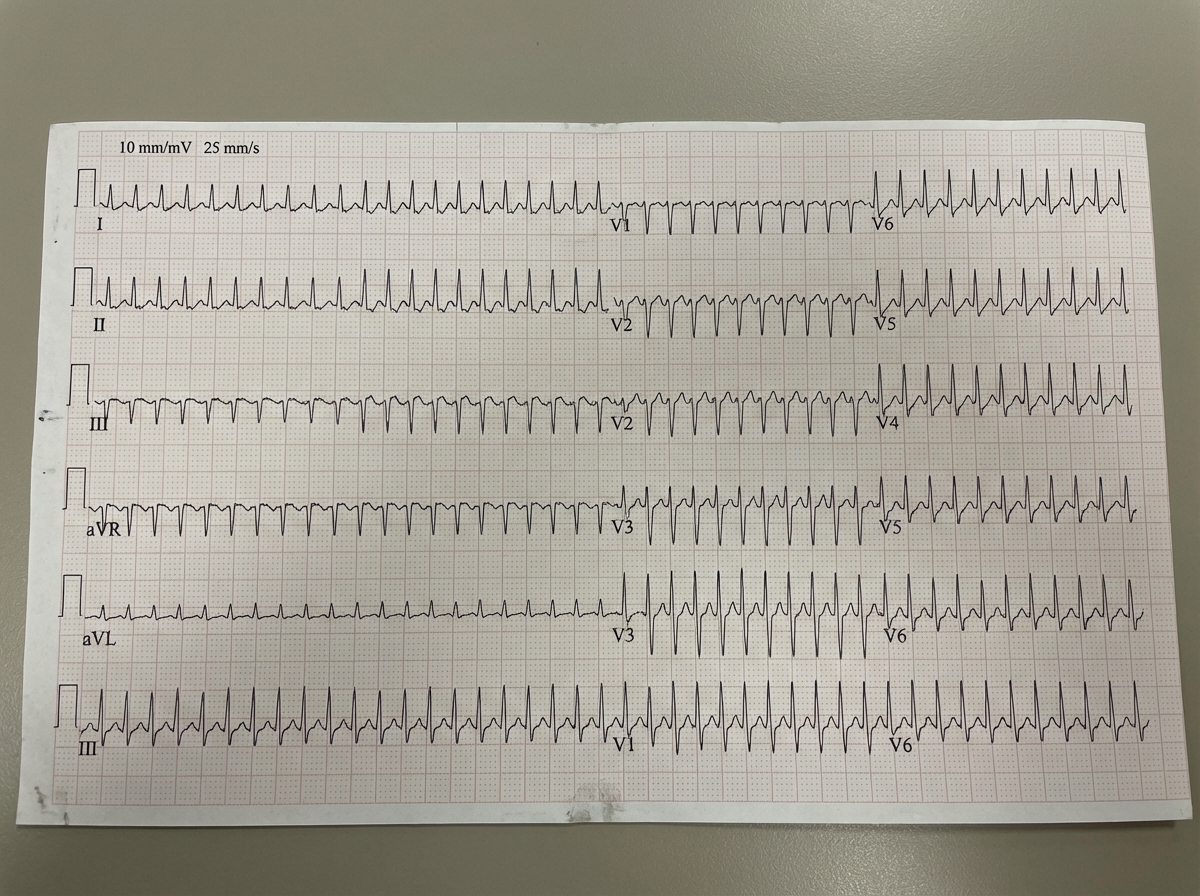
A 43-year-old man comes to the emergency room complaining of chest discomfort. He describes the feeling as "tightness," and also reports weakness and palpitations for the past hour. He denies shortness of breath, diaphoresis, or lightheadedness. He has no significant past medical history, and does not smoke, drink, or use illicit drugs. His father had a myocardial infarction at age 72. He is afebrile, heart rate is 125 bpm, and his blood pressure is 120/76. He is alert and oriented to person, place, and time. His electrocardiogram is shown below. Which of the following tests should be ordered in the initial work-up of this patient's condition?
A 25-year-old woman presents with a history of recurrent attacks of unprovoked fear, palpitations, and fainting. The attacks are usually triggered by entering a crowded place or public transport, so the patient tries to avoid being in public places alone. Besides this, she complains of difficulties in falling asleep, uncontrolled worry about her job and health, fear to lose the trust of her friends, and poor appetite. She enjoys dancing and has not lost a passion for her hobby, but recently when she participated in a local competition, she had an attack which made her stop her performance until she calmed down and her condition improved. She feels upset due to her condition. She works as a sales manager and describes her work as demanding with multiple deadlines to be met. She recently broke up with her boyfriend. She does not report any chronic medical problems, but she sometimes takes doxylamine to fall asleep. She has a 4-pack-year history of smoking and drinks alcohol occasionally. On presentation, her blood pressure is 110/60 mm Hg, heart rate is 71/min, respiratory rate is 13/min, and temperature is 36.5°C (97.7°F). Her physical examination is unremarkable. Which of the following medications can be used for the acute management of the patient’s attacks?
A previously healthy 25-year-old woman comes to the physician because of a 1-month history of palpitations that occur on minimal exertion and sometimes at rest. She has no chest discomfort or shortness of breath. She feels nervous and irritable most of the time and attributes these feelings to her boyfriend leaving her 2 months ago. Since then she has started exercising more frequently and taking an herbal weight-loss pill, since which she has lost 6.8 kg (15 lb) of weight. She finds it hard to fall asleep and awakens 1 hour before the alarm goes off each morning. She has been drinking 2 to 3 cups of coffee daily for the past 7 years and has smoked one pack of cigarettes daily for the past 3 years. Her temperature is 37.4°C (99.4°F), pulse is 110/min, respirations are 18/min, and blood pressure is 150/70 mm Hg. Examination shows moist palms. Neurologic examination shows a fine resting tremor of the hands. Deep tendon reflexes are 3+ with a shortened relaxation phase. Which of the following is the most likely cause of this patient's symptoms?
A 25-year-old man comes to the physician because of palpitations, sweating, and flushing. Since he was promoted to a manager in a large software company 6 months ago, he has had several episodes of these symptoms when he has to give presentations in front of a large group of people. During these episodes, his thoughts start racing and he fears that his face will “turn red” and everyone will laugh at him. He has tried to avoid the presentations but fears that he might lose his job if he continues to do so. He is healthy except for mild-persistent asthma. He frequently smokes marijuana to calm his nerves. He does not drink alcohol. His only medication is an albuterol inhaler. His pulse is 78/min, respirations are 14/min, and blood pressure is 120/75 mm Hg. Cardiopulmonary examination shows no abnormalities. On mental status examination, the patient appears worried and has a flattened affect. Which of the following is the most appropriate next step in management?
A 43-year-old male with a history of thyroid cancer status post total thyroidectomy presents to his primary care physician after repeated bouts of headaches. His headaches are preceded by periods of anxiety, palpitations, and sweating. The patient says he is unable to pinpoint any precipitating factors and instead says the events occur without warning. Of note, the patient's father and uncle also have a history of thyroid cancer. On exam his vitals are: T 36.8 HR 87, BP 135/93, RR 14, and O2 Sat 100% on room air. The patient's TSH is within normal limits, and he reports taking his levothyroxine as prescribed. What is the next best step in diagnosing this patient's chief complaint?
Every time your neighbor in the adjacent apartment flushes the toilet, the water in your shower becomes very hot, causing you to jump out of the way of the water stream. After this has occurred for several months, you note that you reflexively jump back from the water directly after the sound of the flushing toilet but before the water temperature changes. Which of the following situations is the most similar to the conditioning process detailed above?
A goalkeeper of a famous soccer team gives an interview with a health agency regarding his childhood. He describes how when he was a child, he would constantly clear his throat in class and the teachers would write a note to his mother with advice to go see an ENT doctor. He complained of being restless, fidgety, and sometimes hyperactive in class, disrupting the environment and causing him many social problems. He would blurt out the answer at times and keep repeating it without any control, leading to some embarrassing timeouts. But he was always nice to his teachers, so he calls it a “benign frustration” rather than aggressively causing distress. He also talked about how his symptoms were dramatically improved with medication. Which of the following is an FDA approved drug for this patient’s most likely condition?
A 22-year-old woman is in her last few months at community college. She has a very important essay due in 2 weeks that will play a big part in determining her final grades. She decides to focus on writing this essay instead and not to worry about her grades until her essay is completed. Which of the following defense mechanisms best explains her behavior?
Want unlimited practice?
Get full access to all questions, explanations, and performance tracking.
Scan to download app