
Normal V/Q distribution — MCQs

A 71-year-old man is admitted to the ICU with a history of severe pancreatitis and new onset difficulty breathing. His vital signs are a blood pressure of 100/60 mm Hg, heart rate of 100/min, respirations of 27/min, temperature of 36.7°C (98.1°F), and oxygen saturation of 85% on room air. Physical examination shows a cachectic male in severe respiratory distress. Rales are heard at the base of each lung. The patient is intubated and a Swan-Ganz catheter is inserted. Pulmonary capillary wedge pressure is 8 mm Hg. An arterial blood gas study reveals a PaO2: FiO2 ratio of 180. The patient is diagnosed with acute respiratory distress syndrome. In which of the following segments of the respiratory tract are the cells responsible for the symptoms observed in this patient found?
A 71-year-old man is admitted to the hospital one hour after he was found unconscious. His pulse is 80/min and systolic blood pressure is 98 mm Hg; diastolic blood pressure cannot be measured. He is intubated and mechanically ventilated with supplemental oxygen at a tidal volume of 450 mL and a respiratory rate of 10/min. Arterial blood gas analysis shows: PCO2 43 mm Hg O2 saturation 94% O2 content 169 mL/L Pulmonary artery catheterization shows a pulmonary artery pressure of 15 mm Hg and a pulmonary capillary wedge pressure of 7 mm Hg. Bedside indirect calorimetry shows a rate of O2 tissue consumption of 325 mL/min. Given this information, which of the following additional values is sufficient to calculate the cardiac output in this patient?
A 35-year-old man presents to pulmonary function clinic for preoperative evaluation for a right pneumonectomy. His arterial blood gas at room air is as follows: pH: 7.34 PaCO2: 68 mmHg PaO2: 56 mmHg Base excess: +1 O2 saturation: 89% What underlying condition most likely explains these findings?
A 72-year-old obese man presents as a new patient to his primary care physician because he has been feeling tired and short of breath after recently moving to Denver. He is a former 50 pack-year smoker and has previously had deep venous thrombosis. Furthermore, he previously had a lobe of the lung removed due to lung cancer. Finally, he has a family history of a progressive restrictive lung disease. Laboratory values are obtained as follows: Oxygen tension in inspired air = 130 mmHg Alveolar carbon dioxide tension = 48 mmHg Arterial oxygen tension = 58 mmHg Respiratory exchange ratio = 0.80 Respiratory rate = 20/min Tidal volume = 500 mL Which of the following mechanisms is consistent with these values?
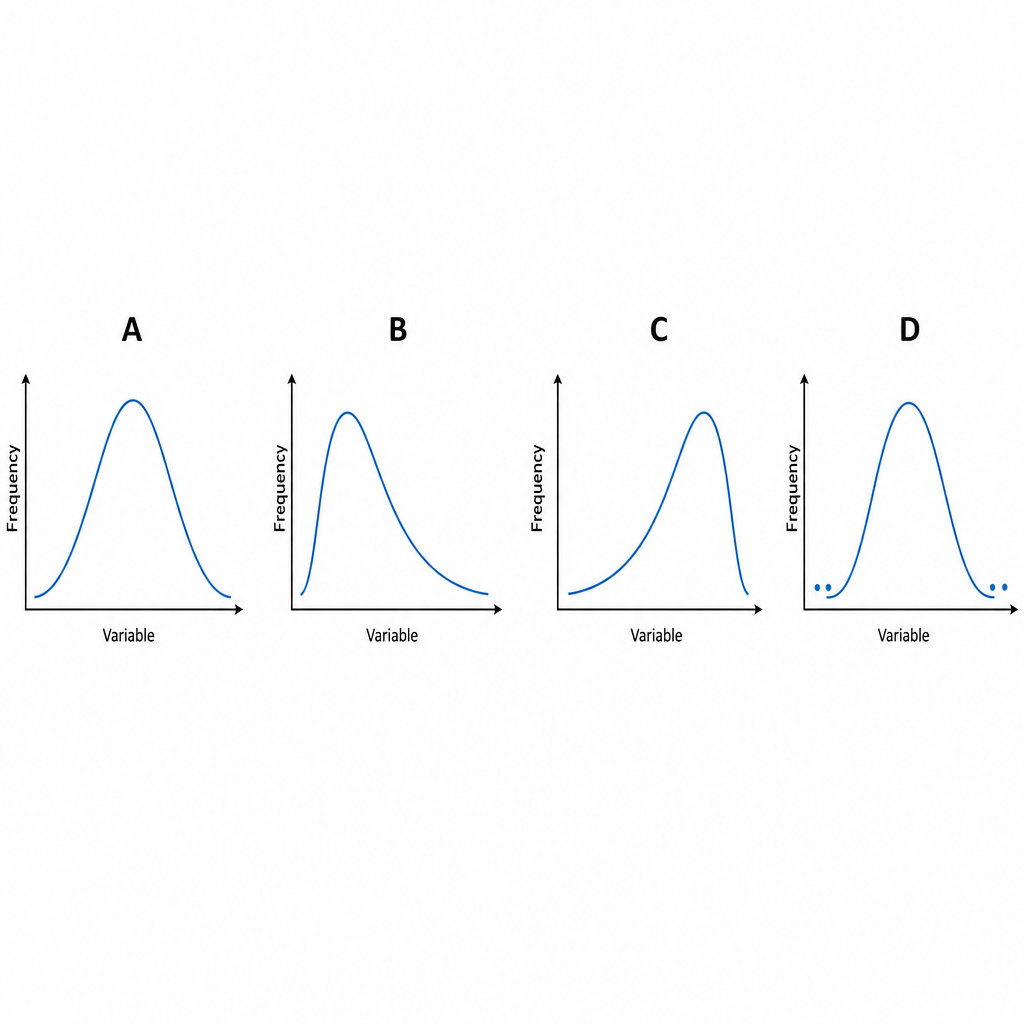
A graph shows four different distribution curves labeled A, B, C, and D. Identify the correct sequence of distribution types shown in the graph.
During a clinical study examining the diffusion of gas between the alveolar compartment and the pulmonary capillary blood, men between the ages of 20 and 50 years are evaluated while they hold a sitting position. After inhaling a water-soluble gas that rapidly combines with hemoglobin, the concentration of the gas in the participant's exhaled air is measured and the diffusion capacity is calculated. Assuming that the concentration of the inhaled gas remains the same, which of the following is most likely to increase the flow of the gas across the alveolar membrane?
A 22-year-old man volunteers for a research study on lung function. He has no history of lung disease or allergies and does not smoke. His pulmonary blood flow is measured in the various labeled segments of the lungs while standing. Then the volunteer, still standing, is given very low continuous positive airway pressure and the blood flow measured again. Which of the following sets of findings are most likely to be present in the second measurements relative to the first?
A 21-year-old man is admitted to the intensive care unit for respiratory failure requiring mechanical ventilation. His minute ventilation is calculated to be 7.0 L/min, and his alveolar ventilation is calculated to be 5.1 L/min. Which of the following is most likely to decrease the difference between minute ventilation and alveolar ventilation?
A 62-year-old man is brought to the emergency department with a 2-day history of cough productive of yellowish sputum. He has had fever, chills, and worsening shortness of breath over this time. He has a 10-year history of hypertension and hyperlipidemia. He does not drink alcohol or smoke cigarettes. His current medications include atorvastatin, amlodipine, and metoprolol. His temperature is 38.9°C (102.0°F), pulse is 105/min, respirations are 27/min, and blood pressure is 110/70 mm Hg. He appears in mild distress. He has rales over the left lower lung field. The remainder of the examination shows no abnormalities. Leukocyte count is 15,000/mm3 (87% segmented neutrophils). Arterial blood gas analysis on room air shows: pH 7.44 pO2 68 mm Hg pCO2 28 mm Hg HCO3- 24 mEq/L O2 saturation 91% An x-ray of the chest shows a consolidation in the left lower lobe. Asking the patient to lie down in the left lateral decubitus position would most likely result in which of the following?
A 52-year-old woman presents to the emergency department with breathlessness for the past 6 hours. She denies cough, nasal congestion or discharge, sneezing, blood in sputum, or palpitation. There is no past history of chronic respiratory or cardiovascular medical conditions, but she mentions that she has been experiencing frequent cramps in her left leg for the past 5 days. She is post-menopausal and has been on hormone replacement therapy for a year now. Her temperature is 38.3°C (100.9°F), the pulse is 116/min, the blood pressure is 136/84 mm Hg, and the respiratory rate is 24/min. Edema and tenderness are present in her left calf region. Auscultation of the chest reveals rales over the left infrascapular and scapular region. The heart sounds are normal and there are no murmurs. Which of the following mechanisms most likely contributed to the pathophysiology of this patient’s condition?
Want unlimited practice?
Get full access to all questions, explanations, and performance tracking.
Scan to download app