
Spirometry interpretation — MCQs

A 62-year-old woman with hypertension and type 2 diabetes mellitus comes to the physician because of increasing shortness of breath and a dry cough over the past 6 months. She has smoked 1 pack of cigarettes daily for the past 40 years. Chest auscultation shows scattered expiratory wheezes in both lung fields. Spirometry shows an FEV1:FVC ratio of 65% and an FEV1 of 70% of predicted. Her diffusing capacity for carbon monoxide (DLCO) is 42% of predicted. Which of the following is the most likely diagnosis?
A previously healthy 64-year-old woman comes to the physician because of a dry cough and progressively worsening shortness of breath for the past 2 months. She has not had fever, chills, or night sweats. She has smoked one pack of cigarettes daily for the past 45 years. She appears thin. Examination of the lung shows a prolonged expiratory phase and end-expiratory wheezing. Spirometry shows decreased FEV1:FVC ratio (< 70% predicted), decreased FEV1, and a total lung capacity of 125% of predicted. The diffusion capacity of the lung (DLCO) is decreased. Which of the following is the most likely diagnosis?
A 57-year-old man presents to the clinic for a chronic cough over the past 4 months. The patient reports a productive yellow/green cough that is worse at night. He denies any significant precipitating event prior to his symptoms. He denies fever, chest pain, palpitations, weight changes, or abdominal pain, but endorses some difficulty breathing that waxes and wanes. He denies alcohol usage but endorses a 35 pack-year smoking history. A physical examination demonstrates mild wheezes, bibasilar crackles, and mild clubbing of his fingertips. A pulmonary function test is subsequently ordered, and partial results are shown below: Tidal volume: 500 mL Residual volume: 1700 mL Expiratory reserve volume: 1500 mL Inspiratory reserve volume: 3000 mL What is the functional residual capacity of this patient?
A 69-year-old man presents with progressive malaise, weakness, and confusion. The patient’s wife reports general deterioration over the last 3 days. He suffers from essential hypertension, but this is well controlled with amlodipine. He also has type 2 diabetes mellitus that is treated with metformin. On physical examination, the patient appears severely ill, weak and is unable to speak. His neck veins are distended bilaterally. His skin is mottled and dry with cool extremities, and he is mildly cyanotic. The respiratory rate is 24/min, the pulse is 94/min, the blood pressure is 87/64 mm Hg, and the temperature is 35.5°C (95.9°F). Auscultation yields coarse crackles throughout both lung bases. Which of the following best represents the mechanism of this patient’s condition?
A 62-year-old female presents with complaint of chronic productive cough for the last 4 months. She states that she has had 4-5 month periods of similar symptoms over the past several years. She has never smoked, but she reports significant exposure to second-hand smoke in her home. She denies any fevers, reporting only occasional shortness of breath and a persistent cough where she frequently expectorates thick, white sputum. Vital signs are as follows: T 37.1 C, HR 88, BP 136/88, RR 18, O2 sat 94% on room air. Physical exam is significant for bilateral end-expiratory wheezes, a blue tint to the patient's lips and mucous membranes of the mouth, and a barrel chest. Which of the following sets of results would be expected on pulmonary function testing in this patient?
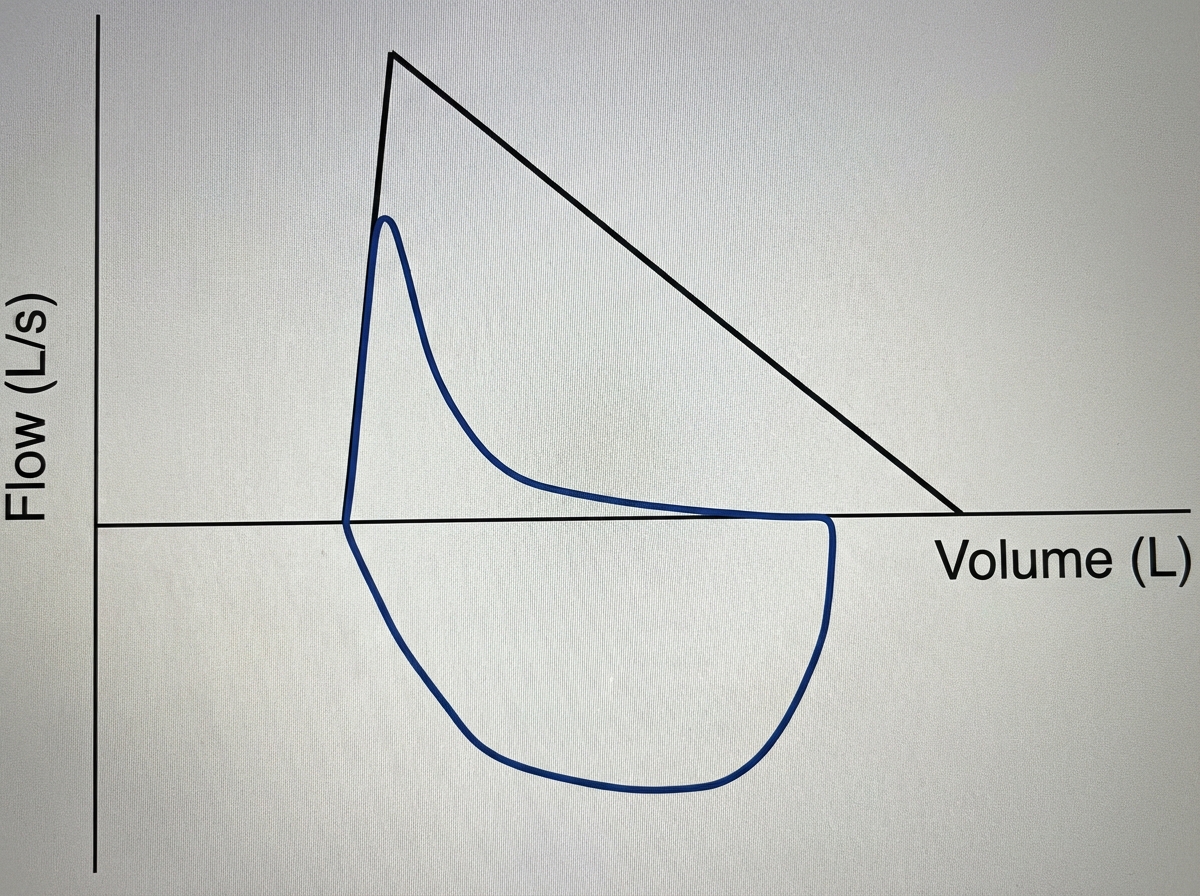
A 63-year-old woman comes to the physician because of worsening shortness of breath, cough, and a 4-kg (8.8-lb) weight loss over the last year. She has no history of serious illness and takes no medications. She has smoked one pack of cigarettes daily for 35 years. Her temperature is 37°C (98.6°F), pulse is 92/min, respirations are 20/min, blood pressure is 124/78 mm Hg, and pulse oximetry on room air shows an oxygen saturation of 93%. Physical examination shows decreased breath sounds. A flow-volume loop obtained via pulmonary function testing is shown. Which of the following is the most likely cause of this patient's respiratory symptoms?
A 72-year-old obese man presents as a new patient to his primary care physician because he has been feeling tired and short of breath after recently moving to Denver. He is a former 50 pack-year smoker and has previously had deep venous thrombosis. Furthermore, he previously had a lobe of the lung removed due to lung cancer. Finally, he has a family history of a progressive restrictive lung disease. Laboratory values are obtained as follows: Oxygen tension in inspired air = 130 mmHg Alveolar carbon dioxide tension = 48 mmHg Arterial oxygen tension = 58 mmHg Respiratory exchange ratio = 0.80 Respiratory rate = 20/min Tidal volume = 500 mL Which of the following mechanisms is consistent with these values?
A 15-year-old boy and his mother were referred to a pulmonology clinic. She is concerned that her son is having some breathing difficulty for the past few months, which is aggravated with exercise. The family is especially concerned because the patient’s older brother has cystic fibrosis. The past medical history is noncontributory. Today, the vital signs include: blood pressure 119/80 mm Hg, heart rate 90/min, respiratory rate 17/min, and temperature 37.0°C (98.6°F). On physical exam, he appears well-developed and well-nourished. The heart has a regular rate and rhythm, and the lungs are clear to auscultation bilaterally. During the exam, he is brought into a special room to test his breathing. A clamp is placed on his nose and he is asked to take in as much air as he can, and then forcefully expire all the air into a spirometer. The volume of expired air represents which of the following?
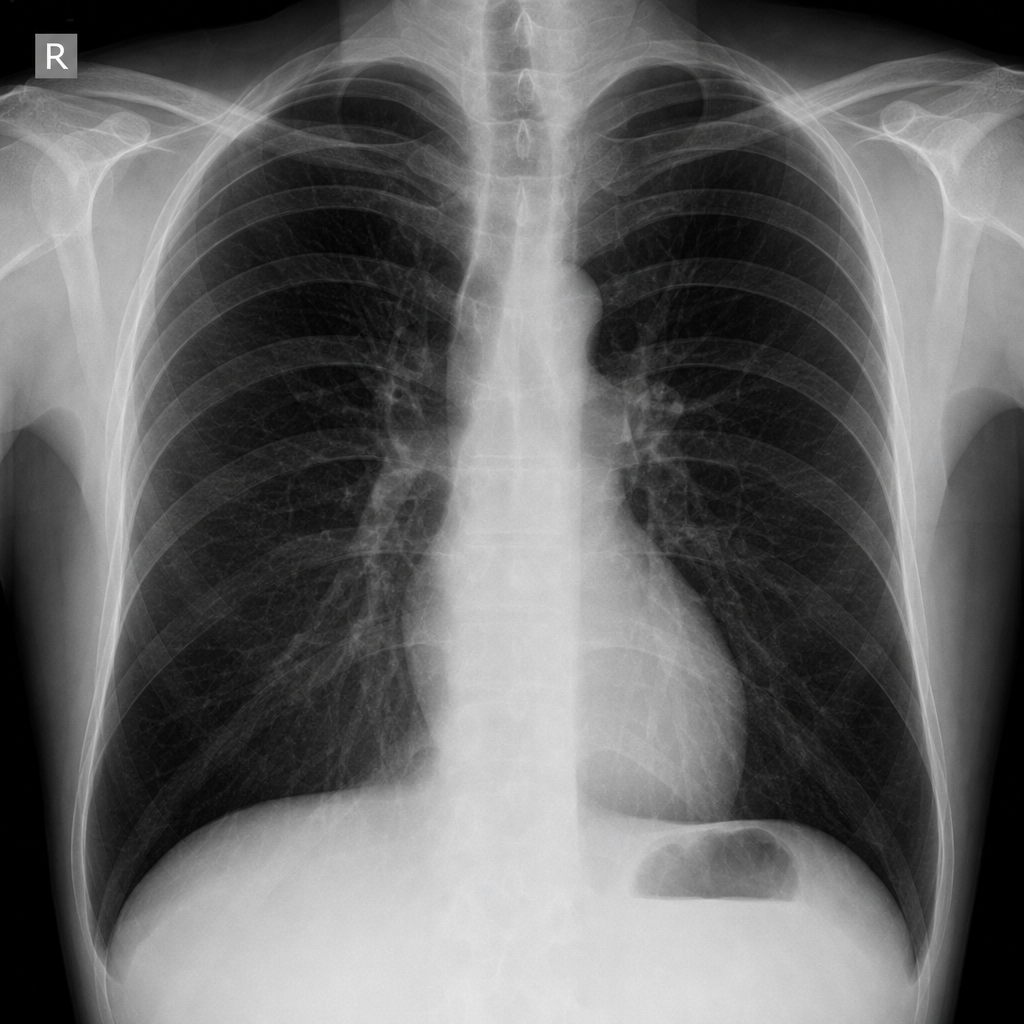
A 55-year-old man with a 60 pack-year smoking history is referred by his primary care physician for a pulmonary function test (PFT). A previously obtained chest x-ray is shown below. Which of the following will most likely appear in his PFT report?
A 68-year-old man comes to the emergency room with difficulty in breathing. He was diagnosed with severe obstructive lung disease a few years back. He uses his medication but often has to come to the emergency room for intravenous therapy to help him breathe. He was a smoker for 40 years smoking two packs of cigarettes every day. Which of the following best represents the expected changes in his ventilation, perfusion and V/Q ratio?
Want unlimited practice?
Get full access to all questions, explanations, and performance tracking.
Scan to download app