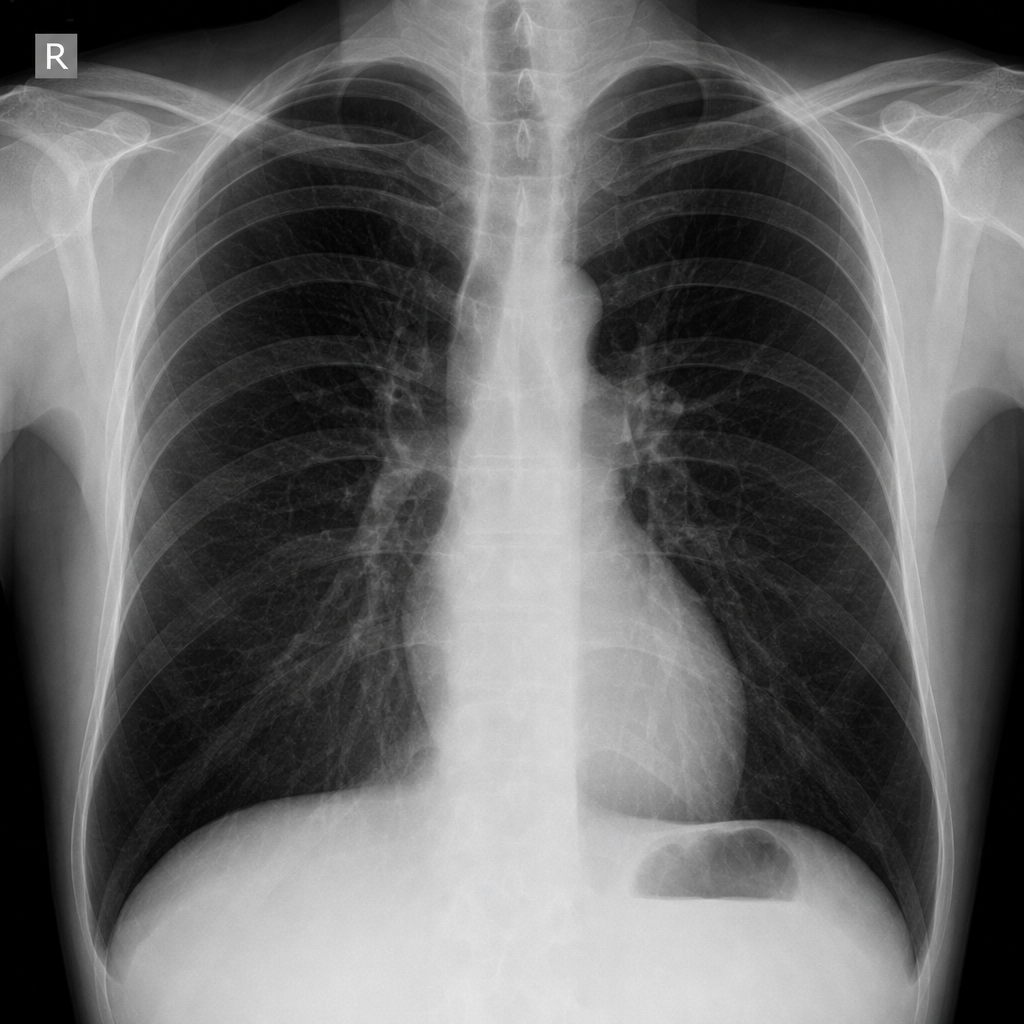
An investigator is studying the clearance of respiratory particles in healthy non-smokers. An aerosol containing radio-labeled particles that are small enough to reach the alveoli is administered to the subjects via a non-rebreather mask. A gamma scanner is then used to evaluate the rate of particle clearance from the lungs. The primary mechanism of particle clearance most likely involves which of the following cell types?
Q32
A 22-year-old female is brought to the emergency department by her friends. She was supposed to attend her first job interview in a few hours when she started having palpitations. Her past medical history is insignificant, and she currently takes no medications. Her vitals show the following: pulse rate is 90/min, respiratory rate is 28/min, and blood pressure is 136/86 mm Hg. Her ECG is normal. What will be the patient’s approximate alveolar carbon dioxide pressure (PACO2) given her normal respiratory rate is 14/min and PACO2 is 36 mm Hg? Ignore dead space and assume carbon dioxide production is constant.
Q33
A 35-year-old woman volunteers for a study on respiratory physiology. Pressure probes A and B are placed as follows:
Probe A: between the parietal and visceral pleura
Probe B: within the cavity of an alveolus
The probes provide a pressure reading relative to atmospheric pressure. To obtain a baseline reading, she is asked to sit comfortably and breathe normally. Which of the following sets of values will most likely be seen at the end of inspiration?
Q34
A 4-month-old boy is brought to the pediatrician for a wellness visit. Upon examination, the physician notes severe burns on the sun-exposed areas of the skin, including the face (especially the ears and nose), dorsal aspect of the hands, shoulders, and dorsal aspect of his feet. The child has very fair skin and blond hair. The parents insist that the child has not spent any extraordinary amount of time in the sun, but they admit that they rarely apply sunscreen. Which of the following physical factors is the most likely etiology for the burns?
Q35
A researcher is studying proteins that contribute to intestinal epithelial permeability. He has isolated intestinal tissue from several mice. After processing the tissue into its individual components, he uses a Western blot analysis to identify a protein that forms part of a multi-protein complex at the apical aspect of epithelial cells. The complex is known to provide a diffusion barrier between the apical and basolateral aspects of epithelial cells. Which of the following proteins is this researcher most likely investigating?
Respiratory US Medical PG Practice Questions and MCQs
Question 31: An investigator is studying the clearance of respiratory particles in healthy non-smokers. An aerosol containing radio-labeled particles that are small enough to reach the alveoli is administered to the subjects via a non-rebreather mask. A gamma scanner is then used to evaluate the rate of particle clearance from the lungs. The primary mechanism of particle clearance most likely involves which of the following cell types?
A. Goblet cells
B. Macrophages (Correct Answer)
C. Club cells
D. Type I pneumocytes
E. Neutrophils
Explanation: ***Macrophages***
- **Alveolar macrophages** are the primary phagocytic cells in the alveoli responsible for clearing inhaled particles that reach this deepest part of the lung.
- They engulf and digest foreign substances, including pathogens and inert particles, protecting the delicate alveolar structures.
*Goblet cells*
- **Goblet cells** are found in the larger airways (trachea, bronchi), where they produce mucus to trap inhaled particles.
- They are not present in the alveoli, so they cannot clear particles that have reached this region.
*Club cells*
- **Club cells** (formerly Clara cells) are located in the bronchioles and secrete components of the surfactant-like material, but they do not primarily function in particle clearance.
- While they have some protective roles, they are not the main phagocytic cells for alveolar particles.
*Type I pneumocytes*
- **Type I pneumocytes** are flattened, thin cells that form the majority of the alveolar surface and are primarily involved in gas exchange.
- They are not phagocytic and do not play a direct role in clearing inhaled particles.
*Neutrophils*
- **Neutrophils** are acute inflammatory cells primarily involved in combating bacterial infections.
- While they can migrate to the lungs during inflammation, they are not the primary, routine phagocytic cells for clearing inhaled particles in healthy individuals.
Question 32: A 22-year-old female is brought to the emergency department by her friends. She was supposed to attend her first job interview in a few hours when she started having palpitations. Her past medical history is insignificant, and she currently takes no medications. Her vitals show the following: pulse rate is 90/min, respiratory rate is 28/min, and blood pressure is 136/86 mm Hg. Her ECG is normal. What will be the patient’s approximate alveolar carbon dioxide pressure (PACO2) given her normal respiratory rate is 14/min and PACO2 is 36 mm Hg? Ignore dead space and assume carbon dioxide production is constant.
A. 18 mm Hg (Correct Answer)
B. 72 mm Hg
C. 36 mm Hg
D. 27 mm Hg
E. 44 mm Hg
Explanation: ***18 mm Hg***
- **PACO2** is inversely proportional to **alveolar ventilation (VA)**. If ventilation doubles, PACO2 halves assuming constant **CO2 production**.
- The patient's respiratory rate has doubled from 14/min to 28/min. Therefore, the new PACO2 will be 36 mmHg / 2 = **18 mm Hg**.
*72 mm Hg*
- This value would suggest a reduction in **alveolar ventilation**, which is contrary to the increased respiratory rate observed.
- If ventilation were halved, PACO2 would double, but the patient is **hyperventilating**.
*36 mm Hg*
- This is the initial **PACO2** at a respiratory rate of 14/min.
- An increase in respiratory rate from 14/min to 28/min will change the **PACO2**.
*27 mm Hg*
- This value suggests a less than doubling of **alveolar ventilation**, which doesn't align with the doubling of the respiratory rate.
- This would imply a more complex change in ventilation beyond simple rate adjustment.
*44 mm Hg*
- This value would represent a slight increase in **PACO2**, indicating **hypoventilation**.
- The patient's increased respiratory rate of 28/min indicates **hyperventilation**, which leads to a decrease in PACO2.
Question 33: A 35-year-old woman volunteers for a study on respiratory physiology. Pressure probes A and B are placed as follows:
Probe A: between the parietal and visceral pleura
Probe B: within the cavity of an alveolus
The probes provide a pressure reading relative to atmospheric pressure. To obtain a baseline reading, she is asked to sit comfortably and breathe normally. Which of the following sets of values will most likely be seen at the end of inspiration?
A. Probe A: -6 mm Hg; Probe B: 0 mm Hg (Correct Answer)
B. Probe A: 0 mm Hg; Probe B: -1 mm Hg
C. Probe A: -4 mm Hg; Probe B: 0 mm Hg
D. Probe A: -4 mm Hg; Probe B: -1 mm Hg
E. Probe A: -6 mm Hg; Probe B: -1 mm Hg
Explanation: ***Probe A: -6 mm Hg; Probe B: 0 mm Hg***
- At the **end of inspiration**, the **intrapleural pressure (Probe A)** is at its most negative, typically around -6 to -8 cm H2O (equivalent to -4 to -6 mmHg), reflecting the maximum expansion of the thoracic cavity.
- At the **end of inspiration**, just before exhalation begins, there is **no airflow**, so the **intrapulmonary pressure (Probe B)** equalizes with atmospheric pressure, resulting in a 0 mm Hg reading.
*Probe A: 0 mm Hg; Probe B: -1 mm Hg*
- An **intrapleural pressure of 0 mm Hg** would indicate a **pneumothorax** since it should always be negative to prevent lung collapse.
- An **intrapulmonary pressure of -1 mm Hg** would indicate that **inspiration is still ongoing**, as air would be flowing into the lungs.
*Probe A: -4 mm Hg; Probe B: 0 mm Hg*
- While an **intrapulmonary pressure of 0 mm Hg** is correct at the end of inspiration, an **intrapleural pressure of -4 mm Hg** is typical for the **end of expiration (Functional Residual Capacity)** during quiet breathing, not the end of inspiration.
- The **intrapleural pressure becomes more negative** during inspiration due to increased thoracic volume, so -4 mm Hg would be insufficient.
*Probe A: -4 mm Hg; Probe B: -1 mm Hg*
- An **intrapleural pressure of -4 mm Hg** is the normal pressure at the **end of expiration**, not the end of inspiration, where it becomes more negative.
- An **intrapulmonary pressure of -1 mm Hg** indicates that **inspiration is still in progress**, not at its end, as air would still be flowing into the lungs.
*Probe A: -6 mm Hg; Probe B: -1 mm Hg*
- While an **intrapleural pressure of -6 mm Hg** is consistent with the end of inspiration, an **intrapulmonary pressure of -1 mm Hg** means that **airflow is still occurring into the lungs**.
- At the **very end of inspiration**, just before the start of exhalation, airflow momentarily ceases, and intrapulmonary pressure becomes zero relative to the atmosphere.
Question 34: A 4-month-old boy is brought to the pediatrician for a wellness visit. Upon examination, the physician notes severe burns on the sun-exposed areas of the skin, including the face (especially the ears and nose), dorsal aspect of the hands, shoulders, and dorsal aspect of his feet. The child has very fair skin and blond hair. The parents insist that the child has not spent any extraordinary amount of time in the sun, but they admit that they rarely apply sunscreen. Which of the following physical factors is the most likely etiology for the burns?
A. UV-B radiation (Correct Answer)
B. Child abuse
C. Gamma radiation
D. Infrared radiation
E. Ionizing radiation
Explanation: ***UV-B radiation***
- **UV-B radiation** is the primary cause of sunburn, especially in individuals with **fair skin** who lack sufficient melanin protection and do not use sunscreen.
- The distribution of burns on **sun-exposed areas** (face, ears, nose, hands, shoulders, feet) is highly consistent with typical sunburn patterns from direct sunlight exposure.
*Child abuse*
- While burns can be a sign of child abuse, the described pattern of burns on **regularly sun-exposed areas** in an infant with fair skin and reported lack of sunscreen use is more indicative of accidental sun exposure.
- Abusive burns often present with **distinct patterns**, such as immersion burns, contact burns with clear borders, or burns in protected areas, which are not described here.
*Gamma radiation*
- **Gamma radiation** exposure is typically associated with very severe, deep tissue damage, systemic illness, and often occurs due to accidents involving radioactive materials or during specific medical treatments.
- The presented scenario describes **skin burns** consistent with everyday environmental exposure, not high-energy gamma radiation.
*Infrared radiation*
- **Infrared radiation** primarily causes heat and thermal burns, often from direct contact with hot objects or intense heat sources.
- While heat can cause burns, this is distinct from the **sunburn** caused by ultraviolet light, which is more specifically linked to the sun's inflammatory effects on the skin.
*Ionizing radiation*
- **Ionizing radiation** (which includes gamma rays, X-rays, and alpha/beta particles) causes cell damage through ionization and can result in radiation burns, but these typically occur in highly controlled environments or after significant exposure to radioactive sources.
- Sunburn is specifically caused by the **non-ionizing UV spectrum** of radiation.
Question 35: A researcher is studying proteins that contribute to intestinal epithelial permeability. He has isolated intestinal tissue from several mice. After processing the tissue into its individual components, he uses a Western blot analysis to identify a protein that forms part of a multi-protein complex at the apical aspect of epithelial cells. The complex is known to provide a diffusion barrier between the apical and basolateral aspects of epithelial cells. Which of the following proteins is this researcher most likely investigating?
A. Integrin
B. Connexon
C. Desmoglein
D. E-cadherin
E. Claudin (Correct Answer)
Explanation: ***Claudin***
- **Claudins** are integral membrane proteins that are primary components of **tight junctions** (zonulae occludentes), which form a diffusion barrier at the **apical aspect** of epithelial cells.
- They regulate **paracellular permeability**, crucial for maintaining the integrity of the intestinal epithelial barrier.
*Integrin*
- **Integrins** are transmembrane receptors that mediate cell-extracellular matrix (ECM) adhesion and cell-cell adhesion, but they are not the primary components of tight junction diffusion barriers.
- They are involved in cell signaling and structural support, rather than forming a direct paracellular seal.
*Connexon*
- A **connexon** is a protein assembly that forms a **gap junction**, allowing direct communication and passage of small molecules between adjacent cells.
- Gap junctions facilitate intercellular communication, but do not primarily contribute to sealing the paracellular space as a diffusion barrier.
*Desmoglein*
- **Desmoglein** is a cadherin family protein found in **desmosomes** (maculae adherens), which are cell-cell adhesion complexes that provide strong mechanical attachments between cells.
- Desmosomes resist shearing forces and provide structural integrity but do not regulate paracellular permeability as tight junctions do.
*E-cadherin*
- **E-cadherin** is a crucial component of **adherens junctions** (zonula adherens), which provide cell-cell adhesion and help establish and maintain cell polarity.
- While important for epithelial integrity, E-cadherin primarily links cells to the actin cytoskeleton and is not directly responsible for forming the selective diffusion barrier itself.