
Parturition physiology — MCQs

A 26-year-old woman comes to the emergency department because of a 3-day history of nausea and vomiting. Her last menstrual period was 9 weeks ago. A urine pregnancy test is positive. Ultrasonography shows an intrauterine pregnancy consistent in size with a 7-week gestation. The hormone that was measured in this patient's urine to detect the pregnancy is also directly responsible for which of the following processes?
A 19-year-old woman comes to the physician because of a delayed menstrual period. She has had regular menses since menarche at age 11. Her last menstrual period was 7 weeks ago. She is sexually active with two male partners. A urine pregnancy test is positive. An ultrasound of the pelvis shows a viable intrauterine pregnancy with an estimated gestational age of 6 weeks and 5 days. She does not wish to continue with the pregnancy. After carefully weighing the options with her physician, she is prescribed two medications, one of which is mifepristone. Which of the following is this drug's primary mechanism of action?
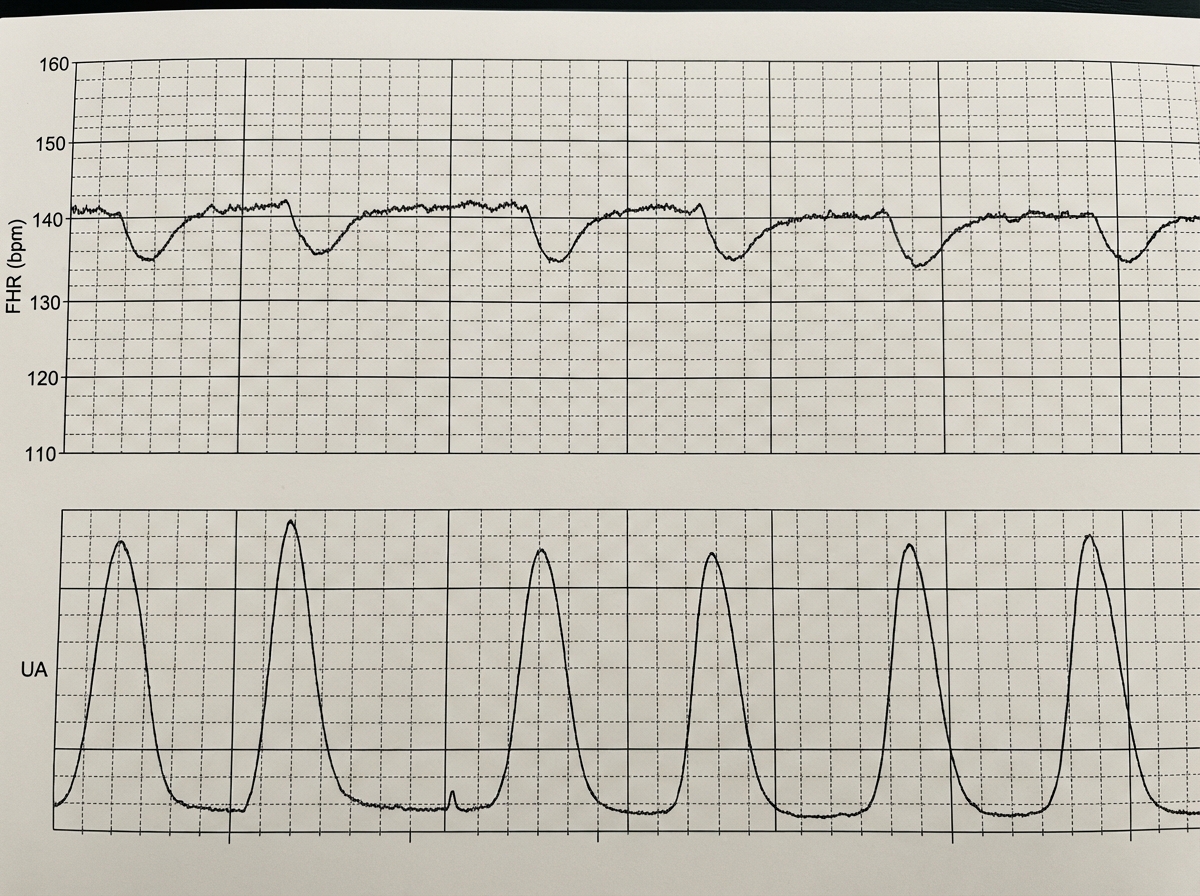
A 39-year-old woman, gravida 5, para 4, at 41 weeks' gestation is brought to the hospital because of regular uterine contractions that started 2 hours ago. Pregnancy has been complicated by iron deficiency anemia treated with iron supplements. Pelvic examination shows the cervix is 90% effaced and 7-cm dilated; the vertex is at -1 station. Fetal heart tracing is shown. The patient is repositioned, O2 therapy is initiated, and amnioinfusion is done. A repeat assessment after 20 minutes shows a similar cervical status, and no changes in the fetal heart tracing, and less than 5 contractions in a period of 10 minutes.What is the most appropriate next step in management?
A 32-year-old female presents to her obstetrician 3 weeks postpartum for failure to lactate. Of note, she has been unable to tolerate cold environments since the birth of her child. Review of systems is positive for fatigue, lightheadedness, and a 3-pound weight gain over the last 3 weeks. Her delivery was complicated by placenta accreta with postpartum blood loss. Her newborn infant is doing well on formula. She denies any personal or family history of thyroid disease. Physical exam is overall unremarkable. On a panel of hormone testing, which of the following levels is most likely to be normal in this patient?
A 23-year-old woman comes to the emergency department because of a 5-day history of nausea and vomiting. There is no associated fever, abdominal pain, constipation, diarrhea, or dysuria. She is sexually active and uses condoms inconsistently. Her last menstrual period was 10 weeks ago. Her temperature is 37°C (98.6°F), pulse is 90/min, respirations are 18/min, and blood pressure is 110/70 mm Hg. There is no rebound tenderness or guarding. A urine pregnancy test is positive. Ultrasonography shows an intrauterine pregnancy consistent in size with an 8-week gestation. The hormone that was measured in this patient's urine to detect the pregnancy is also directly responsible for which of the following processes?
A 22-year-old woman, gravida 2, para 1, at 41 weeks' gestation is admitted to the hospital in active labor. Pregnancy has been uncomplicated. At the beginning of the second stage of labor, the cervix is 100% effaced and 10 cm dilated; the vertex is at -1 station. The fetal heart rate is reactive with no decelerations. As she pushes, it is noted that the fetal heart rate decreases, as seen on cardiotocography (CTG). Which of the following is the most likely cause of this finding?
A 28-year-old primigravid woman at 36 weeks' gestation comes to the emergency department for 2 hours of contractions. Her pregnancy has been uncomplicated. The contractions occur once every 20–30 minutes, last less than 30 seconds, and have been consistent in intensity and duration since onset. During that time there has been an increase in fetal movements. Her temperature is 37.1°C (98.8°F), pulse is 98/min, and blood pressure is 104/76 mm Hg. Pelvic examination shows clear cervical mucus and a firm uterus consistent in size with a 36-week gestation. The cervix is 0% effaced and undilated; the vertex is at -3 station. The fetal heart rate is reassuring. After an hour of monitoring in the emergency department, the character of the contractions and pelvic examination findings remain unchanged. Which of the following is the most appropriate next step?
A 30-year-old woman, gravida 2, para 1, at 38 weeks' gestation comes to the hospital for regular, painful contractions that have been increasing in frequency. Her pregnancy has been complicated by gestational diabetes treated with insulin. Pelvic examination shows the cervix is 50% effaced and 4 cm dilated; the vertex is at -1 station. Ultrasonography shows no abnormalities. A tocometer and Doppler fetal heart monitor are placed on the patient's abdomen. The fetal heart rate monitoring strip shows a baseline heart rate of 145/min with a variability of ≥ 15/min. Within a 20-minute recording, there are 7 uterine contractions, 4 accelerations, and 3 decelerations that have a nadir occurring within half a minute. The decelerations occur at differing intervals relative to the contractions. Which of the following is the most appropriate next step in the management of this patient?
Thirty minutes after vaginal delivery of a 2780-g (6-lb 2-oz) newborn at term, a 25-year-old woman, gravida 1, para 1, has heavy vaginal bleeding. Her pregnancy was complicated by pre-eclampsia. Her pulse is 111/min and blood pressure is 95/65 mm Hg. Physical examination shows a fundal height 2 inches below the xiphoid process of the sternum. A drug with which of the following mechanisms of action is most appropriate for this patient?
Twenty minutes after delivery of a newborn infant, a 22-year-old woman starts breastfeeding. Initially, the expressed milk is thick and yellowish. Three days later, the mother's breasts swell and the expressed milk becomes thinner and whiter. A decrease in maternal serum concentration of which of the following is most likely responsible for the observed changes in milk production?
Want unlimited practice?
Get full access to all questions, explanations, and performance tracking.
Scan to download app