
Proximal tubule reabsorption — MCQs

A scientist is studying the excretion of a novel toxin X by the kidney in order to understand the dynamics of this new substance. He discovers that this new toxin X has a clearance that is half that of inulin in a particular patient. This patient's filtration fraction is 20% and his para-aminohippuric acid (PAH) dynamics are as follows: Urine volume: 100 mL/min Urine PAH concentration: 30 mg/mL Plasma PAH concentration: 5 mg/mL Given these findings, what is the clearance of the novel toxin X?
Which transport mechanism is primarily responsible for calcium reabsorption in the proximal tubule?
A 70-year-old female with chronic kidney failure secondary to diabetes asks her nephrologist to educate her about the techniques used to evaluate the degree of kidney failure progression. She learns about the concept of glomerular filtration rate (GFR) and learns that it can be estimated by measuring the levels of some substances. The clearance of which of the following substances is the most accurate estimate for GFR?
Which mechanism primarily regulates sodium reabsorption in the collecting duct?
A 17-year-old boy is brought to the physician by his father because of a 7-month history of fatigue, recurrent leg cramps, and increased urinary frequency. His pulse is 94/min and blood pressure is 118/85 mm Hg. Physical examination shows dry mucous membranes. Laboratory studies show: Serum Na+ 130 mEq/L K+ 2.8 mEq/L Cl- 92 mEq/L Mg2+ 1.1 mEq/L Ca2+ 10.6 mg/dL Albumin 5.2 g/dL Urine Ca2+ 70 mg/24 h Cl- 375 mEq/24h (N = 110–250) Arterial blood gas analysis on room air shows a pH of 7.55 and an HCO3- concentration of 45 mEq/L. Impaired function of which of the following structures is the most likely cause of this patient's condition?
Renal clearance of substance Y is experimentally studied. At a constant glomerular filtration rate, it is found that the amount of substance Y excreted is greater than the amount filtered. This holds true across all physiologic values on the titration curve. Substance Y is most similar to which of the following?
A 39-year-old woman presents to the clinic with complaints of constipation for the past 2 weeks. She reports that it has been getting increasingly difficult to pass stool to the point that she would go for 2-3 days without going to the bathroom. Prior to this, she passed stool every day without difficulty. She denies weight changes, headaches, chest pain, or abdominal pain but endorses fatigue. Her past medical history is significant for 2 episodes of kidney stones within the past 3 months. A physical examination is unremarkable. Laboratory studies are done and the results are shown below: Serum: Na+: 138 mEq/L Cl-: 97 mEq/L K+: 3.9 mEq/L HCO3-: 24 mEq/L BUN: 10 mg/dL Glucose: 103 mg/dL Creatinine: 1.1 mg/dL Thyroid-stimulating hormone: 3.1 uU/mL Ca2+: 12.1 mg/dL Phosphate: 1.2 mg/dL (Normal: 2.5-4.5 mg/dL) What is the most likely explanation for this patient’s low phosphate levels?
Certain glucose transporters that are expressed predominantly on skeletal muscle cells and adipocytes are unique compared to those transporters found on other cell types within the body. Without directly affecting glucose transport in other cell types, which of the following would be most likely to selectively increase glucose uptake in skeletal muscle cells and adipocytes?
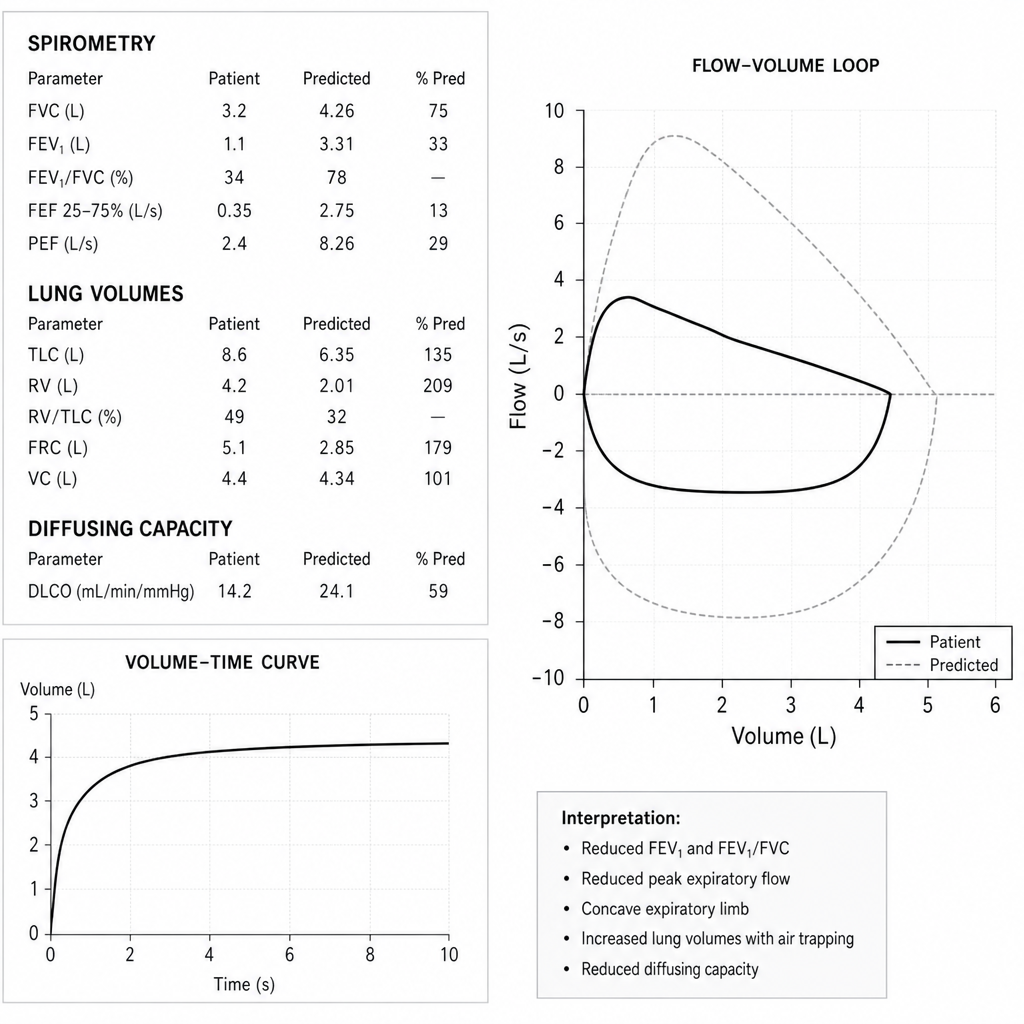
A 58-year-old man with chronic obstructive pulmonary disease is evaluated in the pulmonary function laboratory. Spirometry reveals an FEV1 of 1.1 L, FVC of 3.2 L, and a flow-volume loop. On the loop, peak expiratory flow is markedly reduced and the expiratory limb is concave toward the volume axis, while the inspiratory limb is normal in contour. Which of the following additional findings is most consistent with this pattern?
Want unlimited practice?
Get full access to all questions, explanations, and performance tracking.
Scan to download app