
Calcium and phosphate handling — MCQs

A 65-year-old female with chronic renal failure presents with recent onset of bone pain. Serum analysis reveals decreased levels of calcium and elevated levels of parathyroid hormone. One of the mechanisms driving the elevated PTH is most similar to that seen in:
Which region of the nephron reabsorbs the highest percentage of filtered bicarbonate?
A 55-year-old man with long-standing diabetes presents with a fragility fracture. He has chronic renal failure secondary to his diabetes. His serum parathyroid hormone concentration is elevated. You measure his serum concentration of 25(OH)-vitamin D and find it to be normal, but his concentration of 1,25(OH)-vitamin D is decreased. Which of the following represents a correct pairing of his clinical condition and serum calcium level?
Which factor most strongly influences protein filtration at the glomerulus?
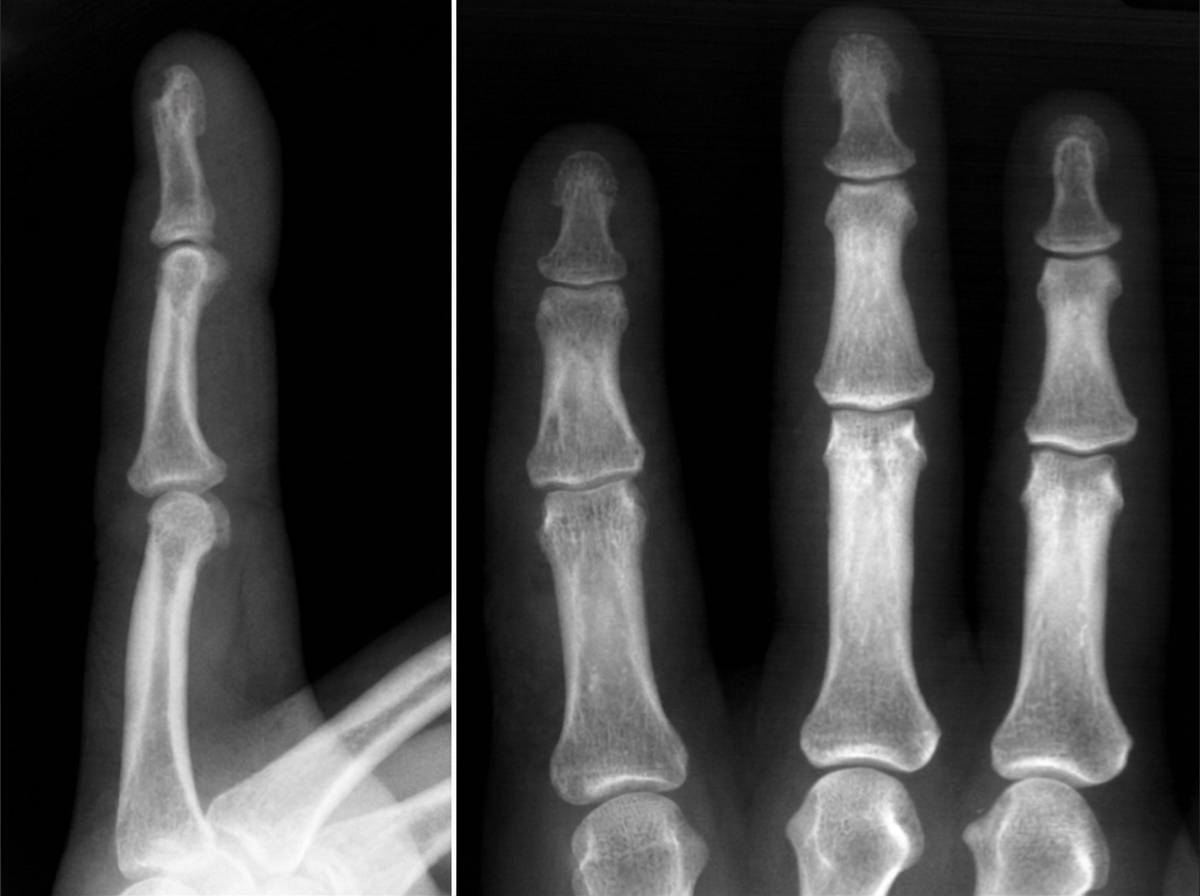
A 76-year-old woman presents to the office with a generalized weakness for the past month. She has a past medical history significant for uncontrolled hypertension and type 2 diabetes mellitus. Her temperature is 37.0°C (98.6°F), blood pressure is 135/82 mm Hg, pulse is 90/min, respiratory rate is 17/min, and oxygen saturation is 99% on room air. Physical exam shows no remarkable findings. Her last recorded glomerular filtration rate was 30 mL/min. A radiograph of the patient’s hand is given. Which of the following lab findings is most likely to be found in this patient?
An investigator is studying the effects of hyperphosphatemia on calcium homeostasis. A high-dose phosphate infusion is administered intravenously to a healthy subject over the course of 3 hours. Which of the following sets of changes is most likely to occur in response to the infusion? $$$ Serum parathyroid hormone %%% Serum total calcium %%% Serum calcitriol %%% Urine phosphate $$$
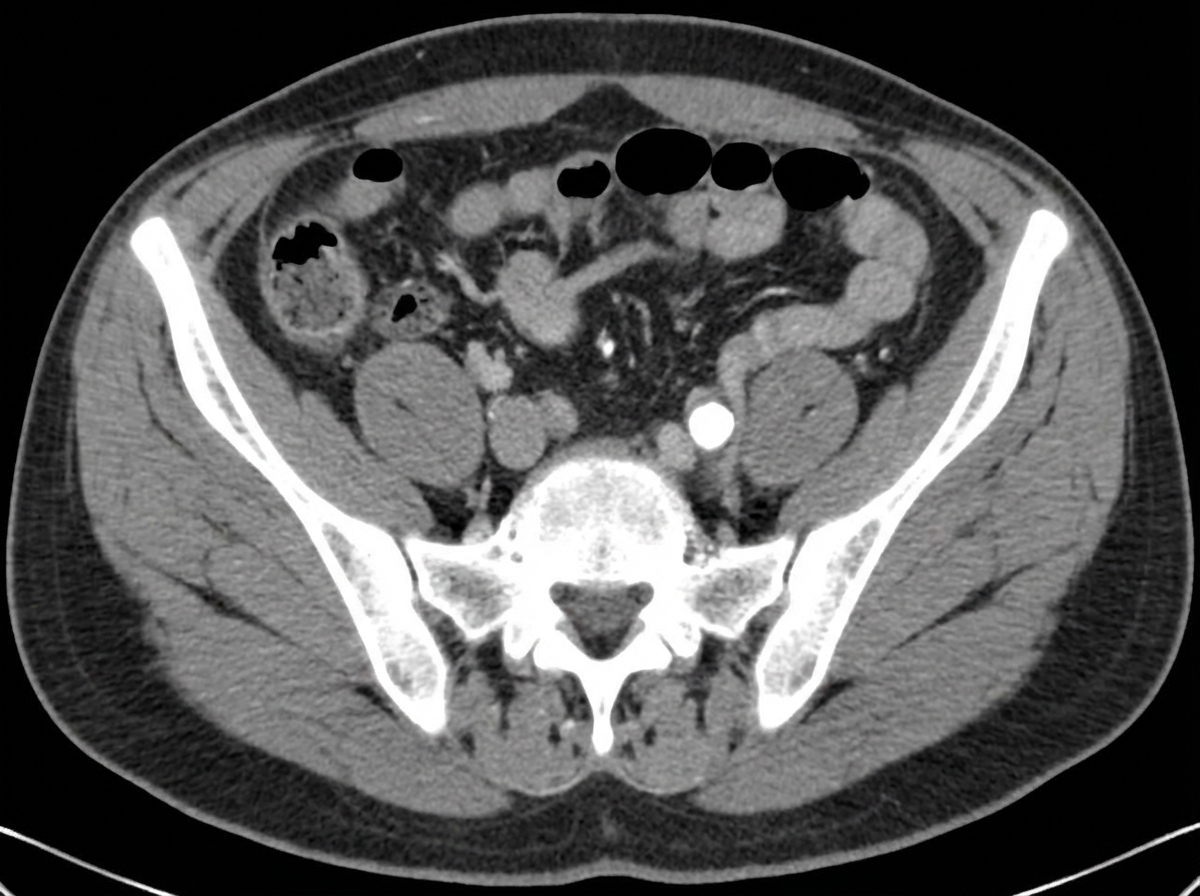
A 55-year-old woman presents to the emergency room with severe abdominal pain for the past 24 hours. She has also noticed blood in her urine. She does not have any significant past medical history. Family history is significant for her mother having cholecystitis status post cholecystectomy at age 45. Her vital signs include: temperature 36.8°C (98.2°F), pulse 103/min, respiratory rate 15/min, blood pressure 105/85 mm Hg. Physical examination is significant for a woman continuously moving on the exam table in an attempt to get comfortable. Laboratory findings are significant for the following: Serum electrolytes Na 138 mEq/L N: 135–145 mEq/L K 4.0 mEq/L N: 3.5–5.0 mEq/L Cl 102 mEq/L N: 98–108 mEq/L CO2 27 mEq/L N: 22–32 mEq/L Ca 9.2 mEq/dL N: 8.4–10.2 mEq/dL PO4 3.5 mg/dL N: 3.0–4.5 mg/dL A 24-hour urine collection is performed and reveals a urinary calcium of 345 mg/day (ref: < 300 mg/day in men; < 250 mg/day in women). A non-contrast CT of the abdomen is performed and is shown in the exhibit. The patient’s symptoms pass within the next 12 hours with hydration and acetaminophen for pain management. She is prescribed a medication to prevent subsequent episodes. At which of the following parts of the nephron does this medication most likely work?
In a healthy patient with no renal abnormalities, several mechanisms are responsible for moving various filtered substances into and out of the tubules. Para-aminohippurate (PAH) is frequently used to estimate renal blood flow when maintained at low plasma concentrations. The following table illustrates the effect of changing plasma PAH concentrations on PAH excretion: Plasma PAH concentration (mg/dL) | Urinary PAH concentration (mg/dL) 0 | 0 10 | 60 20 | 120 30 | 150 40 | 180 Which of the following mechanisms best explains the decreased rate of increase in PAH excretion observed when plasma PAH concentration exceeds 20 mg/dL?
An investigator is studying membranous transport proteins in striated muscle fibers of an experimental animal. An electrode is inserted into the gluteus maximus muscle and a low voltage current is applied. In response to this, calcium is released from the sarcoplasmic reticulum of the muscle fibers and binds to troponin C, which results in a conformational change of tropomyosin and unblocking of the myosin-binding site. The membranous transport mechanism underlying the release of calcium into the cytosol most resembles which of the following processes?
A 52-year-old man comes to the physician because of a 4-month history of fatigue, weakness, constipation, decreased appetite, and intermittent flank pain. He takes ibuprofen for knee and shoulder pain. Physical examination shows mild tenderness bilaterally in the costovertebral areas. His serum calcium concentration is 11.2 mg/dL, phosphorus concentration is 2.5 mg/dL, and N-terminal parathyroid hormone concentration is 830 pg/mL. Which of the following steps in vitamin D metabolism is most likely increased in this patient?
Want unlimited practice?
Get full access to all questions, explanations, and performance tracking.
Scan to download app