
Starling forces in glomerular filtration — MCQs

A 55-year-old woman presents to a physician’s clinic for a diabetes follow-up. She recently lost weight and believes the diabetes is ‘winding down’ because the urinary frequency has slowed down compared to when her diabetes was "at its worst". She had been poorly compliant with medications, but she is now asking if she can decrease her medications as she feels like her diabetes is improving. Due to the decrease in urinary frequency, the physician is interested in interrogating her renal function. Which substance can be used to most accurately assess the glomerular filtration rate (GFR) in this patient?
Which factor most strongly influences protein filtration at the glomerulus?
A 45-year-old man presents with a 3-day history of right-sided flank pain due to a lodged ureteral stone. What changes would be expected to be seen at the level of glomerular filtration?
On cardiology service rounds, your team sees a patient admitted with an acute congestive heart failure exacerbation. In congestive heart failure, decreased cardiac function leads to decreased renal perfusion, which eventually leads to excess volume retention. To test your knowledge of physiology, your attending asks you which segment of the nephron is responsible for the majority of water absorption. Which of the following is a correct pairing of the segment of the nephron that reabsorbs the majority of all filtered water with the means by which that segment absorbs water?
A 70-year-old female with chronic kidney failure secondary to diabetes asks her nephrologist to educate her about the techniques used to evaluate the degree of kidney failure progression. She learns about the concept of glomerular filtration rate (GFR) and learns that it can be estimated by measuring the levels of some substances. The clearance of which of the following substances is the most accurate estimate for GFR?
A 75-year-old woman is brought to a physician’s office by her son with complaints of diarrhea and vomiting for 1 day. Her stool is loose, watery, and yellow-colored, while her vomitus contains partially digested food particles. She denies having blood or mucus in her stools and vomitus. Since the onset of her symptoms, she has not had anything to eat and her son adds that she is unable to tolerate fluids. The past medical history is unremarkable and she does not take any medications regularly. The pulse is 115/min, the respiratory rate is 16/min, the blood pressure is 100/60 mm Hg, and the temperature is 37.0°C (98.6°F). The physical examination shows dry mucous membranes and slightly sunken eyes. The abdomen is soft and non-tender. Which of the following physiologic changes in glomerular filtration rate (GFR), renal plasma flow (RPF), and filtration fraction (FF) are expected?
A researcher is investigating the effects of a new antihypertensive medication on renal physiology. She gives a subject a dose of the new medication, and she then collects plasma and urine samples. She finds the following: Hematocrit: 40%; Serum creatinine: 0.0125 mg/mL; Urine creatinine: 1.25 mg/mL. Urinary output is 1 mL/min. Renal blood flow is 1 L/min. Based on the above information and approximating that the creatinine clearance is equal to the GFR, what answer best approximates filtration fraction in this case?
A 48-year-old woman comes to the physician for a follow-up examination. At her visit 1 month ago, her glomerular filtration rate (GFR) was 100 mL/min/1.73 m2 and her renal plasma flow (RPF) was 588 mL/min. Today, her RPF is 540 mL/min and her filtration fraction (FF) is 0.2. After her previous appointment, this patient was most likely started on a drug that has which of the following effects?
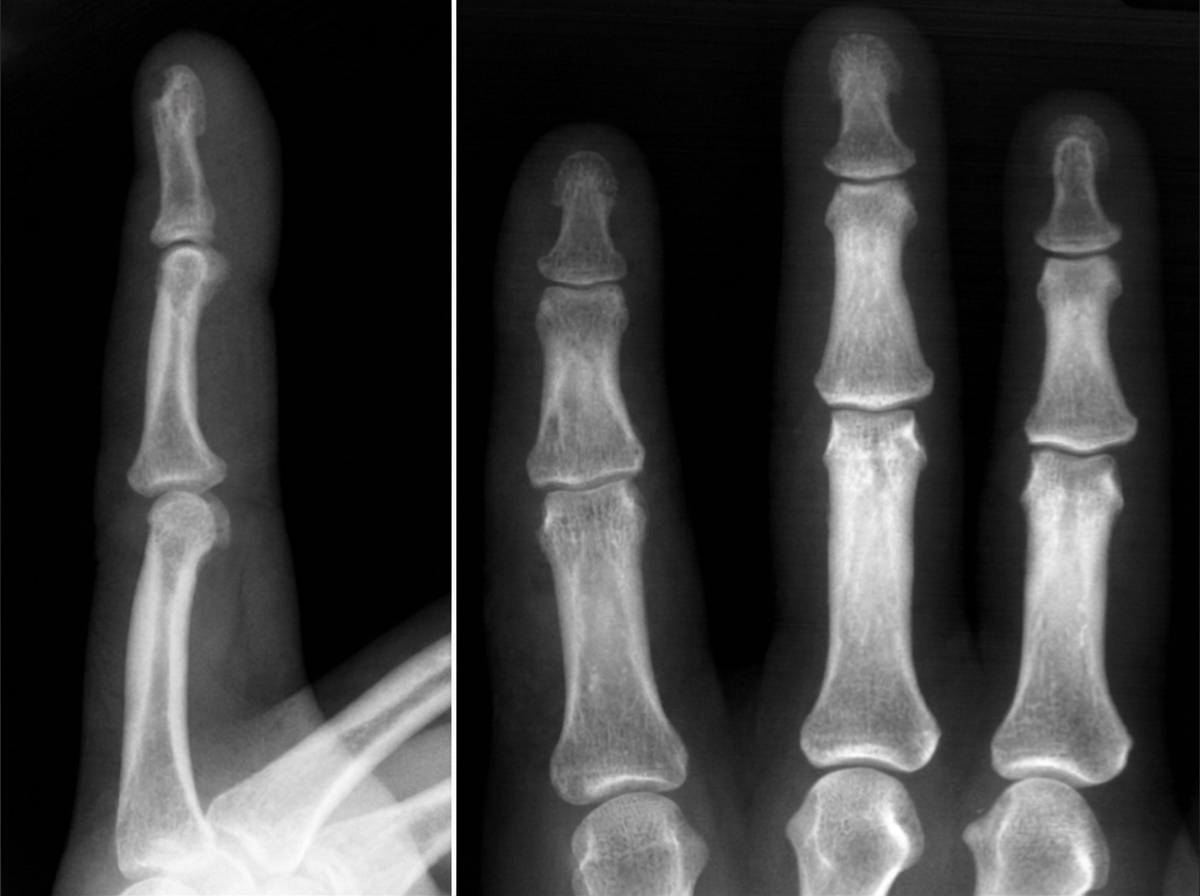
A 76-year-old woman presents to the office with a generalized weakness for the past month. She has a past medical history significant for uncontrolled hypertension and type 2 diabetes mellitus. Her temperature is 37.0°C (98.6°F), blood pressure is 135/82 mm Hg, pulse is 90/min, respiratory rate is 17/min, and oxygen saturation is 99% on room air. Physical exam shows no remarkable findings. Her last recorded glomerular filtration rate was 30 mL/min. A radiograph of the patient’s hand is given. Which of the following lab findings is most likely to be found in this patient?
Activation of the renin-angiotensin-aldosterone system yields a significant physiological effect on renal blood flow and filtration. Which of the following is most likely to occur in response to increased levels of Angiotensin-II?
Want unlimited practice?
Get full access to all questions, explanations, and performance tracking.
Scan to download app