
Age-related changes in GFR — MCQs

Which factor most strongly influences protein filtration at the glomerulus?
A 62-year-old man comes to the physician for a follow-up examination. One month ago, therapy with lisinopril was initiated for treatment of hypertension. His blood pressure is 136/86 mm Hg. Urinalysis shows a creatinine clearance of 92 mL/min. The patient's serum creatinine concentration is most likely closest to which of the following values?
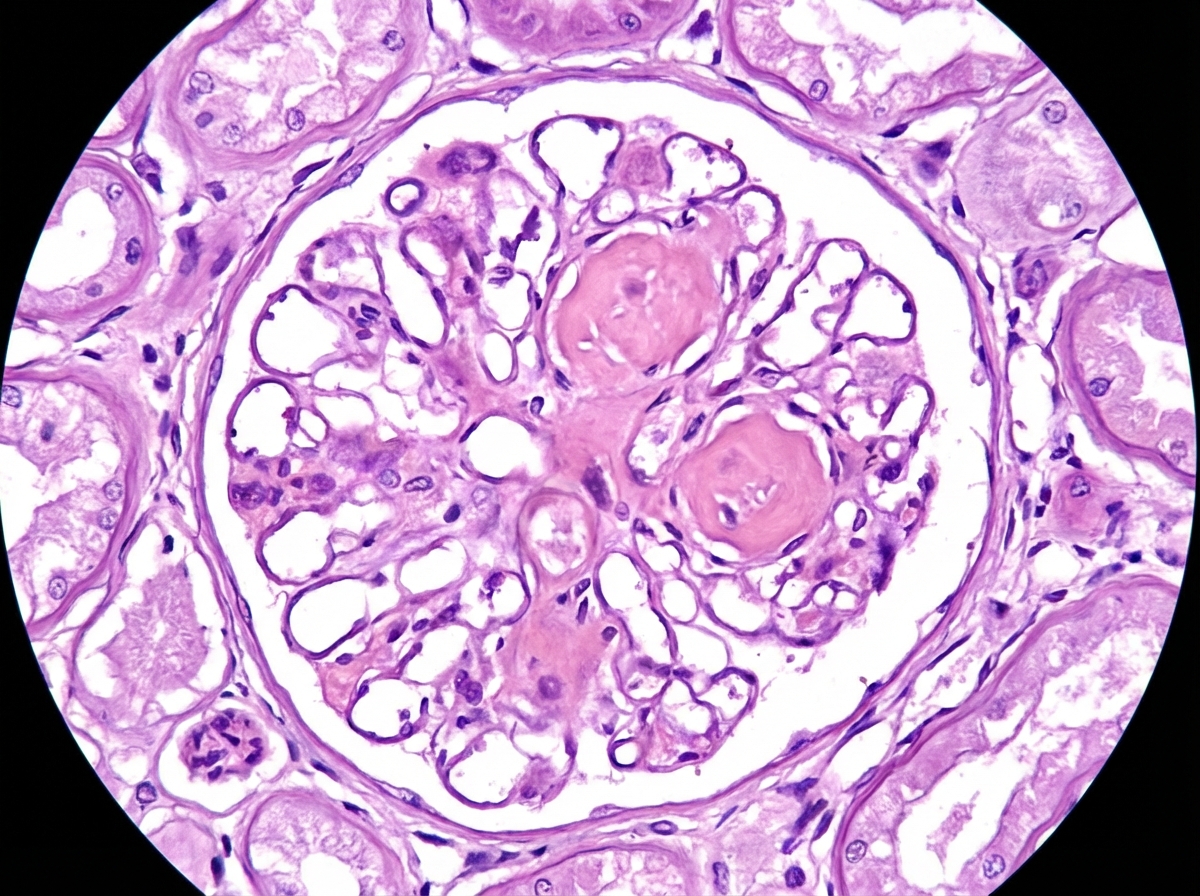
A 62-year-old man comes to the physician because of fatigue and decreased urine output for 2 weeks. He has not been to the physician for many years and takes no medications. Serum studies show a urea nitrogen concentration of 42 mg/dL and a creatinine concentration of 2.3 mg/dL. Urinalysis shows heavy proteinuria. A photomicrograph of a section of a kidney biopsy specimen is shown. Which of the following is the most likely underlying cause of this patient's symptoms?
A laboratory technician processes basic metabolic panels for two patients. Patient A is 18 years old and patient B is 83 years old. Neither patient takes any medications regularly. Serum laboratory studies show: Patient A Patient B Na+ (mEq/L) 145 141 K+ (mEq/L) 3.9 4.4 Cl- (mEq/L) 103 109 HCO3- (mEq/L) 22 21 BUN (mg/dL) 18 12 Cr (mg/dL) 0.8 1.2 Glucose (mg/dL) 105 98 Which of the following most likely accounts for the difference in creatinine seen between these two patients?
A researcher is investigating the effects of a new antihypertensive medication on renal physiology. She gives a subject a dose of the new medication, and she then collects plasma and urine samples. She finds the following: Hematocrit: 40%; Serum creatinine: 0.0125 mg/mL; Urine creatinine: 1.25 mg/mL. Urinary output is 1 mL/min. Renal blood flow is 1 L/min. Based on the above information and approximating that the creatinine clearance is equal to the GFR, what answer best approximates filtration fraction in this case?
A 75-year-old woman is brought to a physician’s office by her son with complaints of diarrhea and vomiting for 1 day. Her stool is loose, watery, and yellow-colored, while her vomitus contains partially digested food particles. She denies having blood or mucus in her stools and vomitus. Since the onset of her symptoms, she has not had anything to eat and her son adds that she is unable to tolerate fluids. The past medical history is unremarkable and she does not take any medications regularly. The pulse is 115/min, the respiratory rate is 16/min, the blood pressure is 100/60 mm Hg, and the temperature is 37.0°C (98.6°F). The physical examination shows dry mucous membranes and slightly sunken eyes. The abdomen is soft and non-tender. Which of the following physiologic changes in glomerular filtration rate (GFR), renal plasma flow (RPF), and filtration fraction (FF) are expected?
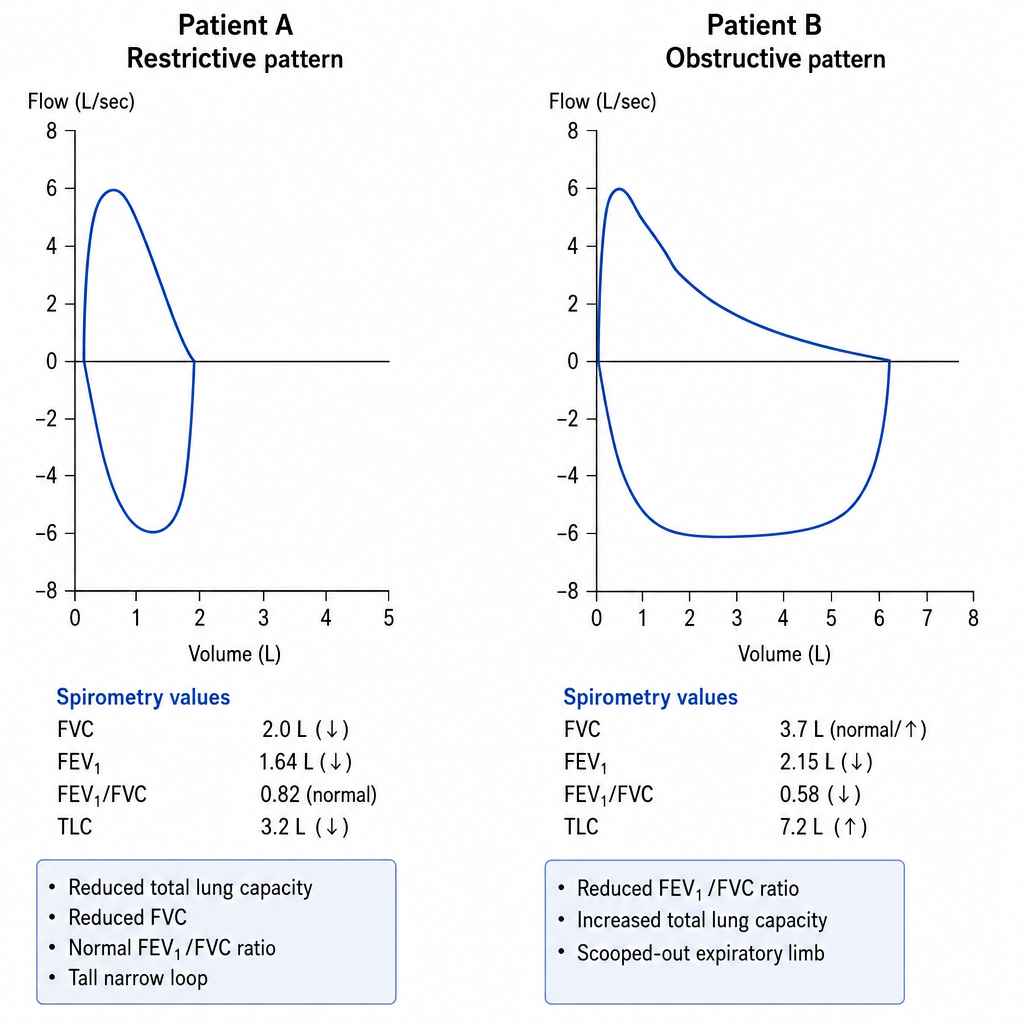
A pulmonologist reviews spirometry tracings from two patients with dyspnea. Patient A's loop demonstrates a reduced total lung capacity, reduced FVC, normal FEV1/FVC ratio (0.82), and a tall narrow loop. Patient B's loop shows a reduced FEV1/FVC ratio (0.58), increased total lung capacity, and a scooped-out expiratory limb. Which of the following correctly identifies the underlying mechanism responsible for the reduced expiratory flow in Patient B?
A 9-year-old boy is brought to the physician's office by his mother because of facial swelling for the past 2 days. The mother says that her son has always been healthy and active but is becoming increasingly lethargic and now has a puffy face. Upon inquiry, the boy describes a foamy appearance of his urine, but denies having blood in the urine, urinary frequency at night, or pain during urination. He has no history of renal or urinary diseases. Physical examination is unremarkable, except for generalized swelling of the face and pitting edema on the lower limbs. Dipstick analysis reveals 4+ proteinuria. An abdominal ultrasound shows normal kidney size and morphology. A renal biopsy yields no findings under light and fluorescence microscopy; however, glomerular podocyte foot effacement is noted on electron microscopy. Which of the following changes in Starling forces occurs in this patient's condition?
A 70-year-old female with chronic kidney failure secondary to diabetes asks her nephrologist to educate her about the techniques used to evaluate the degree of kidney failure progression. She learns about the concept of glomerular filtration rate (GFR) and learns that it can be estimated by measuring the levels of some substances. The clearance of which of the following substances is the most accurate estimate for GFR?
A 73-year-old male is brought in by ambulance after he was found to be lethargic and confused. He has not been routinely seeing a physician and is unable to recall how he came to be in the hospital. His temperature is 99°F (37°C), blood pressure is 150/95 mmHg, pulse is 75/min, and respirations are 18/min. His past medical history is significant for poorly controlled diabetes and longstanding hypertension, and he says that he has not been taking his medications recently. Labs are obtained and shown below: Serum: Na+: 142 mEq/L Cl-: 105 mEq/L K+: 5 mEq/L HCO3-: 16 mEq/L Urea nitrogen: 51 mg/dL Glucose: 224 mg/dL Creatinine: 2.6 mg/dL Which of the following changes would most likely improve the abnormal parameter that is responsible for this patient's symptoms?
Want unlimited practice?
Get full access to all questions, explanations, and performance tracking.
Scan to download app