
Alveolar-arterial oxygen gradient — MCQs

A 32-year-old female with Crohn's disease diagnosed in her early 20s comes to your office for a follow-up appointment. She is complaining of headaches and fatigue. Which of the following arterial blood gas findings might you expect?
Four days after undergoing an elective total hip replacement, a 65-year-old woman develops a DVT that embolizes to the lung. Along with tachypnea, tachycardia, and cough, the patient would most likely present with a PaO2 of what?
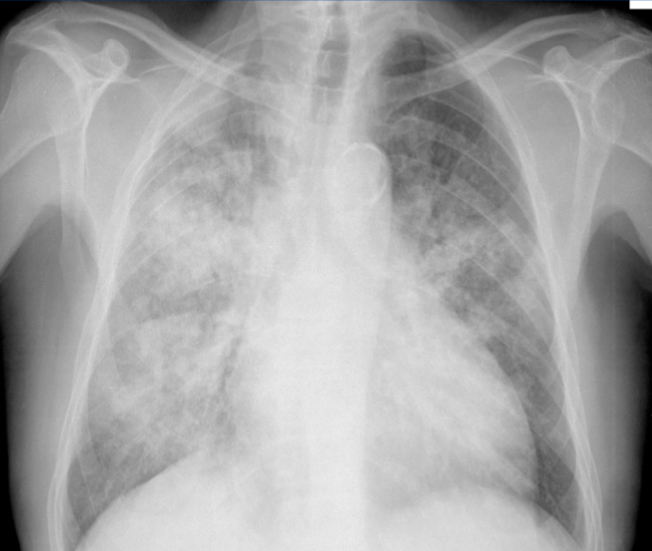
A 17-year-old boy presents to the emergency department of a hospital located in the town of Recuay (which is situated at 3,400 meters above mean sea level [MAMSL]) in the Ancash Region (Peru), 48 hours after returning from a 21-day stay in Lima (the capital city of Peru at 0 MAMSL). The patient has no previous medical history. His current complaints include cough, dyspnea at rest, hemoptysis, chest pain, and vomiting. His vital signs include: blood pressure 90/60 mm Hg; heart rate 149/min; respiratory rate 37/min; temperature 36.5°C (97.7°F); and O2 saturation 71%. Physical examination reveals polypnea, perioral cyanosis, intercostal retractions, and diffuse pulmonary crackles. His laboratory results are as follows: Hemoglobin 19.2 g/dL Hematocrit 60% Leukocytes 13,000 (Bands: 12%, Seg: 78%, Eos: 0%, Bas: 0%, Mon: 6%) Urea 25 mg/dL Creatinine 0.96 mg/dL A chest X-ray is shown. Which of the following statements is true and most likely regarding this patient’s condition?
A 63-year-old man presents to the clinic with fever accompanied by shortness of breath. The symptoms developed a week ago and have been progressively worsening over the last 2 days. He reports his cough is productive of thick, yellow sputum. He was diagnosed with chronic obstructive pulmonary disease 3 years ago and has been on treatment ever since. He quit smoking 10 years ago but occasionally experiences shortness of breath along with chest tightness that improves with the use of an inhaler. However, this time the symptoms seem to be more severe and unrelenting. His temperature is 38.6°C (101.4°F), the respirations are 21/min, the blood pressure is 100/60 mm Hg, and the pulse is 105/min. Auscultation reveals bilateral crackles and expiratory wheezes. His oxygen saturation is 95% on room air. According to this patient’s history, which of the following should be the next step in the management of this patient?
A 50-year-old man presents to the urgent care clinic for 3 hours of worsening cough, shortness of breath, and dyspnea. He works as a long-haul truck driver, and he informs you that he recently returned to the west coast from a trip to Arkansas. His medical history is significant for gout, hypertension, hypercholesterolemia, diabetes mellitus type 2, chronic obstructive pulmonary disease (COPD), and mild intellectual disability. He currently smokes 1 pack of cigarettes/day, drinks a 6-pack of beer/day, and he endorses a past history of injection drug use but currently denies any illicit drug use. The vital signs include: temperature 36.7°C (98.0°F), blood pressure 126/74 mm Hg, heart rate 87/min, and respiratory rate 23/min. His physical examination shows mild, bilateral, coarse rhonchi, but otherwise clear lungs on auscultation, grade 2/6 holosystolic murmur, and a benign abdominal physical examination. He states that he ran out of his albuterol inhaler 6 days ago and has been meaning to follow-up with his primary care physician (PCP) for a refill. Complete blood count (CBC) and complete metabolic panel are within normal limits. He also has a D-dimer result within normal limits. Which of the following is the most appropriate next step in evaluation?
A 63-year-old man with alpha-1-antitrypsin deficiency is brought to the emergency department 1 hour after his daughter found him unresponsive. Despite appropriate care, the patient dies. At autopsy, examination of the lungs shows enlargement of the airspaces in the respiratory bronchioles and alveoli. Enzymatic activity of which of the following cells is the most likely cause of these findings?
Two days after undergoing left hemicolectomy for a colonic mass, a 62-year-old man develops shortness of breath. His temperature is 38.1°C (100.6°F), pulse is 80/min, respirations are 22/min, and blood pressure is 120/78 mm Hg. Pulse oximetry on room air shows an oxygen saturation of 88%. Cardiopulmonary examination shows decreased breath sounds and decreased fremitus at both lung bases. Arterial blood gas analysis on room air shows: pH 7.35 PaO2 70 mm Hg PCO2 40 mm Hg An x-ray of the chest shows a collapse of the bases of both lungs. Which of the following is the most likely underlying mechanism of this patient's hypoxemia?
A 30-year-old woman presents to the emergency department with breathlessness for the last hour. She is unable to provide any history due to her dyspnea. Her vitals include: respiratory rate 20/min, pulse 100/min, and blood pressure 144/84 mm Hg. On physical examination, she is visibly obese, and her breathing is labored. There are decreased breath sounds and hyperresonance to percussion across all lung fields bilaterally. An arterial blood gas is drawn, and the patient is placed on inhaled oxygen. Laboratory findings reveal: pH 7.34 pO2 63 mm Hg pCO2 50 mm Hg HCO3 22 mEq/L Her alveolar partial pressure of oxygen is 70 mm Hg. Which of the following is the most likely etiology of this patient’s symptoms?
A 2-year-old boy is brought to the physician because of coughing and difficulty breathing that started shortly after his mother found him in the living room playing with his older brother's toys. He appears anxious. Respirations are 33/min and pulse oximetry on room air shows an oxygen saturation of 88%. Physical examination shows nasal flaring and intercostal retractions. Auscultation of the lungs shows a high-pitched inspiratory wheeze and absent breath sounds on the right side. There is no improvement in his oxygen saturation after applying a non-rebreather mask with 100% FiO2. Which of the following terms best describes the most likely underlying mechanism of the right lung's impaired ventilation?
A 67-year-old man presents to the surgical clinic with swelling of his right leg, fever, and chills for 2 days. The maximum recorded temperature was 38.3°C (101.0°F) at home. His right leg is red and swollen from the dorsum of the foot to the thigh with an ill-defined edge. Venous stasis ulcers are present in both of his limbs, but those on the right have a yellow discharge. His vitals include the following: blood pressure is 120/78 mm Hg, heart rate is 94/min, temperature is 38.3°C (101.0°F), and respiratory rate is 16/min. On physical examination, there is tenderness and warmth compared with his normal leg. Dorsalis pedis pulses are present on both of the ankles. What is the most likely cause of the right shift of the hemoglobin dissociation curve for his condition?
Want unlimited practice?
Get full access to all questions, explanations, and performance tracking.
Scan to download app