
QT interval and QTc calculation — MCQs

A 21-year-old woman presents with palpitations and anxiety. She had a recent outpatient ECG that was suggestive of supraventricular tachycardia, but her previous physician failed to find any underlying disease. No other significant past medical history. Her vital signs include blood pressure 102/65 mm Hg, pulse 120/min, respiratory rate 17/min, and temperature 36.5℃ (97.7℉). Electrophysiological studies reveal an atrioventricular nodal reentrant tachycardia. The patient refuses an ablation procedure so it is decided to perform synchronized cardioversion with consequent ongoing management with verapamil. Which of the following ECG features should be monitored in this patient during treatment?
A 62-year-old man is brought to the emergency department because of syncope. He reports sudden onset of palpitations followed by loss of consciousness while carrying his groceries to his car. He is unable to recall any further details and does not have any chest pain or dizziness. He has a history of hypertension, type 2 diabetes mellitus, gastroparesis, and osteoarthritis of the knees. Medications include lisinopril, metformin, and ondansetron as needed for nausea. He also takes methadone daily for chronic pain. Apart from an abrasion on his forehead, he appears well. His temperature is 37.2 °C (98.9 F), heart rate is 104/min and regular, and blood pressure is 135/70 mm Hg. While he is in the emergency department, he loses consciousness again. Telemetry shows polymorphic ventricular tachycardia with cyclic alteration of the QRS axis that spontaneously resolves after 30 seconds. Results of a complete blood count, serum electrolyte concentrations, and serum thyroid studies show no abnormalities. Cardiac enzymes are within normal limits. Which of the following is the most likely underlying cause of this patient's syncope?
A 51-year-old woman with a history of paroxysmal atrial fibrillation comes to the physician for a follow-up visit. She feels well and wants to discuss pausing her only current medication, flecainide. Her pulse is 75/min and regular, blood pressure is 125/75 mm Hg. Physical examination shows no abnormalities. An ECG shows a PR interval of 180 ms, QRS time of 120 ms, and corrected QT interval of 440 ms. Which of the following ECG changes is most likely to be seen on cardiac stress testing in this patient?
A 51-year-old woman schedules an appointment with her physician with complaints of upper abdominal pain, nausea, and early satiety for the last 6 months. She has type 1 diabetes for the past 10 years and is on subcutaneous insulin therapy. She complains of occasional heartburn and lost 4.5 kg (10 lb) in the past 6 months without any changes in her diet. The medical history is significant for long QT syndrome. The vital signs include: pulse 74/min, respirations 18/min, temperature 37.7°C (99.9°F), and blood pressure 140/84 mm Hg. Abdominal examination is negative for organomegaly or a palpable mass, but there is a presence of succussion splash. She has slightly decreased vision in both her eyes and fundoscopy reveals diabetic changes in the retina. Esophagogastroduodenoscopy is performed, which is negative for obstruction, but a small ulcer is noted near the cardiac end of the stomach with some food particles. Which of the following drugs would be inappropriate in the management of this patient's condition?
A cardiologist is studying how a new virus that infects the heart affects the electrical conduction system of the cardiac myocytes. He decides to obtain electrocardiograms on patients with this disease in order to see how the wave patterns and durations change over time. While studying these records, he asks a medical student who is working with him to interpret the traces. Specifically, he asks her to identify the part that represents initial ventricular depolarization. Which of the following characteristics is most consistent with this feature of the electrocardiogram?
A 52-year-old man comes to the physician because of a 3-day history of intermittent chest tightness that worsens with exercise. He has chronic atrial fibrillation treated with a drug that prolongs the QT interval. During cardiac stress testing, an ECG shows progressive shortening of the QT interval as the heart rate increases. Which of the following drugs is this patient most likely taking?
A 68-year-old man comes to the physician because of fatigue and muscle cramps for the past 4 weeks. He has also noticed several episodes of tingling in both hands. He has not had fever or nausea. He has had a chronic cough for 10 years. He has chronic bronchitis, hypertension, and osteoarthritis of both knees. His father died from lung cancer. Current medications include salbutamol, ibuprofen, and ramipril. He has smoked 1 pack of cigarettes daily for 45 years. He is 175 cm (5 ft 9 in) tall and weighs 68 kg (163 lb); BMI is 22 kg/m2. His temperature is 36.7°C (98°F), pulse is 60/min, and blood pressure is 115/76 mm Hg. While measuring the patient's blood pressure, the physician observes carpopedal spasm. Cardiopulmonary examination shows no abnormalities. His hematocrit is 41%, leukocyte count is 5,800/mm3, and platelet count is 195,000/mm3. Serum alkaline phosphatase activity is 55 U/L. An ECG shows sinus rhythm with a prolonged QT interval. Which of the following is the most likely underlying cause of this patient's symptoms?
A 17-year-old girl suddenly grabs her chest and collapses to the ground while playing volleyball at school. The teacher rushes to evaluate the situation and finds that the girl has no pulse and is not breathing. He starts chest compressions. An automated external defibrillator (AED) is brought to the scene within 3 minutes and a shock is delivered. The girl regains consciousness and regular sinus rhythm. She is rushed to the emergency department. The vital signs include: blood pressure 122/77 mm Hg and pulse 65/min. The pulse is regular. An electrocardiogram (ECG) shows a shortened PR interval, a wide QRS complex, a delta wave, and an inverted T wave. Which of the following is the most likely pathology in the conduction system of this patient’s heart?
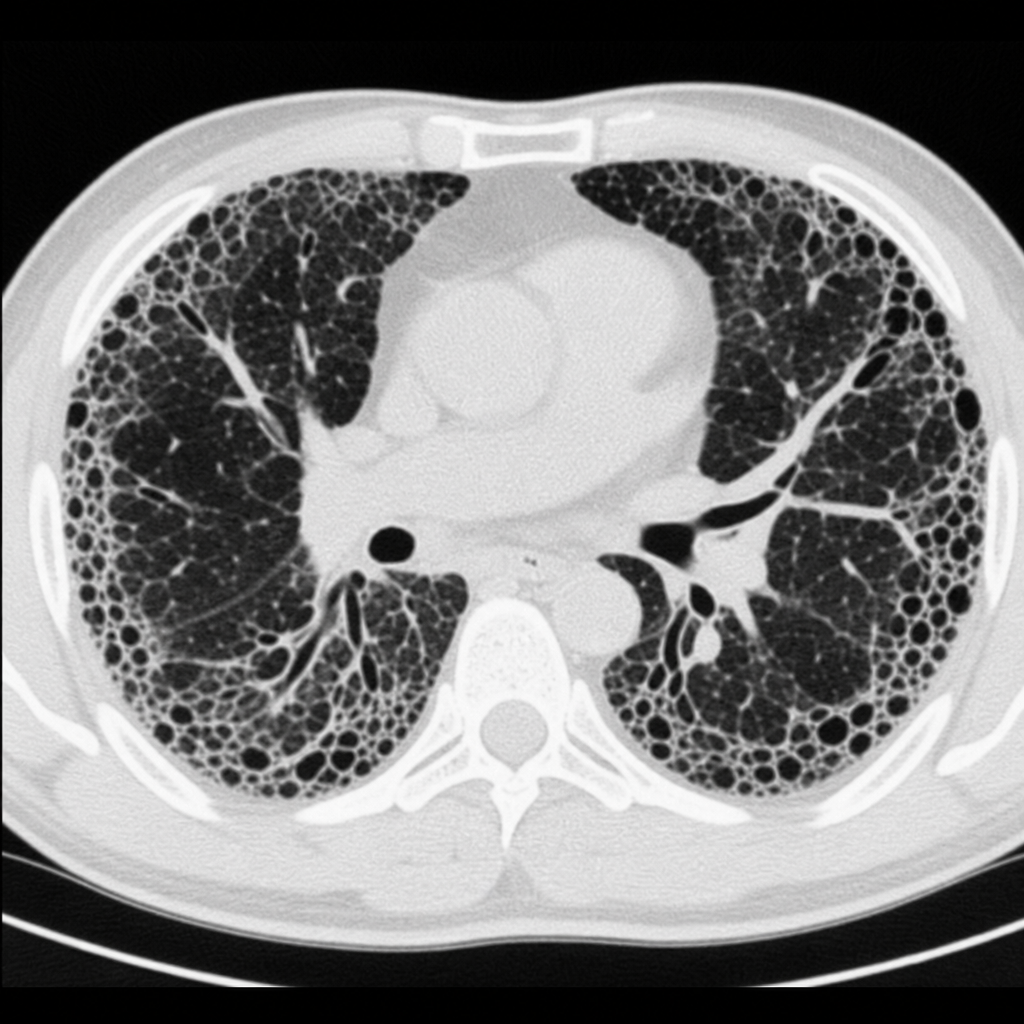
A 19-year-old male college student presents with progressive exertional dyspnea over 6 months. He has a history of childhood radiation therapy to the chest for mediastinal lymphoma. High-resolution CT of the chest shows bilateral interstitial fibrosis with honeycombing and traction bronchiectasis. Pulmonary function testing yields the following results: FVC 3.1 L (predicted 4.8 L), FEV1 2.7 L (predicted 4.0 L), FEV1/FVC 87%, TLC 3.4 L (predicted 6.2 L), DLCO 58% of predicted. Which of the following physiological mechanisms best accounts for the reduced DLCO in this patient?
An investigator develops a new drug that decreases the number of voltage-gated potassium channels in cardiac muscle cell membranes. Which of the following is the most likely effect of this drug on the myocardial action potential?
Want unlimited practice?
Get full access to all questions, explanations, and performance tracking.
Scan to download app