
Electrolyte effects on ECG — MCQs

Four days after admission to the hospital for anorexia nervosa, a 20-year-old woman has new-onset palpitations and paresthesias in all four limbs. Prior to admission, she was found unconscious by her parents on the floor of a residential treatment center. The patient was started on a trial of nutritional rehabilitation upon arrival to the hospital. Her temperature is 36°C (96.8°F), pulse is 47/min, and blood pressure is 90/60 mmHg. She is 160 cm tall and weighs 35 kg; BMI is 14 kg/m2. The patient appears emaciated. Examination shows lower leg edema. A 2/6 holosystolic murmur is heard over the 5th intercostal space at the midclavicular line. An ECG shows intermittent supraventricular tachycardia and QTc prolongation. Serum studies show: Day 2 Day 4 Potassium (mEq/L) 3.5 2.7 Calcium (mg/dL) 8.5 7.8 Magnesium (mEq/L) 1.2 0.5 Phosphorus (mg/dL) 3.6 1.5 Which of the following is the most likely underlying cause of this patient's condition?
An ECG from an 8-year-old male with neurosensory deafness and a family history of sudden cardiac arrest demonstrates QT-interval prolongation. Which of the following is this patient most at risk of developing?
A 53-year-old man with obesity and heart disease presents to your outpatient clinic with complaints of orthopnea, significant dyspnea on minimal exertion, nausea, vomiting, and diarrhea. He says that his old doctor gave him "some pills" that he takes in varying amounts every morning. Physical exam is significant for a severely displaced point of maximal impulse, bilateral rales in the lower lung fields, an S3 gallop, and hepatomegaly. You decide to perform an EKG (shown in figure A). Suddenly, his rhythm changes to ventricular tachycardia followed by ventricular fibrillation, and he syncopizes and expires despite resuscitative efforts. High levels of which medication are most likely responsible?
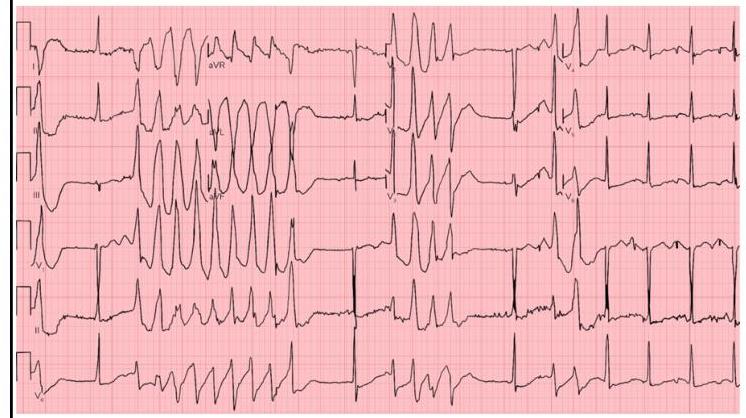
An 8-year-old boy is brought to the emergency department by his parents because of vomiting, abdominal pain, and blurry vision for the past hour. The parents report that the boy developed these symptoms after he accidentally ingested 2 tablets of his grandfather’s heart failure medication. On physical examination, the child is drowsy, and his pulse is 120/min and irregular. Digoxin toxicity is suspected. A blood sample is immediately sent for analysis and shows a serum digoxin level of 4 ng/mL (therapeutic range: 0.8–2 ng/mL). Which of the following electrolyte abnormalities is most likely to be present in the boy?
A 58-year-old African-American man with a history of congestive heart failure presents to the emergency room with headache, frequent vomiting, diarrhea, anorexia, and heart palpitations. He is taking a drug that binds the sodium-potassium pump in myocytes. EKG reveals ventricular dysrhythmia. Which of the following is likely also present in the patient?
A 32-year-old woman is hospitalized after developing an allergic reaction to the contrast medium used for a cerebral angiography. The study was initially ordered as part of the diagnostic approach of a suspected case of pseudotumor cerebri. Her medical history is unremarkable. On physical examination she has stable vital signs, a diffuse maculopapular rash over her neck and chest, and a mild fever. She is started on hydrocortisone and monitored for the next 8 hours. After the monitoring period, a laboratory test shows significant azotemia. The patient complains of generalized weakness and palpitations. Tall-peaked T waves are observed on ECG. Which of the following explains this clinical manifestation?
A 42-year-old man comes to the emergency department because of tingling in his hands and legs and palpitations for 1 week. He has also had severe cramping in his hands, feet, and abdomen during this period. Three months ago, he was hospitalized for acute pancreatitis. He discharged himself against medical advice at that time. There is no family history of illness. He does not smoke. He drinks 2–3 beers and a pint of vodka daily. He has a history of using intravenous heroin. He has not had a stable job for a year. He is only oriented to place and person. His temperature is 37.1°C (98.8°F), pulse is 90/min, and blood pressure is 110/96 mm Hg. There is a carpopedal spasm while measuring his blood pressure. Cardiopulmonary examination shows no abnormalities. Deep tendon reflexes are 4+ bilaterally. Neurologic examination shows no focal findings. Which of the following is the most appropriate pharmacotherapy?
A 67-year-old man with a history of chronic alcoholism presents to the emergency department after a suicide attempt. The patient was found in his apartment by his grandson with wrist lacerations. He was rushed to the emergency department and was resuscitated en route. The patient has a past medical history of ischemic heart disease and depression. His pulse is barely palpable and he is not responding to questions coherently. His temperature is 98.2°F (36.8°C), blood pressure is 107/48 mmHg, pulse is 160/min, respirations are 14/min, and oxygen saturation is 99% on room air. After fluid resuscitation and wound care, his blood pressure improves to 127/55 mmHg. On physical exam, the patient complains of numbness surrounding his mouth and pain in the location of the lacerations of his wrists. Which of the following best describes the laboratory findings in this patient?
A 65-year-old woman comes to the physician because of a 3-month history of intermittent palpitations and shortness of breath. Cardiopulmonary examination shows no other abnormalities. An ECG shows an absence of P waves, an oscillating baseline, and irregular RR intervals at a rate of approximately 95 beats per minute. The difference between atrial and ventricular rates in this patient is most likely due to which of the following?
A researcher is studying how electrical activity propagates across the heart. In order to do this, he decides to measure the rate at which an action potential moves within various groups of cardiac muscle tissue. In particular, he isolates fibers from areas of the heart with the following characteristics: A) Dysfunction leads to fixed PR intervals prior to a dropped beat B) Dysfunction leads to increasing PR intervals prior to a dropped beat C) Dysfunction leads to tachycardia with a dramatically widened QRS complex D) Dysfunction leads to tachycardia with a sawtooth pattern on electrocardiogram Which of the following is the proper order of these tissues from fastest action potential propagation to slowest action potential propagation.
Want unlimited practice?
Get full access to all questions, explanations, and performance tracking.
Scan to download app