
Surface tension effects on compliance — MCQs

An investigator is studying the clearance of respiratory particles in healthy non-smokers. An aerosol containing radio-labeled particles that are small enough to reach the alveoli is administered to the subjects via a non-rebreather mask. A gamma scanner is then used to evaluate the rate of particle clearance from the lungs. The primary mechanism of particle clearance most likely involves which of the following cell types?
Thirty minutes after delivery, a 1780-g (3-lb 15-oz) male newborn develops respiratory distress. He was born at 30 weeks' gestation via vaginal delivery. His temperature is 36.8C (98.2F), pulse is 140/min, respirations are 64/min, and blood pressure is 61/32 mm Hg. Pulse oximetry on room air shows an oxygen saturation of 90%. Examination shows pale extremities. Grunting and moderate subcostal retractions are present. Pulmonary examination shows decreased breath sounds bilaterally. Supplemental oxygen is administered. Ten minutes later, his pulse is 148/min and respirations are 66/min. Pulse oximetry on 60% oxygen shows an oxygen saturation of 90%. Which of the following is the most likely diagnosis?
A P2G1 diabetic woman is at risk of delivering at 29 weeks gestation. Her obstetrician counsels her that there is a risk the baby could have significant pulmonary distress after it is born. However, she states she will give the mother corticosteroids, which will help prevent this from occurring. Additionally, the obstetrician states she will perform a test on the amniotic fluid which will indicate the likelihood of the infant being affected by this syndrome. Which of the following ratios would be most predictive of the infant having pulmonary distress?
A P1G0 diabetic woman is at risk of delivering at 30 weeks gestation. Her obstetrician counsels her that there is a risk the baby could have significant pulmonary distress after it is born. However, she states she will administer a drug to the mother to help prevent this from occurring. By what action will this drug prevent respiratory distress in the premature infant?
A 19-year-old primigravid woman at 32 weeks' gestation comes to the physician because of a 2-day history of headache and blurred vision. She has had no prenatal care. She is diagnosed with pre-eclampsia. Amniocentesis shows a lecithin-sphingomyelin ratio of 0.7. If delivery is induced at this time, the newborn is most likely to show which of the following findings?
Two days after undergoing left hemicolectomy for a colonic mass, a 62-year-old man develops shortness of breath. His temperature is 38.1°C (100.6°F), pulse is 80/min, respirations are 22/min, and blood pressure is 120/78 mm Hg. Pulse oximetry on room air shows an oxygen saturation of 88%. Cardiopulmonary examination shows decreased breath sounds and decreased fremitus at both lung bases. Arterial blood gas analysis on room air shows: pH 7.35 PaO2 70 mm Hg PCO2 40 mm Hg An x-ray of the chest shows a collapse of the bases of both lungs. Which of the following is the most likely underlying mechanism of this patient's hypoxemia?
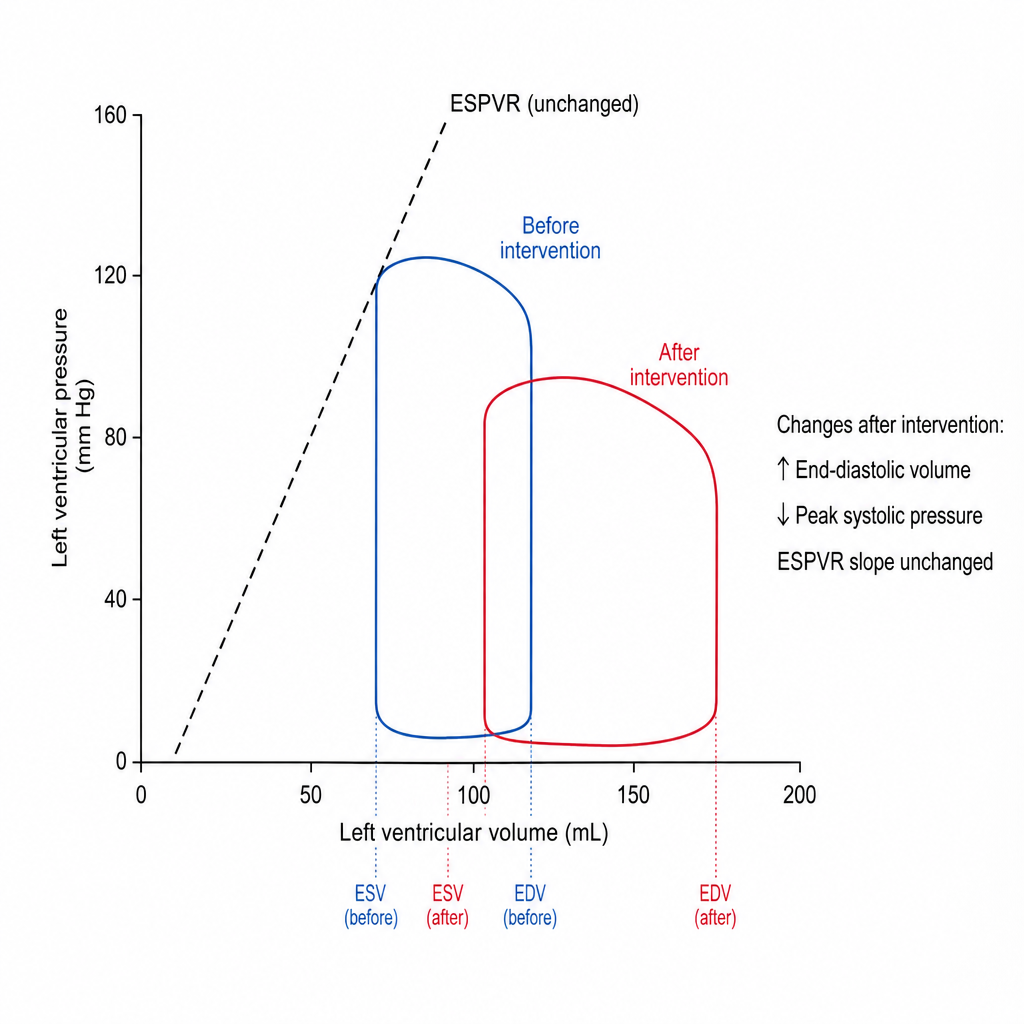
A pressure-volume loop is recorded from the left ventricle of a patient before and after an intervention. The post-intervention loop is shifted rightward with a larger end-diastolic volume, a lower peak systolic pressure, and the slope of the end-systolic pressure-volume relationship (ESPVR) is unchanged. Which of the following interventions most likely produced this change?
A 68-year-old man with both severe COPD (emphysema) and newly diagnosed idiopathic pulmonary fibrosis presents with worsening dyspnea. His pressure-volume curve shows a complex pattern with features of both diseases. Static compliance measured at mid-lung volumes is 120 mL/cm H2O. His pulmonologist must decide on optimal management. Synthesizing the pathophysiology of both conditions, what represents the most significant clinical challenge in managing his combined disease?
A 42-year-old woman with systemic sclerosis develops both pulmonary fibrosis and chest wall restriction from skin thickening. Her measured total respiratory system compliance is 30 mL/cm H2O. Testing with complete paralysis and positive pressure ventilation shows isolated lung compliance of 50 mL/cm H2O. She is being considered for immunosuppressive therapy versus supportive care. Evaluate which intervention would provide the greatest improvement in her respiratory mechanics.
A 58-year-old man with end-stage pulmonary fibrosis is being evaluated for lung transplantation. His current static compliance is 25 mL/cm H2O (normal: 200 mL/cm H2O). He also has mild obesity (BMI 32) and ankylosing spondylitis affecting chest wall mobility. Post-transplant, assuming successful bilateral lung transplant with normal donor lungs, what would be the expected change in his total respiratory system compliance?
Want unlimited practice?
Get full access to all questions, explanations, and performance tracking.
Scan to download app