
Static vs dynamic compliance — MCQs

Which of the following physiologic changes decreases pulmonary vascular resistance (PVR)?
A 57-year-old man presents to the clinic for a chronic cough over the past 4 months. The patient reports a productive yellow/green cough that is worse at night. He denies any significant precipitating event prior to his symptoms. He denies fever, chest pain, palpitations, weight changes, or abdominal pain, but endorses some difficulty breathing that waxes and wanes. He denies alcohol usage but endorses a 35 pack-year smoking history. A physical examination demonstrates mild wheezes, bibasilar crackles, and mild clubbing of his fingertips. A pulmonary function test is subsequently ordered, and partial results are shown below: Tidal volume: 500 mL Residual volume: 1700 mL Expiratory reserve volume: 1500 mL Inspiratory reserve volume: 3000 mL What is the functional residual capacity of this patient?
A 65-year-old woman presents to her physician with chronic breathlessness. Her condition has been progressively worsening over the last 20 years despite treatment with inhaled salbutamol, inhaled corticosteroids, and multiple courses of antibiotics. She has a 30-pack-year smoking history but quit 20 years ago. Her pulse is 104/min and respirations are 28/min. Physical examination shows generalized wasting. Chest auscultation reveals expiratory wheezes bilaterally and distant heart sounds. Pulmonary function testing shows a non-reversible obstructive pattern. Her carbon monoxide diffusion capacity of the lungs (DLCO) is markedly reduced. Which of the following explains the underlying mechanism of her condition?
A 30-year-old patient presents to clinic for pulmonary function testing. With body plethysmography, the patient's functional residual capacity is 3 L, tidal volume is 650 mL, expiratory reserve volume is 1.5 L, total lung capacity is 8 L, and dead space is 150 mL. Respiratory rate is 15 breaths per minute. What is the alveolar ventilation?
A 35-year-old woman volunteers for a study on respiratory physiology. Pressure probes A and B are placed as follows: Probe A: between the parietal and visceral pleura Probe B: within the cavity of an alveolus The probes provide a pressure reading relative to atmospheric pressure. To obtain a baseline reading, she is asked to sit comfortably and breathe normally. Which of the following sets of values will most likely be seen at the end of inspiration?
In which of the following pathological states would the oxygen content of the trachea resemble the oxygen content in the affected alveoli?
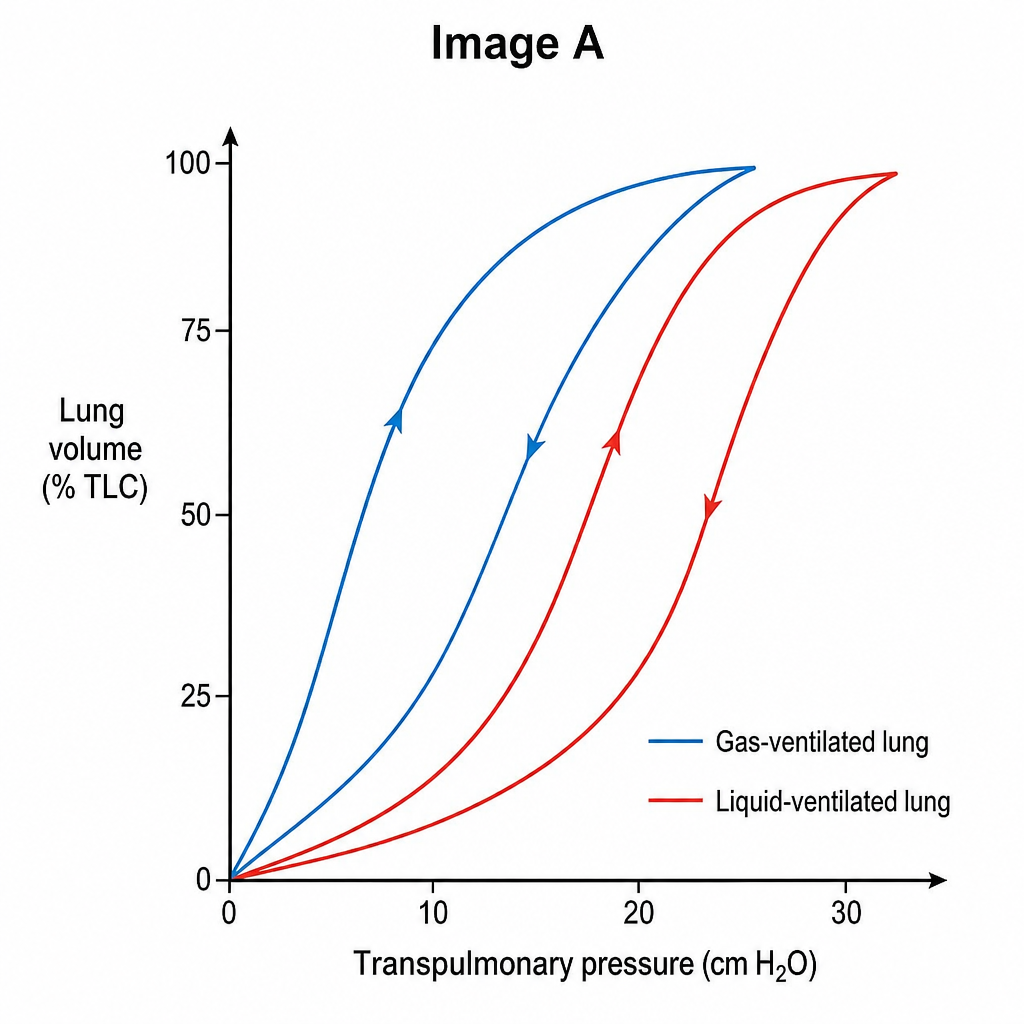
A scientist is designing experiments to better appreciate how the lung expands. He acquires two sets of cat lungs and fills one set with saline. He plots changes in the lungs' volume with respect to pressure as shown in Image A. The pressure-volume loop of the liquid-ventilated lung is different from the gas-ventilated lung because of what property?
A 21-year-old lacrosse player comes to the doctor for an annual health assessment. She does not smoke or drink alcohol. She is 160 cm (5 ft 3 in) tall and weighs 57 kg (125 lb); BMI is 22 kg/m2. Pulmonary function tests show an FEV1 of 90% and an FVC of 3600 mL. Whole body plethysmography is performed to measure airway resistance. Which of the following structures of the respiratory tree is likely to have the highest contribution to total airway resistance?
A 30-year-old woman presents to the emergency department with breathlessness for the last hour. She is unable to provide any history due to her dyspnea. Her vitals include: respiratory rate 20/min, pulse 100/min, and blood pressure 144/84 mm Hg. On physical examination, she is visibly obese, and her breathing is labored. There are decreased breath sounds and hyperresonance to percussion across all lung fields bilaterally. An arterial blood gas is drawn, and the patient is placed on inhaled oxygen. Laboratory findings reveal: pH 7.34 pO2 63 mm Hg pCO2 50 mm Hg HCO3 22 mEq/L Her alveolar partial pressure of oxygen is 70 mm Hg. Which of the following is the most likely etiology of this patient’s symptoms?
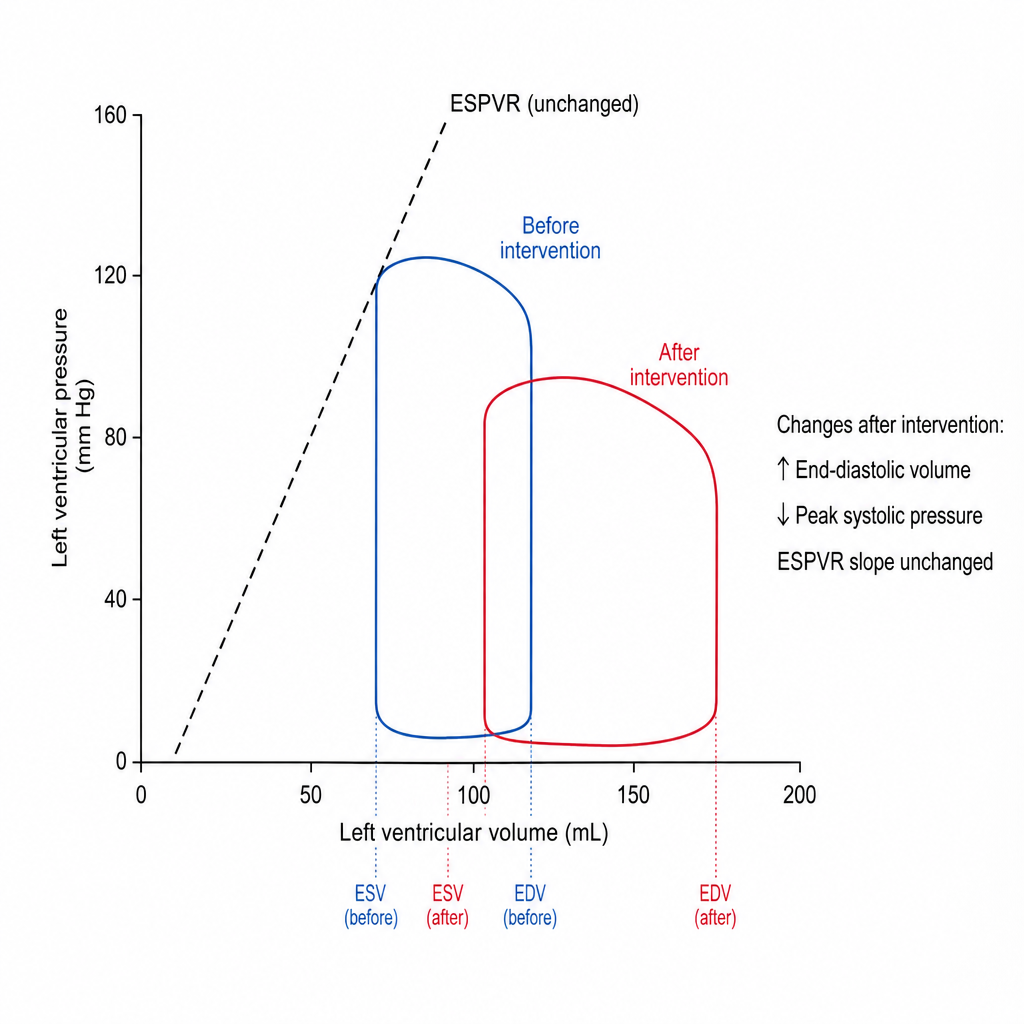
A pressure-volume loop is recorded from the left ventricle of a patient before and after an intervention. The post-intervention loop is shifted rightward with a larger end-diastolic volume, a lower peak systolic pressure, and the slope of the end-systolic pressure-volume relationship (ESPVR) is unchanged. Which of the following interventions most likely produced this change?
Want unlimited practice?
Get full access to all questions, explanations, and performance tracking.
Scan to download app