
Combined respiratory system compliance — MCQs

An 85-year-old man with hypertension and type 2 diabetes mellitus is brought to the emergency department because of a 2-day history of shortness of breath. He has smoked one pack of cigarettes daily for 30 years. His temperature is 36.9°C (98.4°F), pulse is 100/min, respirations are 30/min, and blood pressure is 138/75 mm Hg. Pulmonary function testing shows decreased tidal volume and normal lung compliance. Which of the following is the most likely underlying etiology of this patient's tachypnea?
A 35-year-old woman volunteers for a study on respiratory physiology. Pressure probes A and B are placed as follows: Probe A: between the parietal and visceral pleura Probe B: within the cavity of an alveolus The probes provide a pressure reading relative to atmospheric pressure. To obtain a baseline reading, she is asked to sit comfortably and breathe normally. Which of the following sets of values will most likely be seen at the end of inspiration?
A 57-year-old man comes to the physician because of a 2-year history of fatigue, worsening shortness of breath, and a productive cough for 2 years. He has smoked 1 pack of cigarettes daily for the past 40 years. Examination shows pursed-lip breathing and an increased anteroposterior chest diameter. There is diffuse wheezing bilaterally and breath sounds are distant. Which of the following parameters is most likely to be decreased in this patient?
In which of the following pathological states would the oxygen content of the trachea resemble the oxygen content in the affected alveoli?
A 60-year-old man presents with breathlessness for the past 3 months. His symptoms have been getting progressively worse during this time. He denies any history of cough, fever, or chest pain. He works at a local shipyard and is responsible for installing the plumbing aboard the vessels. His past medical history is significant for hypertension for which he takes metoprolol every day. He denies smoking and any illicit drug use. His pulse is 74/min, respiratory rate is 14/min, blood pressure is 130/76 mm Hg, and temperature is 36.8°C (98.2°F). Physical examination is significant for fine bibasilar crackles at the end of inspiration without digital clubbing. Which of the following additional findings would most likely be present in this patient?
A 30-year-old woman presents to the emergency department with breathlessness for the last hour. She is unable to provide any history due to her dyspnea. Her vitals include: respiratory rate 20/min, pulse 100/min, and blood pressure 144/84 mm Hg. On physical examination, she is visibly obese, and her breathing is labored. There are decreased breath sounds and hyperresonance to percussion across all lung fields bilaterally. An arterial blood gas is drawn, and the patient is placed on inhaled oxygen. Laboratory findings reveal: pH 7.34 pO2 63 mm Hg pCO2 50 mm Hg HCO3 22 mEq/L Her alveolar partial pressure of oxygen is 70 mm Hg. Which of the following is the most likely etiology of this patient’s symptoms?
A 57-year-old man presents to the clinic for a chronic cough over the past 4 months. The patient reports a productive yellow/green cough that is worse at night. He denies any significant precipitating event prior to his symptoms. He denies fever, chest pain, palpitations, weight changes, or abdominal pain, but endorses some difficulty breathing that waxes and wanes. He denies alcohol usage but endorses a 35 pack-year smoking history. A physical examination demonstrates mild wheezes, bibasilar crackles, and mild clubbing of his fingertips. A pulmonary function test is subsequently ordered, and partial results are shown below: Tidal volume: 500 mL Residual volume: 1700 mL Expiratory reserve volume: 1500 mL Inspiratory reserve volume: 3000 mL What is the functional residual capacity of this patient?
A 68-year-old man comes to the emergency room with difficulty in breathing. He was diagnosed with severe obstructive lung disease a few years back. He uses his medication but often has to come to the emergency room for intravenous therapy to help him breathe. He was a smoker for 40 years smoking two packs of cigarettes every day. Which of the following best represents the expected changes in his ventilation, perfusion and V/Q ratio?
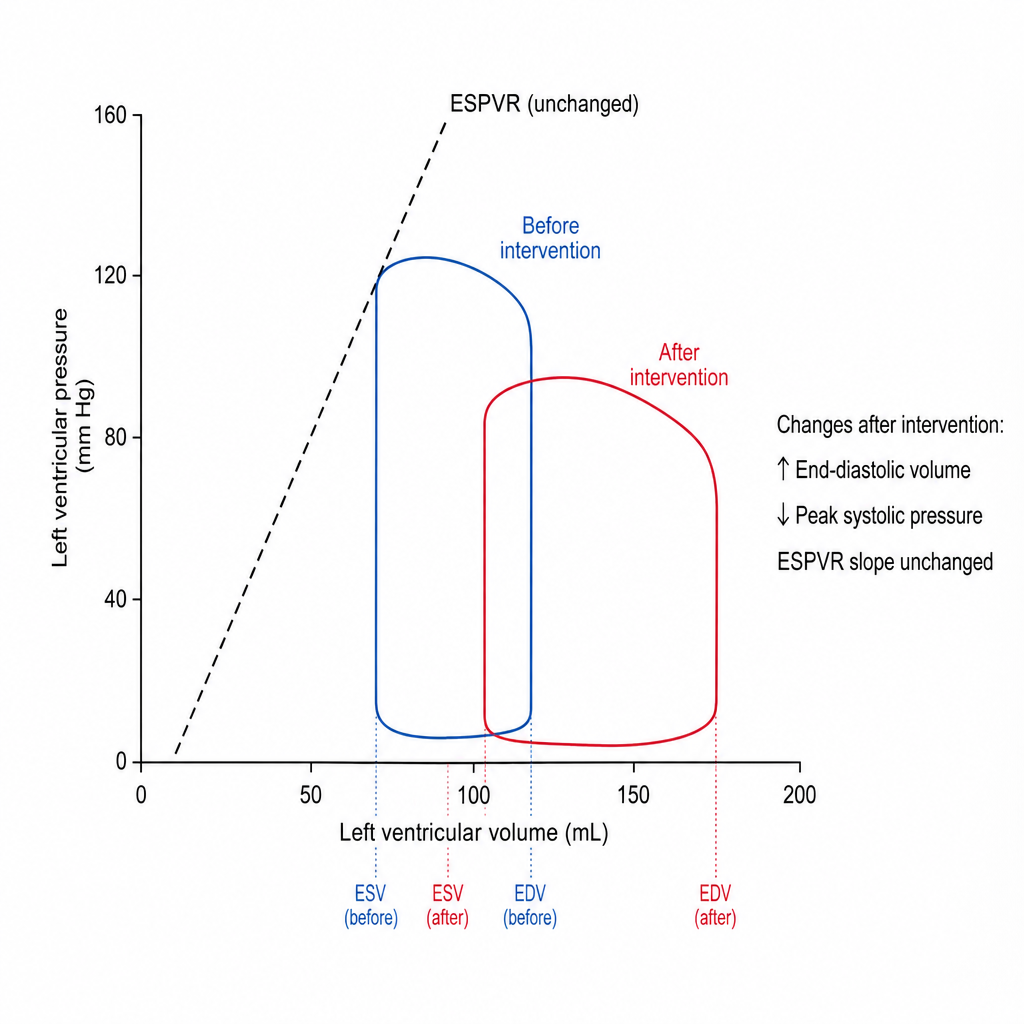
A pressure-volume loop is recorded from the left ventricle of a patient before and after an intervention. The post-intervention loop is shifted rightward with a larger end-diastolic volume, a lower peak systolic pressure, and the slope of the end-systolic pressure-volume relationship (ESPVR) is unchanged. Which of the following interventions most likely produced this change?
A 68-year-old man with both severe COPD (emphysema) and newly diagnosed idiopathic pulmonary fibrosis presents with worsening dyspnea. His pressure-volume curve shows a complex pattern with features of both diseases. Static compliance measured at mid-lung volumes is 120 mL/cm H2O. His pulmonologist must decide on optimal management. Synthesizing the pathophysiology of both conditions, what represents the most significant clinical challenge in managing his combined disease?
Want unlimited practice?
Get full access to all questions, explanations, and performance tracking.
Scan to download app