An investigator is studying muscle contraction in tissue obtained from the thigh muscle of an experimental animal. After injection of radiolabeled ATP, the tissue is stimulated with electrical impulses. Radioassay of these muscle cells is most likely to show greatest activity in which of the following structures?
Q42
A 40-year-old Caucasian male presents to the emergency room after being shot in the arm in a hunting accident. His shirt is soaked through with blood. He has a blood pressure of 65/40, a heart rate of 122, and his skin is pale, cool to the touch, and moist. This patient is most likely experiencing all of the following EXCEPT:
Q43
A 56-year-old woman is admitted to the hospital for progressive bilateral lower extremity weakness and absent deep tendon reflexes. Cerebrospinal fluid analysis shows an elevated protein concentration and a normal cell count. Treatment with plasmapheresis is initiated, after which her symptoms start to improve. Four weeks after her initial presentation, physical examination shows normal muscle strength in the bilateral lower extremities and 2+ deep tendon reflexes. Which of the following changes in neuronal properties is the most likely explanation for the improvement in her neurological examination?
Q44
A 45-year-old man comes to the physician because of persistent reddening of the face for the past 3 months. During this period he also had difficulty concentrating at work and experienced generalized fatigue. He has fallen asleep multiple times during important meetings. His mother has rheumatoid arthritis. He has hypertension and asthma. He has smoked one pack of cigarettes daily for 28 years and drinks one alcoholic beverage per day. Medications include labetalol and a salbutamol inhaler. He is 170 cm (5 ft 7 in) tall and weighs 88 kg (194 lb); BMI is 30.4 kg/m2. His temperature is 37.1°C (98.8°F), pulse is 88/min, respirations are 14/min, and blood pressure is 145/85 mm Hg. Physical examination shows erythema of the face that is especially pronounced around the cheeks, nose, and ears. His neck appears short and wide. The remainder of the examination shows no abnormalities. Which of the following is the most likely cause of this patient's facial discoloration?
Q45
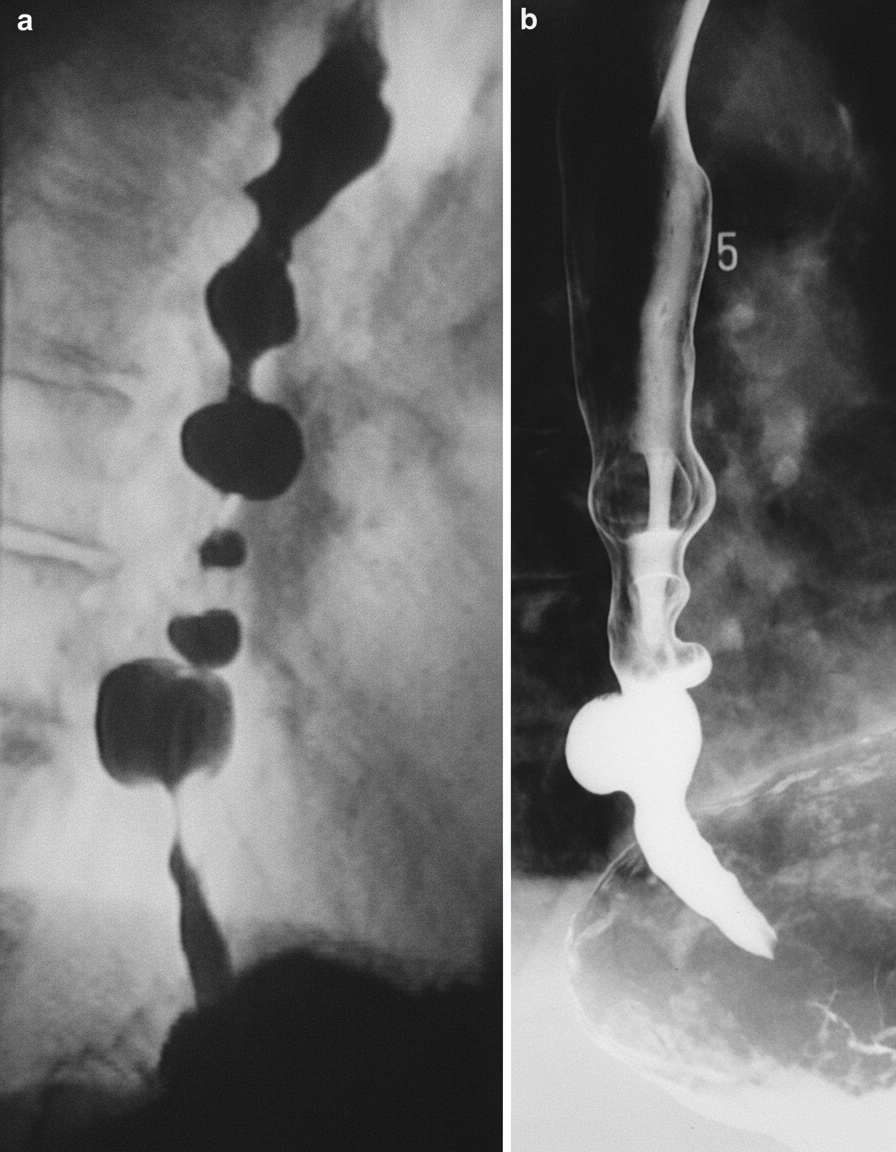
A previously healthy 49-year-old woman comes to the emergency department because of chest pain that radiates to her back. The pain started 45 minutes ago while she was having lunch. Over the past 3 months, she has frequently had the feeling of food, both liquid and solid, getting “stuck” in her chest while she is eating. The patient's vital signs are within normal limits. An ECG shows a normal sinus rhythm with no ST-segment abnormalities. An esophagogram is shown. Further evaluation is most likely to show which of the following?
Q46
A 26-year-old male engineer presents to a reproductive specialist due to the inability to conceive after 2 years of trying with his 28-year-old wife. He reports that he is healthy without any significant medical history, surgeries, or medications. He was adopted at 17 years-old. On exam, he is well appearing without dysmorphic features. He has a high pitched voice, absent facial hair, is 5 feet 8 inches tall, and has a BMI of 19 kg/m^2. On genitourinary exam, his testicles are descended bilaterally without varicoceles, and testicular volume is 8cc bilaterally. He has a stretched penile length of 6cm. He has labwork from his primary care physician that is significant for low LH, FSH, and testosterone. What is the most likely cause of his infertility?
Q47
A recently deceased 92-year-old woman with a history of arrhythmia was discovered to have amyloid deposition in her atria upon autopsy. Upon further examination, there was no amyloid found in any other organs. The peptide at fault was identified and characterized by the pathologist performing the autopsy. Before its eventual deposition in the cardiac atria, which of the following functions was associated with the peptide?
Q48
A researcher is studying physiologic and hormonal changes that occur during pregnancy. Specifically, they examine the behavior of progesterone over the course of the menstrual cycle and find that it normally decreases over time; however, during pregnancy this decrease does not occur in the usual time frame. The researcher identifies a circulating factor that appears to be responsible for this difference in progesterone behavior. In order to further examine this factor, the researcher denatures the circulating factor and examines the sizes of its components on a western blot as compared to several other hormones. One of the bands the researcher identifies in this circulating factor is identical to that of another known hormone with which of the following sites of action?
Q49
A group of scientists discovered a neurotoxin that prevents neurons from releasing neurotransmitters. They performed a series of experiments to determine the protein that the neurotoxin affected. They used a fluorescent molecule that localizes to synaptic vesicles. In the control experiment, they observed the movement of vesicles from the cell body down the axon and finally to the synapse, and they saw movement from the synapse back to the cell body. When the neurotoxin was applied, the vesicles stopped moving down the axon, but movement back to the cell body still occurred. They also applied tetanospasmin and botulinum toxin to see if these toxins exhibited similar behavior but they did not. Which of the following proteins is most likely affected by this neurotoxin?
Q50
A 20-year-old man is brought to the emergency room for evaluation of a back injury sustained while at work. A CT scan of the lumbar spine shows an incidental 2-cm mass adjacent to the inferior vena cava. Histologic examination of a biopsy specimen of the mass shows clusters of chromaffin cells. This mass is most likely to secrete which of the following substances?
Cardiovascular US Medical PG Practice Questions and MCQs
Question 41: An investigator is studying muscle contraction in tissue obtained from the thigh muscle of an experimental animal. After injection of radiolabeled ATP, the tissue is stimulated with electrical impulses. Radioassay of these muscle cells is most likely to show greatest activity in which of the following structures?
A. H zone
B. M line
C. A band (Correct Answer)
D. Z line
E. I band
Explanation: ***A band***
- The **A band** contains the entire length of the **thick myosin filaments** along with the **overlap zone** where myosin and actin interact. Myosin has **ATPase activity**, meaning it binds and hydrolyzes **ATP** to power muscle contraction through cross-bridge cycling.
- Therefore, the greatest accumulation of **radiolabeled ATP** and its breakdown products would be found where **myosin heads** are located throughout the A band.
- The A band represents the most complete answer as it encompasses all regions containing myosin ATPase activity.
*H zone*
- The **H zone** is the central part of the **A band** where only **thick myosin filaments** are present, with no overlap with thin actin filaments.
- While myosin heads with ATPase activity are present here and would show radiolabeled ATP, the **H zone** is only a **subset** of the A band. The **A band** is the more comprehensive answer as it includes both the H zone and the overlap regions where most cross-bridge cycling occurs.
*M line*
- The **M line** is the very center of the **H zone** and anchors the **thick filaments**.
- It consists of structural proteins like **myomesin** and **creatine kinase**. While creatine kinase can phosphorylate ADP to regenerate ATP, it does not directly hydrolyze ATP for muscle contraction the way myosin ATPase does.
*Z line*
- The **Z line** (or Z disc) marks the boundaries of a **sarcomere** and anchors the **thin actin filaments**.
- It contains proteins like **alpha-actinin** and **desmin** but does not directly consume ATP for muscle contraction.
*I band*
- The **I band** contains only **thin actin filaments** and extends from the edge of the A band to the Z line.
- While actin is crucial for contraction, it does not possess **ATPase activity**; ATP hydrolysis primarily occurs at the **myosin heads** located in the A band.
Question 42: A 40-year-old Caucasian male presents to the emergency room after being shot in the arm in a hunting accident. His shirt is soaked through with blood. He has a blood pressure of 65/40, a heart rate of 122, and his skin is pale, cool to the touch, and moist. This patient is most likely experiencing all of the following EXCEPT:
A. Decreased sarcomere length in the myocardium
B. Increased stroke volume (Correct Answer)
C. Confusion and irritability
D. Decreased preload
E. Increased thromboxane A2
Explanation: ***Increased stroke volume***
- The patient is experiencing **hypovolemic shock** due to significant blood loss, meaning their **cardiac output** is severely compromised.
- In shock, the heart attempts to compensate by increasing **heart rate**, but **stroke volume** is typically decreased due to reduced **preload**.
*Decreased sarcomere length in the myocardium*
- In situations of significant blood loss and **decreased preload**, there is less venous return to the heart, leading to reduced end-diastolic volume.
- According to the **Frank-Starling law**, reduced end-diastolic volume results in shorter initial sarcomere length, which reduces the force of contraction and thus, **stroke volume**.
*Confusion and irritability*
- **Hypovolemic shock** leads to widespread **tissue hypoperfusion**, especially to vital organs like the brain.
- Reduced cerebral blood flow results in impaired brain function, manifesting as **confusion, irritability**, and altered mental status.
*Decreased preload*
- Significant blood loss leads to a reduction in the **total circulating blood volume**.
- This reduction directly decreases the venous return to the heart, thus lowering the **end-diastolic volume** and subsequently, the **preload**.
*Increased thromboxane A2*
- In response to **vascular injury and bleeding**, the body initiates hemostasis, a critical component of which is platelet aggregation.
- **Thromboxane A2** is a potent vasoconstrictor and platelet aggregator released by activated platelets to form a **platelet plug** and help stop bleeding.
Question 43: A 56-year-old woman is admitted to the hospital for progressive bilateral lower extremity weakness and absent deep tendon reflexes. Cerebrospinal fluid analysis shows an elevated protein concentration and a normal cell count. Treatment with plasmapheresis is initiated, after which her symptoms start to improve. Four weeks after her initial presentation, physical examination shows normal muscle strength in the bilateral lower extremities and 2+ deep tendon reflexes. Which of the following changes in neuronal properties is the most likely explanation for the improvement in her neurological examination?
A. Increase in length constant (Correct Answer)
B. Decrease in action potential amplitude
C. Decrease in transmembrane resistance
D. Increase in axial resistance
E. Increase in axonal capacitance
Explanation: ***Increase in length constant***
- The clinical picture of **Guillain-Barré Syndrome (GBS)** involves **demyelination**, leading to a *decrease* in the **length constant**, which impairs action potential propagation.
- **Plasmapheresis** in GBS helps remove autoantibodies, allowing for remyelination or repair, thereby *increasing* the **length constant** and improving nerve conduction.
*Decrease in action potential amplitude*
- A decrease in action potential amplitude would indicate *worsening* nerve function, not improvement, as it suggests the nerve is less able to generate strong electrical signals.
- The amplitude of an action potential is primarily determined by the **number and conductance of voltage-gated sodium channels**, not directly affected in a way that would reflect recovery by a *decrease*.
*Decrease in transmembrane resistance*
- A *decrease* in **transmembrane resistance** (resistance to current flow across the membrane) would allow more current to leak out, *reducing* the length constant and *impairing* conduction.
- In GBS, demyelination already causes a *decrease* in transmembrane resistance; recovery would involve an *increase* in resistance due to remyelination.
*Increase in axial resistance*
- An *increase* in **axial resistance** (resistance to current flow along the axon) would *impede* the spread of depolarization and *slow* conduction velocity.
- Factors such as **axon diameter** affect axial resistance, and an *increase* would lead to *worsening* of neurological function, not improvement.
*Increase in axonal capacitance*
- An *increase* in **axonal capacitance** would mean the axon requires more charge to change its voltage, thus *slowing down* the rate of depolarization and *impairing* conduction velocity.
- **Myelination** *reduces* capacitance, which is crucial for rapid signal propagation; an *increase* would be detrimental to nerve function.
Question 44: A 45-year-old man comes to the physician because of persistent reddening of the face for the past 3 months. During this period he also had difficulty concentrating at work and experienced generalized fatigue. He has fallen asleep multiple times during important meetings. His mother has rheumatoid arthritis. He has hypertension and asthma. He has smoked one pack of cigarettes daily for 28 years and drinks one alcoholic beverage per day. Medications include labetalol and a salbutamol inhaler. He is 170 cm (5 ft 7 in) tall and weighs 88 kg (194 lb); BMI is 30.4 kg/m2. His temperature is 37.1°C (98.8°F), pulse is 88/min, respirations are 14/min, and blood pressure is 145/85 mm Hg. Physical examination shows erythema of the face that is especially pronounced around the cheeks, nose, and ears. His neck appears short and wide. The remainder of the examination shows no abnormalities. Which of the following is the most likely cause of this patient's facial discoloration?
A. Increased cortisol levels
B. Delayed-type hypersensitivity
C. Antibody-mediated vasculopathy
D. Increased serotonin levels
E. Increased EPO production (Correct Answer)
Explanation: ***Increased EPO production***
- The patient's **facial redness (plethora)**, **fatigue**, **difficulty concentrating**, and **sleepiness** are characteristic symptoms of **polycythemia**, which can be caused by increased **erythropoietin (EPO)** production.
- His chronic smoking (**28 pack-years**) and obesity (**BMI 30.4 kg/m²**) put him at high risk for **chronic hypoxemia** (e.g., from **COPD** or **sleep apnea**), which can trigger a compensatory increase in EPO and subsequent **secondary polycythemia**.
*Increased cortisol levels*
- Increased cortisol (e.g., in **Cushing's syndrome**) can cause **facial plethora** and fatigue, but it is typically associated with features like **central obesity**, **striae**, muscle weakness, and new-onset diabetes, which are not described.
- While he has hypertension and obesity, the primary complaint of prominent facial redness and hypersomnia points more specifically to a red blood cell disorder.
*Delayed-type hypersensitivity*
- This mechanism is associated with **allergic contact dermatitis** or other inflammatory skin conditions, typically characterized by **itching**, **blistering**, or **eczematous changes**.
- It does not explain the generalized symptoms of fatigue, difficulty concentrating, or the specific appearance of uniform facial redness (plethora).
*Antibody-mediated vasculopathy*
- Conditions like **lupus** or **vasculitis** can cause skin manifestations, but these usually present as specific lesions (e.g., **rashes**, **ulcers**, **purpura**) or systemic symptoms of inflammation, rather than just generalized facial redness.
- The patient's symptoms are more consistent with a volume-related issue rather than an immune-mediated vascular inflammation.
*Increased serotonin levels*
- Elevated serotonin, such as in **carcinoid syndrome**, can cause episodic **flushing** and fatigue.
- However, carcinoid syndrome is also typically associated with **diarrhea**, **bronchospasm**, and **cardiac valvular lesions**, none of which are mentioned in this patient's presentation.
Question 45: A previously healthy 49-year-old woman comes to the emergency department because of chest pain that radiates to her back. The pain started 45 minutes ago while she was having lunch. Over the past 3 months, she has frequently had the feeling of food, both liquid and solid, getting “stuck” in her chest while she is eating. The patient's vital signs are within normal limits. An ECG shows a normal sinus rhythm with no ST-segment abnormalities. An esophagogram is shown. Further evaluation is most likely to show which of the following?
A. Gastroesophageal junction mass on endoscopy
B. Hypertensive contractions on manometry
C. Elevated lower esophageal sphincter pressure on manometry
D. Multiple mucosal erosions on endoscopy
E. Simultaneous multi-peak contractions on manometry (Correct Answer)
Explanation: ***Simultaneous multi-peak contractions on manometry***
- The history of **dysphagia for both liquids and solids**, chest pain radiating to the back, and the esophagogram showing a **corkscrew esophagus** are highly suggestive of **esophageal spasm**.
- **Esophageal manometry** in diffuse esophageal spasm typically reveals simultaneous, high-amplitude, and often multi-peak contractions in the distal esophagus.
*Gastroesophageal junction mass on endoscopy*
- While dysphagia can be a symptom of a **gastroesophageal junction (GEJ) mass**, the intermittent nature of the dysphagia and the classic "corkscrew" appearance on the esophagogram makes a mass less likely.
- A GEJ mass would typically cause **progressive dysphagia**, often more pronounced for solids than liquids over time, and would likely reveal an anatomical obstruction on the esophagogram.
*Hypertensive contractions on manometry*
- **Hypertensive peristalsis** (nutcracker esophagus) typically presents with abnormally high-amplitude peristaltic contractions, but they remain **coordinated and propagated**, unlike the simultaneous contractions seen in esophageal spasm.
- Although chest pain is common in nutcracker esophagus, the hallmark simultaneous contractions for diffuse esophageal spasm are not seen.
*Elevated lower esophageal sphincter pressure on manometry*
- **Elevated LES pressure** and **incomplete LES relaxation** are characteristic findings in **achalasia**, which also causes dysphagia for both liquids and solids and chest pain.
- However, achalasia often presents with a **dilated esophagus** and a **bird's beak appearance** at the GEJ on esophagogram, which is not seen here; instead, the image shows marked tertiary contractions.
*Multiple mucosal erosions on endoscopy*
- **Mucosal erosions** are typically associated with conditions like **reflux esophagitis** or **pill esophagitis**, which can cause chest pain but often presents with **heartburn** and **odynophagia**.
- These conditions do not explain the dysphagia for both liquids and solids or the characteristic "corkscrew" esophagus seen on the imaging.
Question 46: A 26-year-old male engineer presents to a reproductive specialist due to the inability to conceive after 2 years of trying with his 28-year-old wife. He reports that he is healthy without any significant medical history, surgeries, or medications. He was adopted at 17 years-old. On exam, he is well appearing without dysmorphic features. He has a high pitched voice, absent facial hair, is 5 feet 8 inches tall, and has a BMI of 19 kg/m^2. On genitourinary exam, his testicles are descended bilaterally without varicoceles, and testicular volume is 8cc bilaterally. He has a stretched penile length of 6cm. He has labwork from his primary care physician that is significant for low LH, FSH, and testosterone. What is the most likely cause of his infertility?
A. Primary Hypogonadism
B. Fragile X Syndrome
C. Kleinfelter Syndrome
D. Prader-Willi Syndrome
E. Kallman Syndrome (Correct Answer)
Explanation: ***Kallman Syndrome***
- The patient presents with **hypogonadotropic hypogonadism** (low LH, FSH, and testosterone) and associated features like **absent facial hair**, **high-pitched voice**, and **micropenis** (stretched penile length of 6cm). While not explicitly stated, **anosmia** or **hyposmia** is a hallmark of Kallman syndrome, differentiating it from other causes of hypogonadotropic hypogonadism.
- The patient's presentation with **infertility** and signs of **incomplete pubertal development** (absent facial hair, high-pitched voice, reduced testicular volume of 8cc) in the context of low gonadotropins points to a central defect in gonadotropin-releasing hormone secretion, characteristic of Kallman syndrome.
*Primary Hypogonadism*
- This condition is characterized by **elevated LH and FSH** with low testosterone, due to a problem with testicular function, which is contrary to the patient's lab results of low LH and FSH.
- While it causes **infertility** and **low testosterone**, it does not typically present with the specific constellation of symptoms like micropenis and absent facial hair in the presence of low gonadotropins.
*Fragile X Syndrome*
- This syndrome is associated with **intellectual disability**, **macroorchidism** (large testes), and distinctive facial features, none of which are described in the patient.
- While it can cause infertility, it is not typically associated with **hypogonadotropic hypogonadism** or the specific phenotypic features presented.
*Kleinfelter Syndrome*
- This is a form of **primary hypogonadism** (47,XXY karyotype) characterized by **small, firm testes**, gynecomastia, and typically **elevated FSH and LH** due to testicular failure.
- The patient's lab results show **low LH and FSH**, and the testicular volume, while small, is not described as "firm," making Klinefelter syndrome less likely.
*Prader-Willi Syndrome*
- This syndrome is characterized by **obesity**, **intellectual disability**, and **hypotonia**, alongside hypogonadism, which are not consistent with the patient's presentation (BMI 19, no intellectual disability mentioned).
- The hypogonadism in Prader-Willi syndrome is **hypogonadotropic**, but the absence of other defining features makes this diagnosis less probable.
Question 47: A recently deceased 92-year-old woman with a history of arrhythmia was discovered to have amyloid deposition in her atria upon autopsy. Upon further examination, there was no amyloid found in any other organs. The peptide at fault was identified and characterized by the pathologist performing the autopsy. Before its eventual deposition in the cardiac atria, which of the following functions was associated with the peptide?
A. Antigen recognition
B. Reduction of blood calcium concentration
C. Stimulation of lactation
D. Vasodilation (Correct Answer)
E. Slowing of gastric emptying
Explanation: ***Vasodilation***
- The description of amyloid deposition confined to the atria in an elderly patient points to **isolated atrial amyloidosis**, which involves the deposition of **atrial natriuretic peptide (ANP)**.
- Before deposition, ANP's primary function is to promote **vasodilation** and natriuresis, contributing to blood pressure regulation.
*Antigen recognition*
- **Antigen recognition** is a function of proteins like immunoglobulins and T-cell receptors, which are not typically involved in isolated atrial amyloidosis.
- Amyloid associated with antigen recognition is usually **AL amyloidosis (light-chain amyloidosis)**, which is systemic and affects multiple organs, unlike the localized deposition described.
*Reduction of blood calcium concentration*
- The reduction of blood calcium concentration is primarily mediated by **calcitonin**, a hormone secreted by the thyroid gland.
- This function is unrelated to the atrial amyloidosis described, which involves a peptide from cardiac myocytes.
*Stimulation of lactation*
- **Lactation** is stimulated by hormones like **prolactin** and oxytocin, which are produced in the pituitary gland and hypothalamus, respectively.
- This process is entirely unconnected to the peptide responsible for amyloid deposition in the heart.
*Slowing of gastric emptying*
- **Slowing of gastric emptying** can be influenced by various hormones, such as **peptide YY** or **glucagon-like peptide-1 (GLP-1)**, which are primarily secreted in the gastrointestinal tract.
- This physiological process is not linked to the function of ANP or the pathology of atrial amyloidosis.
Question 48: A researcher is studying physiologic and hormonal changes that occur during pregnancy. Specifically, they examine the behavior of progesterone over the course of the menstrual cycle and find that it normally decreases over time; however, during pregnancy this decrease does not occur in the usual time frame. The researcher identifies a circulating factor that appears to be responsible for this difference in progesterone behavior. In order to further examine this factor, the researcher denatures the circulating factor and examines the sizes of its components on a western blot as compared to several other hormones. One of the bands the researcher identifies in this circulating factor is identical to that of another known hormone with which of the following sites of action?
A. Thyroid gland (Correct Answer)
B. Adrenal gland
C. Adipocytes
D. Bones
E. Kidney tubules
Explanation: ***Correct: Thyroid gland***
- The circulating factor described is **human chorionic gonadotropin (hCG)**, which maintains the corpus luteum and progesterone production during early pregnancy
- hCG is a **glycoprotein hormone** composed of an **α subunit** and a **β subunit**
- The **α subunit of hCG is identical** to the α subunits of **TSH (thyroid-stimulating hormone)**, **LH (luteinizing hormone)**, and **FSH (follicle-stimulating hormone)**
- When denatured and examined on Western blot, one of the bands (the α subunit) would be identical to that of **TSH**
- **TSH acts on the thyroid gland** to stimulate thyroid hormone synthesis and release
- This structural similarity explains why very high levels of hCG (as in molar pregnancy or hyperemesis gravidarum) can sometimes cause **thyrotoxicosis** due to cross-reactivity with TSH receptors
*Incorrect: Adrenal gland*
- **ACTH (adrenocorticotropic hormone)** acts on the adrenal cortex to stimulate cortisol production
- ACTH is a **peptide hormone** derived from POMC (pro-opiomelanocortin) and does **NOT share any structural components** with hCG
- There is no identical band between hCG and ACTH on Western blot
*Incorrect: Adipocytes*
- Adipocytes are regulated by hormones like **insulin** and **leptin**
- Neither of these hormones share structural components with hCG
*Incorrect: Bones*
- Bones are primarily regulated by **PTH (parathyroid hormone)**, **calcitonin**, and **vitamin D**
- None of these hormones share structural components with hCG
*Incorrect: Kidney tubules*
- Kidney tubules are regulated by **ADH (antidiuretic hormone/vasopressin)** and **aldosterone**
- Neither shares structural components with hCG
Question 49: A group of scientists discovered a neurotoxin that prevents neurons from releasing neurotransmitters. They performed a series of experiments to determine the protein that the neurotoxin affected. They used a fluorescent molecule that localizes to synaptic vesicles. In the control experiment, they observed the movement of vesicles from the cell body down the axon and finally to the synapse, and they saw movement from the synapse back to the cell body. When the neurotoxin was applied, the vesicles stopped moving down the axon, but movement back to the cell body still occurred. They also applied tetanospasmin and botulinum toxin to see if these toxins exhibited similar behavior but they did not. Which of the following proteins is most likely affected by this neurotoxin?
A. SNAP-25
B. Kinesin (Correct Answer)
C. Dynein
D. Synaptobrevin
E. Alpha/Beta tubulin
Explanation: ***Kinesin***
- Kinesin is a **motor protein** responsible for **anterograde transport** (movement away from the cell body) of vesicles along microtubules in axons.
- The neurotoxin stopping vesicles from moving down the axon indicates interference with anterograde transport, which is primarily mediated by kinesin.
*SNAP-25*
- **SNAP-25** is a component of the **SNARE complex** involved in the fusion of synaptic vesicles with the presynaptic membrane, leading to neurotransmitter release.
- Tetanospasmin and botulinum toxin, which affect neurotransmitter release, specifically cleave SNARE proteins like SNAP-25, but the described toxin's effect on vesicle *movement* rather than *fusion* differentiates it.
*Dynein*
- Dynein is a **motor protein** responsible for **retrograde transport** (movement towards the cell body) of vesicles along microtubules.
- The observation that movement back to the cell body (retrograde transport) still occurred after neurotoxin application rules out dynein as the affected protein.
*Synaptobrevin*
- **Synaptobrevin** (also known as VAMP) is another component of the **SNARE complex**, located on the vesicle membrane, crucial for neurotransmitter release.
- Its disruption would primarily impair vesicle fusion and neurotransmitter release, similar to SNAP-25, but would not directly stop the *downstream movement* of vesicles.
*Alpha/Beta tubulin*
- **Alpha/beta tubulin dimers** are the building blocks of **microtubules**, which serve as tracks for both anterograde and retrograde transport.
- While microtubules are essential for vesicle movement, if tubulin itself were directly affected, both anterograde and retrograde transport would likely be impaired, which contradicts the observation that retrograde movement continued.
Question 50: A 20-year-old man is brought to the emergency room for evaluation of a back injury sustained while at work. A CT scan of the lumbar spine shows an incidental 2-cm mass adjacent to the inferior vena cava. Histologic examination of a biopsy specimen of the mass shows clusters of chromaffin cells. This mass is most likely to secrete which of the following substances?
A. Aldosterone
B. Dehydroepiandrosterone
C. Norepinephrine (Correct Answer)
D. Cortisol
E. Estrogen
Explanation: **Norepinephrine**
- The description of a mass with **clusters of chromaffin cells** is characteristic of a **pheochromocytoma**, a tumor typically arising from the **adrenal medulla**.
- **Pheochromocytomas** are known to secrete catecholamines, primarily **norepinephrine** and epinephrine.
*Aldosterone*
- **Aldosterone** is secreted by the **zona glomerulosa** of the **adrenal cortex** and is involved in blood pressure regulation.
- Tumors secreting aldosterone are usually **aldosteronomas** (Conn's syndrome) and do not arise from chromaffin cells.
*Dehydroepiandrosterone*
- **Dehydroepiandrosterone (DHEA)** is an **adrenal androgen** secreted by the **zona reticularis** of the adrenal cortex.
- Its secretion is associated with cortical tumors or hyperplasia, not chromaffin cell tumors.
*Cortisol*
- **Cortisol** is a glucocorticoid produced by the **zona fasciculata** of the **adrenal cortex**.
- Elevated cortisol levels are usually due to **Cushing's syndrome**, often caused by adrenal adenomas or hyperplasia, not chromaffin cell tumors.
*Estrogen*
- While small amounts of **estrogen** can be produced by the adrenal glands, the primary sites of estrogen synthesis are the **ovaries** and **placenta**.
- A tumor composed of **chromaffin cells** is not typically associated with significant estrogen secretion.