
Metabolic acidosis mechanisms and compensation — MCQs

A 65-year-old man is brought to the emergency department from his home. He is unresponsive. His son requested a wellness check because he had not heard from his father in 2 weeks. He reports that his father was sounding depressed during a telephone call. The paramedics found a suicide note and a half-empty bottle of antifreeze near the patient. The medical history includes hypertension and hyperlipidemia. The vital signs include: blood pressure 120/80 mm Hg, respiratory rate 25/min, heart rate 95/min, and temperature 37.0°C (98.5°F). He is admitted to the hospital. What do you expect the blood gas analysis to show?
A 72-year-old female is brought to the emergency department after being found unresponsive in her garage with an open bottle of unmarked fluid. She is confused and is unable to answer questions on arrival. Her medical history is significant for Alzheimer disease, but her family says she has no medical comorbidities. Serum analysis of this patient's blood shows a pH of 7.28 with a high anion gap. The electrolyte that is most likely significantly decreased in this patient follows which of the following concentration curves across the proximal tubule of the kidney?
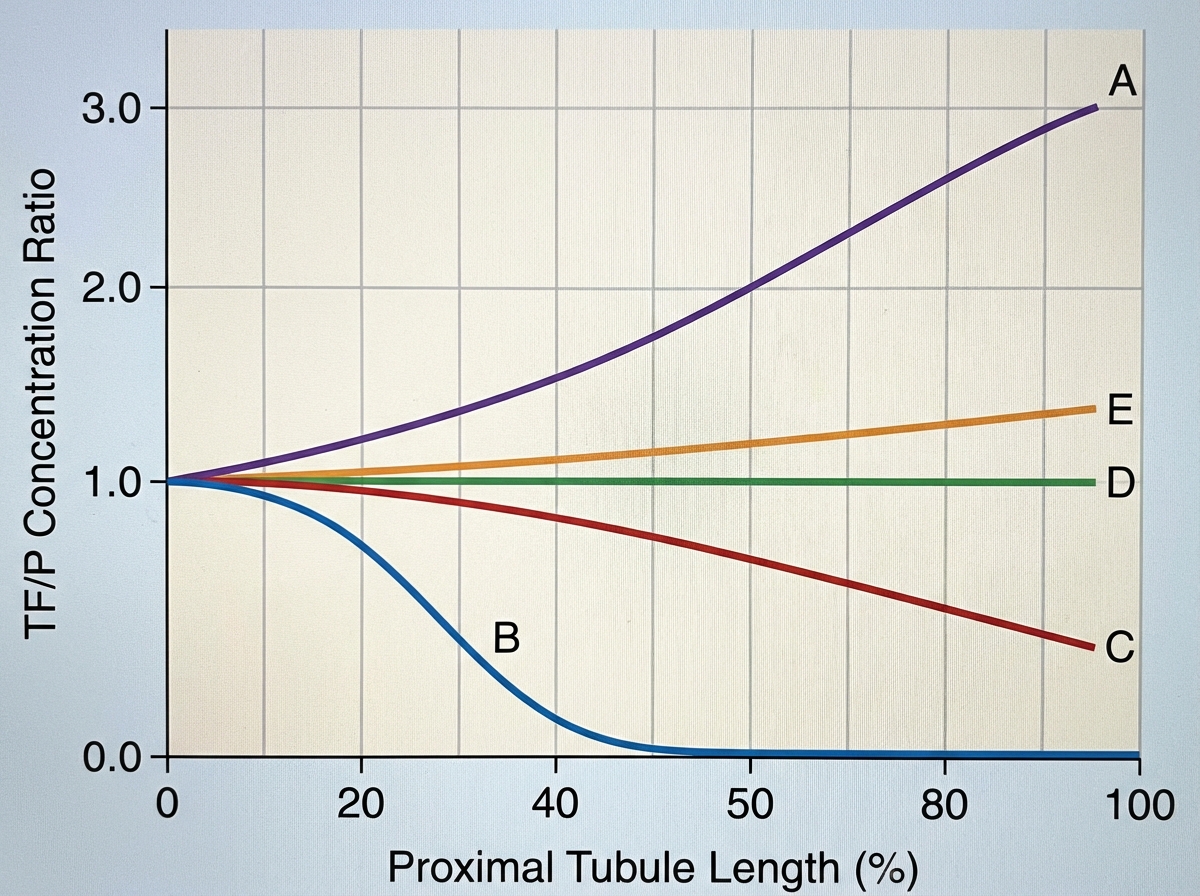
A 37-year-old G1P0 woman presents to her primary care physician for a routine checkup. She has a history of diabetes and hypertension but has otherwise been healthy with no change in her health status since the last visit. She is expecting her first child 8 weeks from now. She also enrolled in a study about pregnancy where serial metabolic panels and arterial blood gases are obtained. Partial results from these studies are shown below: Serum: Na+: 141 mEq/L Cl-: 108 mEq/L pH: 7.47 pCO2: 30 mmHg HCO3-: 21 mEq/L Which of the following disease processes would most likely present with a similar panel of metabolic results?
A 72-year-old man being treated for benign prostatic hyperplasia (BPH) is admitted to the emergency department for 1 week of dysuria, nocturia, urge incontinence, and difficulty initiating micturition. His medical history is relevant for hypertension, active tobacco use, chronic obstructive pulmonary disease, and BPH with multiple urinary tract infections. Upon admission, he is found with a heart rate of 130/min, respiratory rate of 19/min, body temperature of 39.0°C (102.2°F), and blood pressure of 80/50 mm Hg. Additional findings during the physical examination include decreased breath sounds, wheezes, crackles at the lung bases, and intense right flank pain. A complete blood count shows leukocytosis and neutrophilia with a left shift. A sample for arterial blood gas analysis (ABG) was taken, which is shown below. Laboratory test Serum Na+ 140 mEq/L Serum Cl- 102 mEq/L Serum K+ 4.8 mEq/L Serum creatinine (SCr) 2.3 mg/dL Arterial blood gas pH 7.12 Po2 82 mm Hg Pco2 60 mm Hg SO2% 92% HCO3- 12.0 mEq/L Which of the following best explains the patient’s condition?
A 14-year-old male presents to the emergency department with altered mental status. His friends who accompanied him said that he complained of abdominal pain while camping. They denied his consumption of anything unusual from the wilderness, or any vomiting or diarrhea. His temperature is 100.5°F (38.1°C), blood pressure is 95/55 mmHg, pulse is 130/min, and respirations are 30/min. His pupils are equal and reactive to light bilaterally. The remainder of the physical exam is unremarkable. His basic metabolic panel is displayed below: Serum: Na+: 116 mEq/L Cl-: 70 mEq/L K+: 4.0 mEq/L HCO3-: 2 mEq/L BUN: 50 mg/dL Glucose: 1010 mg/dL Creatinine: 1.2 mg/dL While the remainder of his labs are pending, the patient becomes bradypneic and is intubated. His ventilator is adjusted to volume control assist-control with a respiratory rate (RR) of 14/min, tidal volume (Vt) of 350 mL, positive end-expiratory pressure (PEEP) of 5 cm H2O, and fractional inspired oxygen (FiO2) of 40%. His height is 5 feet 5 inches. Intravenous fluids and additional medical therapy are administered. An arterial blood gas obtained after 30 minutes on these settings shows the following: pH: 7.05 pCO2 :40 mmHg pO2: 150 mmHg SaO2: 98% What is the best next step in management?
A 25-year-old woman with an extensive psychiatric history is suspected of having metabolic acidosis after ingesting a large amount of aspirin in a suicide attempt. Labs are drawn and the values from the ABG are found to be: PCO2: 25, and HCO3: 15, but the pH value is smeared on the print-out and illegible. The medical student is given the task of calculating the pH using the pCO2 and HCO3 concentrations. He recalls from his first-year physiology course that the pKa of relevance for the bicarbonate buffering system is approximately 6.1. Which of the following is the correct formula the student should use, using the given values from the incomplete ABG?
A 58-year-old man presents to the emergency department with a chief complaint of ringing in his ears that started several hours previously that has progressed to confusion. The patient denies any history of medical problems except for bilateral knee arthritis. He was recently seen by an orthopedic surgeon to evaluate his bilateral knee arthritis but has opted to not undergo knee replacement and prefers medical management. His wife noted that prior to them going on a hike today, he seemed confused and not himself. They decided to stay home, and roughly 14 hours later, he was no longer making any sense. Physical exam is notable for a confused man. The patient's vitals are being performed and his labs are being drawn. Which of the following is most likely to be seen on blood gas analysis?
A person is exercising strenuously on a treadmill for 1 hour. An arterial blood gas measurement is then taken. Which of the following are the most likely values?
A 32-year-old woman is admitted to the emergency department for 36 hours of intense left-sided back pain that extends into her left groin. She reports that the pain started a day after a charitable 5 km (3.1 mi) marathon. The past medical history is relevant for multiple complaints of eye dryness and dry mouth. Physical examination is unremarkable, except for intense left-sided costovertebral pain. The results from laboratory tests are shown. Laboratory test Result Serum Na+ 137 Serum Cl- 110 Serum K+ 3.0 Serum creatinine (SCr) 0.82 Arterial blood gas Result pH 7.28 pO2 98 mm Hg pCO2 28.5 mm Hg SaO2% 98% HCO3- 15 mm Hg Which of the following explains this patient’s condition?
Two hours after undergoing laparoscopic roux-en-Y gastric bypass surgery, a 44-year-old man complains of pain in the site of surgery and nausea. He has vomited twice in the past hour. He has hypertension, type 2 diabetes mellitus, and hypercholesterolemia. Current medications include insulin, atorvastatin, hydrochlorothiazide, acetaminophen, and prophylactic subcutaneous heparin. He drinks two to three beers daily and occasionally more on weekends. He is 177 cm (5 ft 10 in) tall and weighs 130 kg (286 lb); BMI is 41.5 kg/m2. His temperature is 37.3°C (99.1°F), pulse is 103/min, and blood pressure is 122/82 mm Hg. Examination shows five laparoscopic incisions with no erythema or discharge. The abdomen is soft and non-distended. There is slight diffuse tenderness to palpation. Bowel sounds are reduced. Laboratory studies show: Hematocrit 45% Serum Na+ 136 mEq/L K+ 3.5 mEq/L Cl- 98 mEq/L Urea nitrogen 31 mg/dL Glucose 88 mg/dL Creatinine 1.1 mg/dL Arterial blood gas analysis on room air shows: pH 7.28 pCO2 32 mm Hg pO2 74 mm Hg HCO3- 14.4 mEq/L Which of the following is the most likely cause for the acid-base status of this patient?
Want unlimited practice?
Get full access to all questions, explanations, and performance tracking.
Scan to download app