
TNF inhibitors — MCQs

A 50-year-old woman presents to the clinic with joint pain that has persisted for the last 2 months. She reports having intermittently swollen, painful hands bilaterally. She adds that when she wakes up in the morning, her hands are stiff and do not loosen up until an hour later. The pain tends to improve with movement. Physical examination is significant for warm, swollen, tender proximal interphalangeal joints, metacarpophalangeal joints, and wrists bilaterally. Laboratory results are positive for rheumatoid factor (4-fold greater than the upper limit of normal (ULN)) and anti-cyclic citrullinated peptide (anti-CCP) antibodies (3-fold greater than ULN). CRP and ESR are elevated. Plain X-rays of the hand joints show periarticular osteopenia and bony erosions. She was started on the first-line drug for her condition which inhibits dihydrofolate reductase. Which medication was this patient started on?
A 22-year-old man comes to the physician for a follow-up evaluation for chronic lower back pain. He has back stiffness that lasts all morning and slowly improves throughout the day. He has tried multiple over-the-counter medications, including ibuprofen, without any improvement in his symptoms. Physical examination shows tenderness over the iliac crest bilaterally and limited range of motion of the lumbar spine with forward flexion. The results of HLA-B27 testing are positive. An x-ray of the lumbar spine shows fusion of the lumbar vertebrae and sacroiliac joints. The physician plans to prescribe a new medication but first orders a tuberculin skin test to assess for the risk of latent tuberculosis reactivation. Inhibition of which of the following is the most likely primary mechanism of action of this drug?
A 24-year-old man comes to the physician for a routine health maintenance examination. He feels well. He has type 1 diabetes mellitus. His only medication is insulin. He immigrated from Nepal 2 weeks ago . He lives in a shelter. He has smoked one pack of cigarettes daily for the past 5 years. He has not received any routine childhood vaccinations. The patient appears healthy and well nourished. He is 172 cm (5 ft 8 in) tall and weighs 68 kg (150 lb); BMI is 23 kg/m2. His temperature is 36.8°C (98.2°F), pulse is 72/min, and blood pressure is 123/82 mm Hg. Examination shows a healed scar over his right femur. The remainder of the examination shows no abnormalities. A purified protein derivative (PPD) skin test is performed. Three days later, an induration of 13 mm is noted. Which of the following is the most appropriate initial step in the management of this patient?
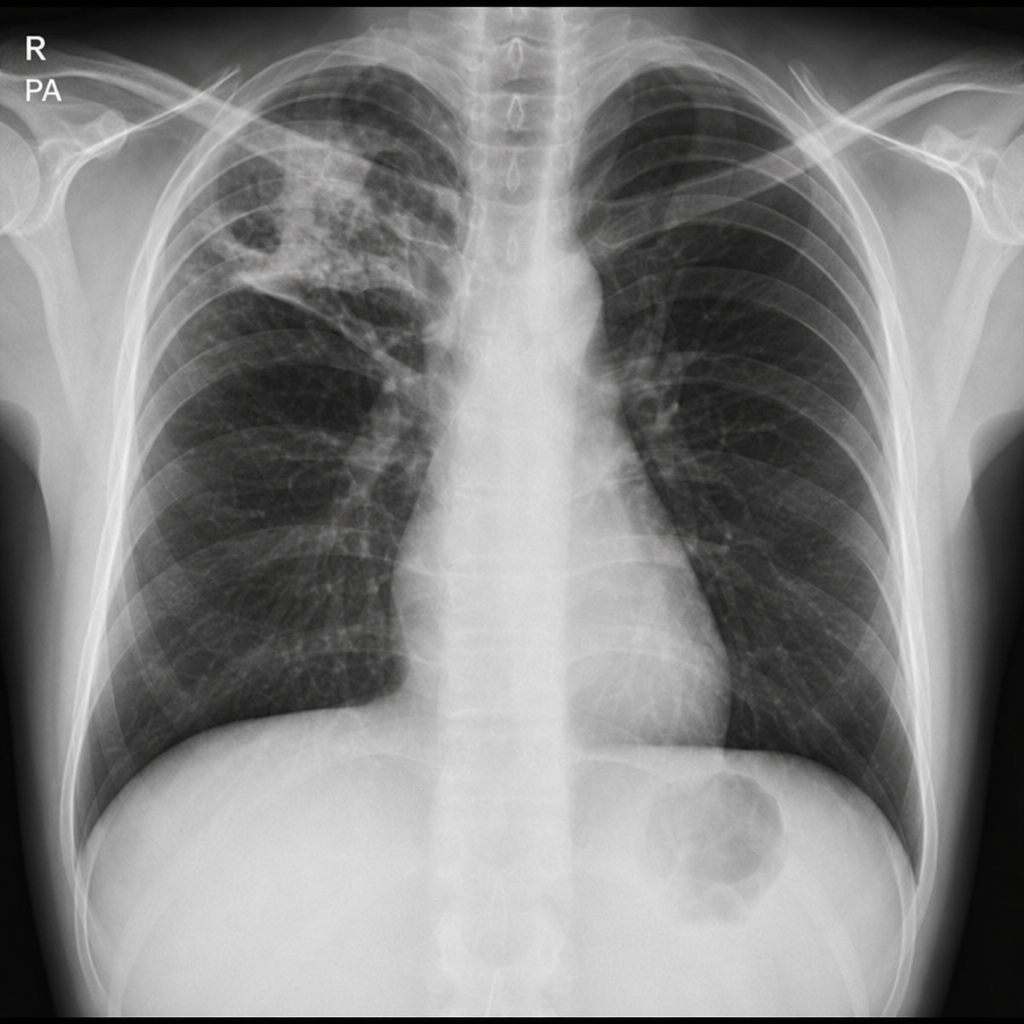
A 35-year-old man who recently emigrated from a country with a high prevalence of tuberculosis presents with 3 weeks of cough, night sweats, and weight loss. Chest radiography shows a right upper-lobe cavitary opacity with surrounding infiltrate, as shown. Which of the following is the most appropriate initial management?
A 55-year-old woman comes to the clinic complaining of joint pain and stiffness for the past year. The pain is mainly concentrated in her hands and is usually worse towards the late afternoon. It is described with a burning quality that surrounds the joint with some numbness and tingling. The stiffness is especially worse in the morning and lasts approximately for 15-20 minutes. Her past medical history is significant for recurrent gastric ulcers. She reports that her mother struggled with lupus and is concerned that she might have the same thing. She denies fever, rashes, ulcers, genitourinary symptoms, weight loss, or bowel changes. Physical examination is significant for mild tenderness at the distal interphalangeal joints bilaterally. What is the best initial medication to prescribe to this patient?
A 65-year-old man comes to the physician for a routine health maintenance examination. He feels well. His most recent examination 2 years ago included purified protein derivative (PPD) skin testing and showed no abnormalities. He is a retired physician and recently came back from rural China where he completed a voluntary service at a local healthcare center. A PPD skin test is performed. Three days later, an induration of 12 mm is noted. An x-ray of the chest shows no abnormalities. He is started on a drug that inhibits the synthesis of mycolic acid. This patient is at greatest risk of developing which of the following adverse effects?
A 47-year-old woman presents to the physician with complaints of fatigue accompanied by symmetric pain, swelling, and stiffness in her wrists, fingers, knees, and other joints. She describes the stiffness as being particularly severe upon awakening, but gradually improves as she moves throughout her day. Her physician initially suggests that she take NSAIDs. However, after a few months of minimal symptomatic improvement, she is prescribed an immunosuppressive drug that has a mechanism of preventing IL-2 transcription. What is the main toxicity that the patient must be aware of with this particular class of drugs?
A 32-year-old woman comes to the physician because of pain and stiffness in both of her hands for the past 3 weeks. The pain is most severe early in the day and does not respond to ibuprofen. She has no history of serious illness and takes no medications. Vital signs are within normal limits. Examination shows swelling and tenderness of the wrists and metacarpophalangeal joints bilaterally. Range of motion is decreased due to pain. There are subcutaneous, nontender, firm, mobile nodules on the extensor surface of the forearm. Which of the following is the most appropriate pharmacotherapy for this patient's current symptoms?
A 29-year-old female presents to her gynecologist complaining of a painful rash around her genitals. She has multiple sexual partners and uses condoms intermittently. Her last STD screen one year ago was negative. On examination, she has bilateral erosive vesicles on her labia majora and painful inguinal lymphadenopathy. She is started on an oral medication that requires a specific thymidine kinase for activation. Which of the following adverse effects is associated with this drug?
A 38-year-old woman comes to the physician for a follow-up examination. Two years ago, she was diagnosed with multiple sclerosis. Three weeks ago, she was admitted and treated for right lower leg weakness with high-dose methylprednisone for 5 days. She has had 4 exacerbations over the past 6 months. Current medications include interferon beta and a multivitamin. Her temperature is 37°C (98.6°F), pulse is 90/min, and blood pressure is 116/74 mm Hg. Examination shows pallor of the right optic disk. Neurologic examination shows no focal findings. She is anxious about the number of exacerbations and repeated hospitalizations. She is counseled about the second-line treatment options available to her. She consents to treatment with natalizumab. However, she has read online about its adverse effects and is concerned. This patient is at increased risk for which of the following complications?
Want unlimited practice?
Get full access to all questions, explanations, and performance tracking.
Scan to download app